Artwork
Untitled
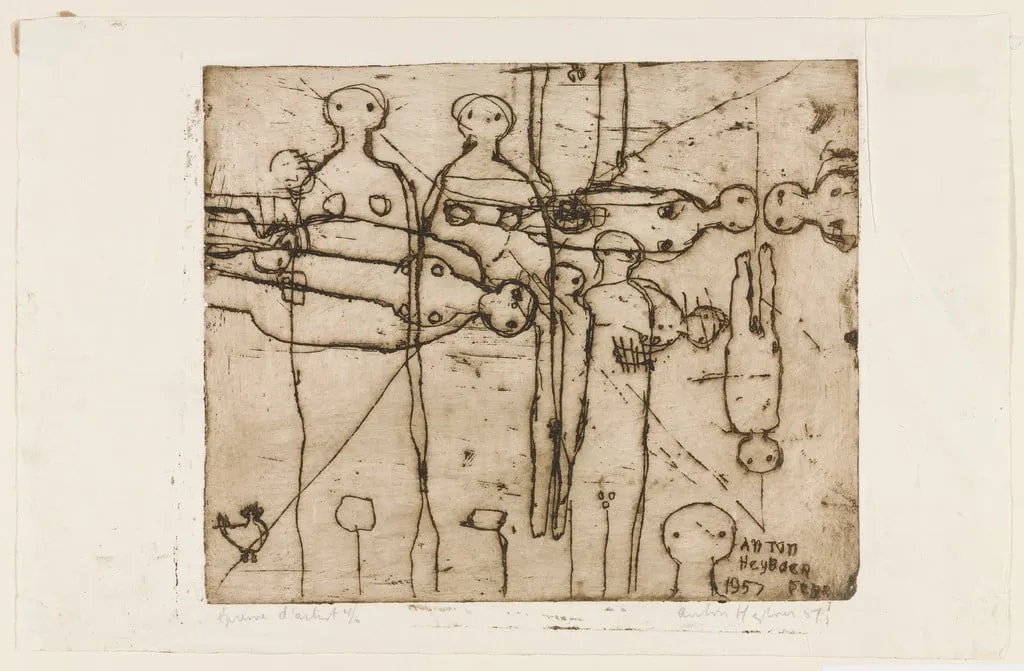
Untitled is an ink print by Anton Heyboer. It dates from 1957 and is held in the collection of the Museum of Modern Art.
About this work
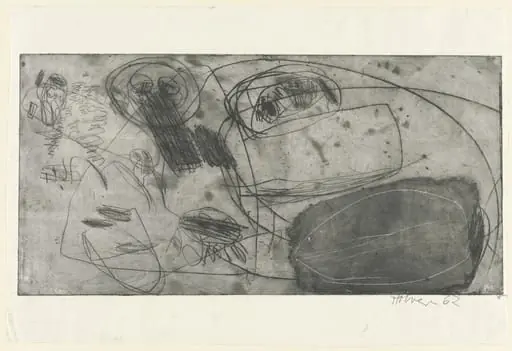
Their faces are simple circles with dots for eyes, and their bodies look stiff and connected by messy, crisscrossing marks.
This drawing shows a group of stick-like figures tangled in lines. Their faces are simple circles with dots for eyes, and their bodies look stiff and connected by messy, crisscrossing marks. The background is mostly blank, with just a few tiny shapes like a bird or a tree at the bottom left.
The artist signed it in the corner with the year 1957. The lines feel rough and uneven, like they were scratched into the surface.
Next, look up etching to see how this technique works.
Overview
Created in 1957, this etching by Anton Heyboer is part of The Museum of Modern Art’s print collection. It presents a sparse, abstract composition of human forms rendered in rough, linear strokes. The work carries no title, emphasizing its open-ended nature. The artist’s signature and date appear in one corner, anchoring it to a specific moment in his practice. The image avoids narrative clarity, inviting interpretation through its fragmented structure.
Subject & Meaning
A cluster of simplified figures, each marked by circular heads and rigid limbs, appears entangled in a web of erratic lines. Their forms suggest interaction or conflict, yet lack clear context or emotion. Minimal background elements—a small bird, a tree—hint at an external world, but remain detached. The ambiguity of their relationships resists fixed interpretation, reflecting Heyboer’s interest in raw human presence over storytelling.
Technique & Style
The image was made using etching, a process involving acid-bitten lines on a metal plate. Heyboer’s hand is evident in the uneven, urgent strokes that resemble scratches rather than polished contours. The lines vary in density and weight, creating texture without shading. The absence of tone or detail emphasizes line as both structure and expression, aligning with a raw, expressive approach to printmaking.
History & Provenance
The work entered The Museum of Modern Art’s collection as part of its broader engagement with postwar European prints. While specific acquisition details are not widely documented, its inclusion reflects institutional interest in artists who challenged conventional aesthetics in the 1950s. Heyboer, largely self-taught and outside mainstream art circles, gained recognition through such institutional acquisitions in the later 20th century.
Context
Made during a period of artistic experimentation in postwar Europe, this etching aligns with movements that valued spontaneity and emotional immediacy over formal polish. Heyboer, working in relative isolation in the Netherlands, developed a visual language influenced by outsider art and existential themes. His work resonated with contemporaries exploring the limits of representation and the body’s vulnerability.
Legacy
Heyboer’s etchings, including this one, contributed to a broader reevaluation of non-traditional printmaking in the late 20th century. His unpolished aesthetic influenced later artists seeking authenticity over technical refinement. Though not widely exhibited during his lifetime, his prints are now studied for their emotional directness and their role in expanding the boundaries of modern print culture.
Artist & collection