Artwork
Views of Venice and Environs: A City Beyond a River
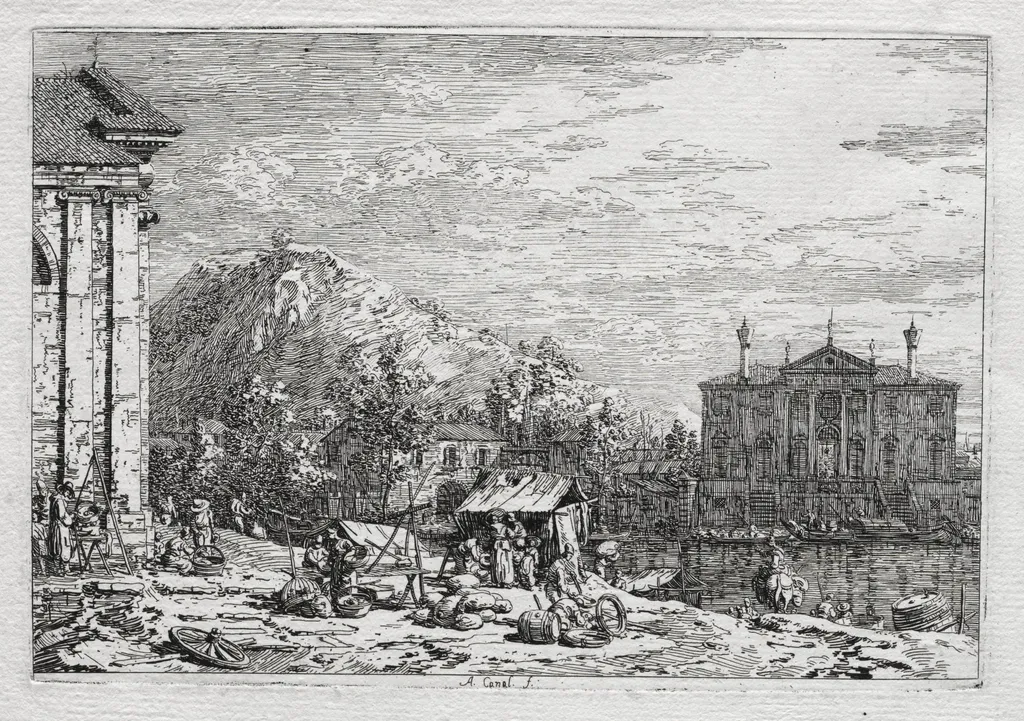
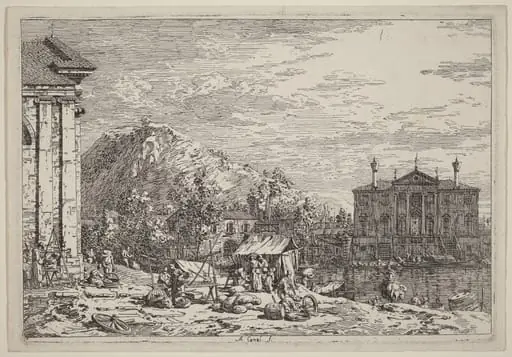
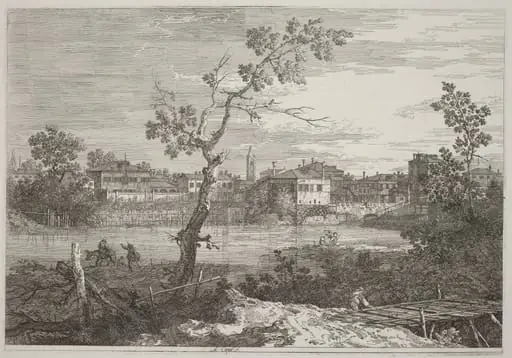
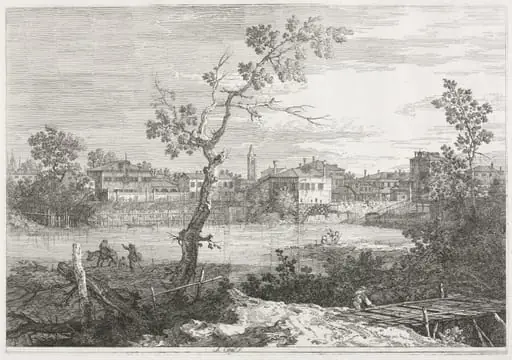
Views of Venice and Environs: A City Beyond a River is a print by the Baroque artist Canaletto. It dates from 1704 and is held in the collection of the Cleveland Museum of Art.
About this work
Overview
Executed in fine, precise lines, the print captures a quiet moment of urban life with attention to architectural detail and subtle atmospheric variation.
This black-and-white etching, attributed to Antonio Canaletto around 1704, presents a riverside view of Venice and its surrounding structures. Executed in fine, precise lines, the print captures a quiet moment of urban life with attention to architectural detail and subtle atmospheric variation. Though often associated with oil paintings, Canaletto also produced etchings that documented the city’s topography with clarity and restraint.
Subject & Meaning
The scene depicts a stretch of the Venetian lagoon bordered by stone towers, colonnaded platforms, and modest shelters. Figures gather near tools and trees, suggesting daily labor or transit. The composition avoids grandeur, instead emphasizing the ordinary rhythms of the city—boats on the water, people on the shore—offering a quiet record of Venice’s functional landscape rather than its ceremonial splendor.
Technique & Style
Canaletto employed etching to render fine linear detail, using controlled hatching to suggest depth and texture. The river’s surface is indicated by delicate, wavy lines, while buildings are defined by sharp, angular contours. The overall effect is crisp yet soft, balancing precision with a slight blurring of form—characteristic of early 18th-century printmaking that prioritized observational accuracy over dramatic contrast.
History & Provenance
Created early in Canaletto’s career, this print likely served as a study or preparatory work for later paintings. It reflects the growing demand in Venice for visual records of the city’s architecture and waterways, circulated among travelers and collectors. Its survival as a standalone etching suggests it was valued for its documentary quality rather than as a finished artistic statement.
Context
In early 1700s Venice, printmaking flourished as a means of documenting urban life for both locals and foreign visitors. Canaletto’s work emerged alongside a broader interest in topographical accuracy, influenced by the scientific spirit of the age. His etchings contributed to a visual culture that treated the city as a subject worthy of systematic observation, distinct from idealized Baroque spectacle.
Legacy
Though less celebrated than his paintings, Canaletto’s etchings laid groundwork for later topographical artists across Europe. This print exemplifies how Venetian artists shifted from allegorical representation toward empirical depiction, influencing the development of urban documentation in print. Its restrained tone and attention to detail became a model for recording cityscapes with fidelity rather than flourish.
Own this work as a print
Artist & collection
Artist
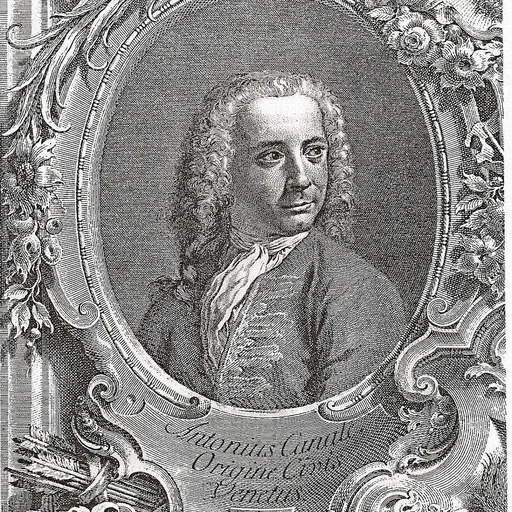
Giovanni Antonio Canal (18 October 1697 – 19 April 1768), commonly known as Canaletto (Italian: ), was an Italian painter from the Republic of Venice, considered an important member of the 18th-century Venetian school.

![The Market at Dolo [lower left], by Canaletto](https://artifactworldgallery.com/img/canaletto--the-market-at-dolo-lower-left--67bc6365ace095d4-w320.webp) The Market at Dolo [lower left]
The Market at Dolo [lower left]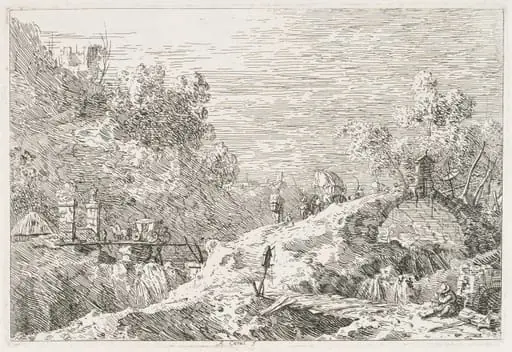 Views: Mountain Landscape with Five Bridges
 The Market at Dolo
![Mountain Landscape with Five Bridges [lower right], by Canaletto](https://artifactworldgallery.com/img/canaletto--mountain-landscape-with-five-bridges-lower-right--69277fee18bd5080-w320.webp) Mountain Landscape with Five Bridges [lower right]
Mountain Landscape with Five Bridges [lower right]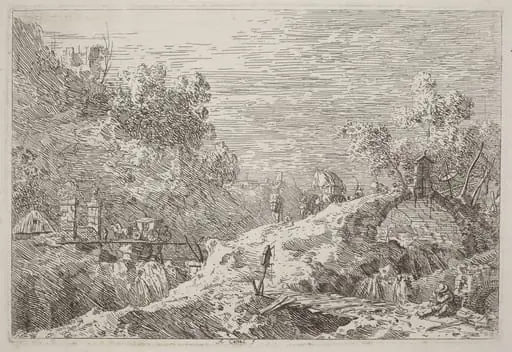 Mountain Landscape with Five Bridges
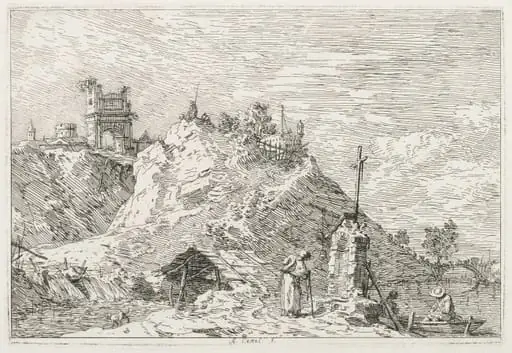 Views: A Pilgrim at Prayer
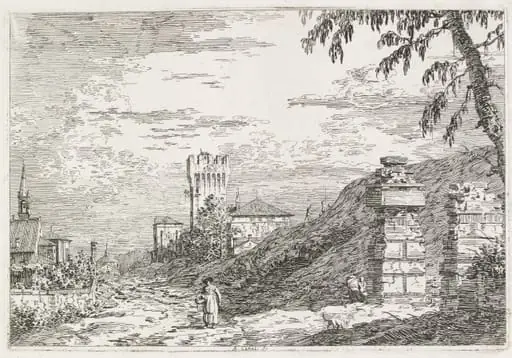 Views: Two Ruined Pillars
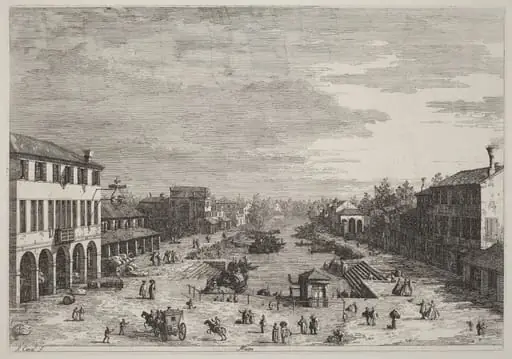 Mestre
 View of a Town on a River Bank
 Views: View of Burano, a Town on an Island in the Venetian Lagoon
![Landscape with the Pilgrim at Prayer [upper left], by Canaletto](https://artifactworldgallery.com/img/canaletto--landscape-with-the-pilgrim-at-prayer-upper-left--38f583de7d08bebc-w320.webp) Landscape with the Pilgrim at Prayer [upper left]
Landscape with the Pilgrim at Prayer [upper left]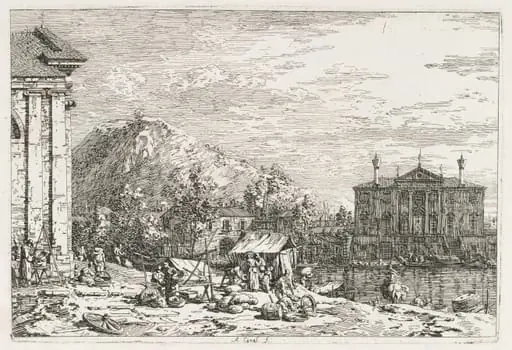 Views: A City Beyond a River