Artwork
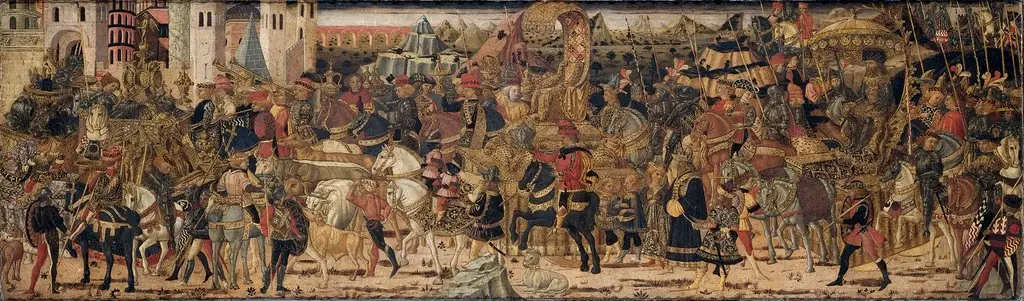
Darius Marching to the Battle of Issus
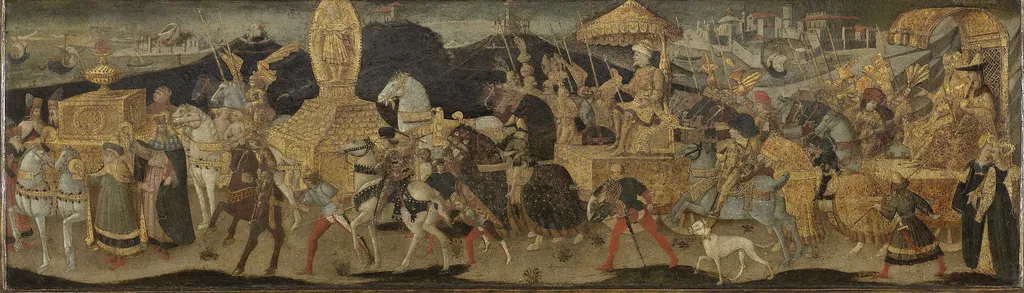
Darius Marching to the Battle of Issus is an oil painting by Apollonio di Giovanni. It dates from 1450 and is held in the collection of the Munich Central Collecting Point.
About this work
Overview
Created around 1450, this tempera panel by Apollonio di Giovanni portrays the Persian king Darius III as he prepares to engage Alexander the Great at Issus. The composition gathers a sizable procession of figures, set before a landscape of buildings and hills, and is presently displayed in the Rijksmuseum.
Subject & Meaning
The work focuses on Darius III, shown on horseback with a gilded helmet and spear, symbolizing his royal authority and military resolve. Accompanying him is a charioteer bearing a scepter, while surrounding participants display a range of attire from armor to ceremonial dress, suggesting the diverse ranks and cultures within the Persian army.
Technique & Style
Executed in tempera, the painting employs a vivid palette of gold, red, and blue that highlights the elaborate costumes and decorative details. The medium’s quick-drying nature yields crisp outlines and a luminous surface, while the composition balances narrative depth with a decorative, courtly aesthetic typical of mid‑15th‑century Italian history painting.
History & Provenance
Apollonio di Giovanni, a Florentine artist active in the mid‑1400s, produced the panel for an unknown patron. Over the centuries the work entered various collections before being acquired by the Rijksmuseum, where it now forms part of the museum’s holdings of Northern European and Italian Renaissance art.
Context
The Battle of Issus (333 BC) was a pivotal clash between Alexander the Great and Darius III, a subject frequently revisited in Renaissance art to explore themes of power, destiny, and cultural encounter. Apollonio’s rendition reflects contemporary interest in classical history, using a courtly visual language to convey the drama of the encounter.