Artwork
H Beard Print Collection
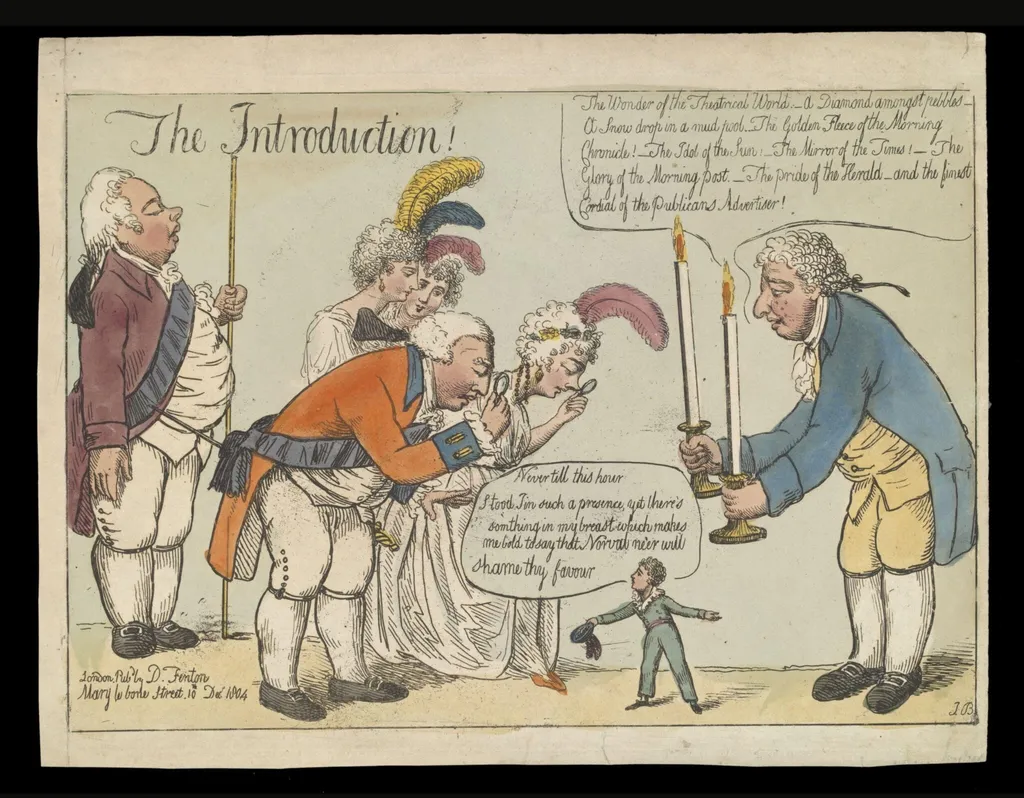
H Beard Print Collection is a print by the Romanticist artist J.B. Arnaud. It dates from 10 and is held in the collection of the Victoria and Albert Museum. This 1804 print, titled 'The Introduction!
About this work
” and features a boy actor named Master Betty meeting King George III, Queen Charlotte, two princesses, and the Earl of Dartmouth.
This print shows a crowded 1804 scene in London. It’s called “The Introduction!” and features a boy actor named Master Betty meeting King George III, Queen Charlotte, two princesses, and the Earl of Dartmouth. Richard Brinsley Sheridan makes the introductions.
Master Betty was a teenage star of the London stage, so this print celebrates a famous young performer meeting royalty.
Look up the Victoria and Albert Museum.
Overview
This 1804 print, titled 'The Introduction!', depicts a formal meeting between the young actor Master Betty and members of the British royal family, alongside the Earl of Dartmouth. Created by D. Fenton in London, the scene captures a moment of cultural significance, highlighting the intersection of theatrical fame and aristocratic recognition during the early 19th century.
Subject & Meaning
Master Betty, a celebrated teenage actor known for his emotional performances, is being presented to King George III, Queen Charlotte, two princesses, and the Earl of Dartmouth. The scene underscores the social prestige granted to popular stage performers, reflecting how public admiration could bridge class boundaries and earn royal acknowledgment in an era when theater held considerable cultural weight.
Technique & Style
The print is a finely detailed engraving, typical of early 19th-century British publishing. Figures are arranged in a staged, hierarchical composition, with the royal group seated and centrally positioned, while Master Betty and Sheridan stand to the right. Delicate line work and subtle shading convey texture in clothing and facial expressions, emphasizing formality and social order.
History & Provenance
Produced by D. Fenton in London shortly after the event, the print was likely sold as a commemorative item to theatergoers and admirers of Master Betty. Its survival in collections such as the Victoria and Albert Museum suggests it was widely circulated and preserved as a record of popular culture and royal engagement with the arts during the Regency period.
Context
In early 1800s London, child actors like Master Betty commanded extraordinary public attention, often rivaling adult stars. His appearance before the royal family was not merely ceremonial but symbolized the growing legitimacy of theater as a respected art form. Such events were reported in newspapers and memorialized in prints, reinforcing the cultural status of performers in a society still stratified by class.
Legacy
The print remains a tangible artifact of the era’s fascination with celebrity and the blurring of social boundaries through performance. It documents how theatrical talent could elevate a youth from the stage to the royal court, offering insight into the evolving relationship between public figures and monarchy in Georgian England.
Artist & collection
Artist
These hand-colored prints show Paris street life in the early 1800s, tiny figures crowding markets and carriages under crisp December skies.