Artwork
The Butter Cross and Public Buildings, Witney
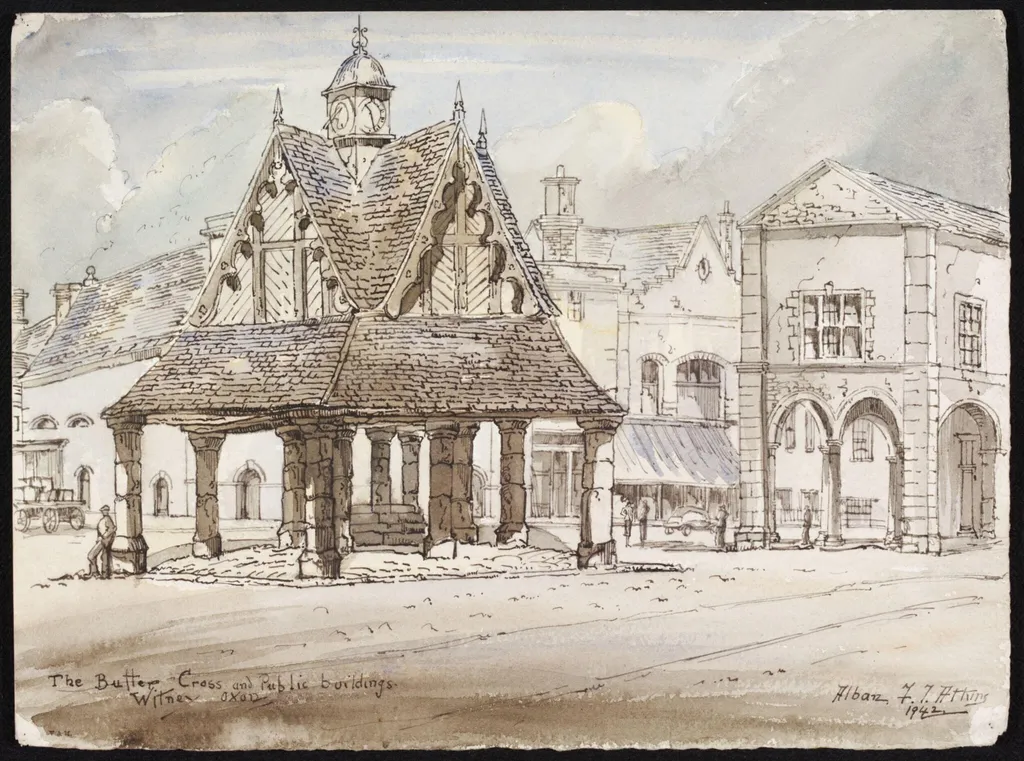
The Butter Cross and Public Buildings, Witney is a watercolor work on paper by Atkins. It dates from 1942 and is held in the collection of the Victoria and Albert Museum.
About this work
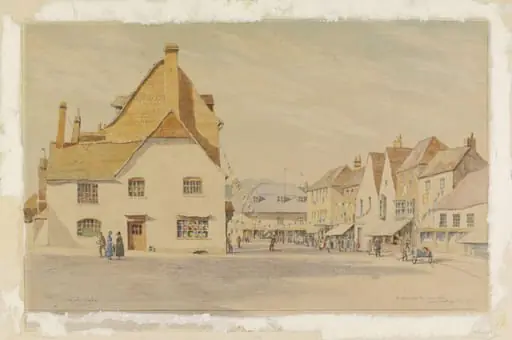
A few people and a horse-drawn cart are scattered in the background, and the ground looks wet or muddy.
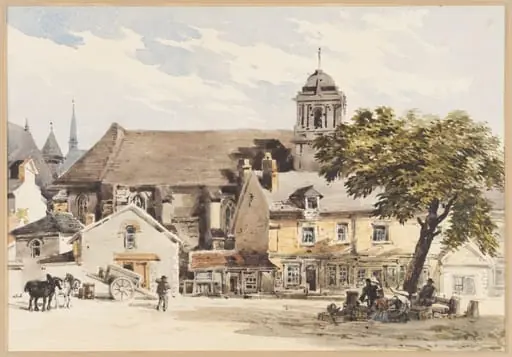
This sketch shows a small town square with a covered wooden shelter in the center. The shelter has a steep, tiled roof and thick wooden beams supporting it. Around it are stone buildings with tall windows and arched doorways. A few people and a horse-drawn cart are scattered in the background, and the ground looks wet or muddy.
The title says this is the Butter Cross in Witney, a spot where people once gathered. The artist signed it in 1942, using watercolor to keep the lines light and sketchy.
Check out the Victoria and Albert Museum to see more works like this.
Overview
The watercolor, executed in 1942 by an artist named Atkins, records the Butter Cross and surrounding public buildings in the market square of Witney. The composition centers on the covered market structure, characterized by robust columns and a decorative gabled roof, set amid stone façades with tall windows and arched entrances. A few figures, a horse‑drawn cart and a wet ground surface complete the scene, conveying a modest town atmosphere.
Subject & Meaning
The Butter Cross served historically as a communal gathering point for the town’s butter trade, embodying local commercial life. By portraying this landmark, the work captures a slice of everyday activity and the architectural character of Witney’s market square, reflecting the social and economic functions of such spaces in mid‑twentieth‑century England.
Technique & Style
Atkins employs watercolor to render the scene with light, sketch‑like lines, allowing the architecture to emerge through delicate washes of colour. The medium’s translucency conveys the wet or muddy ground and the texture of the tiled roof, while the use of bold outlines defines the structural elements of the cross and surrounding buildings.
History & Provenance
The painting belongs to the Recording Britain project, a wartime initiative launched by Sir Kenneth Clark and financed by the Pilgrim Trust. Created to document vulnerable architectural and rural heritage during World War II, the scheme commissioned over 1,500 works, predominantly of English locales. This piece entered the collection as part of that effort, preserving Witney’s market square for posterity.
Context
During the early 1940s, many British towns faced the threat of bomb damage and post‑war redevelopment. Recording Britain aimed to capture scenes considered at risk, providing a visual archive of traditional settings. The Butter Cross, as a historic market structure, exemplified the type of heritage the program sought to safeguard.
Artist & collection
Artist
Anna Atkins turned their hand to quiet watercolours of Cotswold buildings in the 1940s.