Artwork
Alzata dell'Obelisco di Campo Marzio (Excavation of the Obelisk from the Campo Marzio)
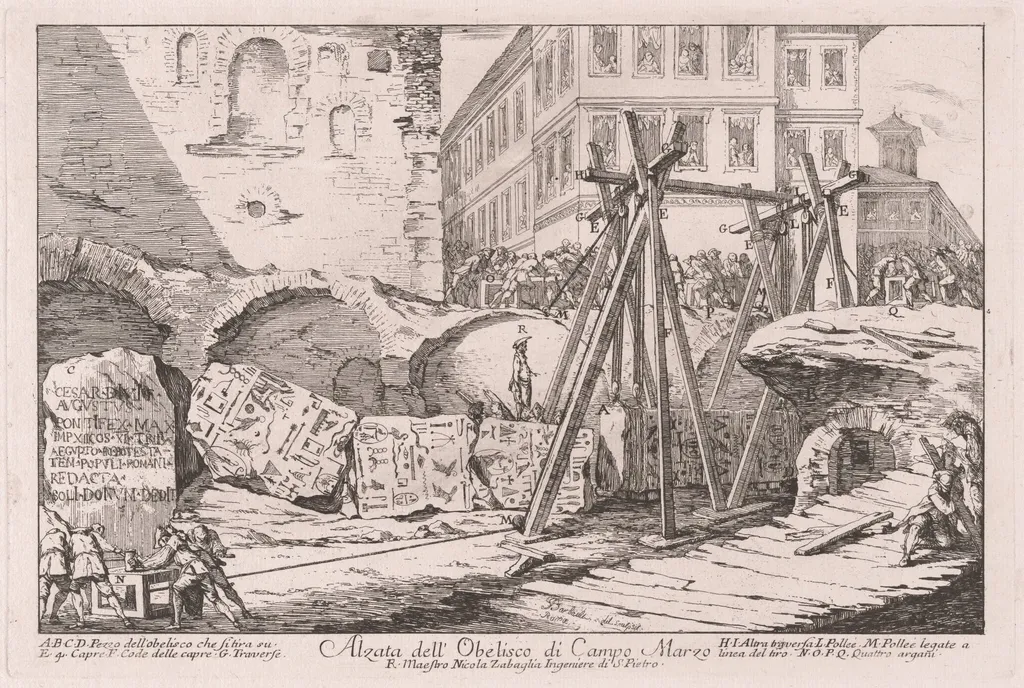
Alzata dell'Obelisco di Campo Marzio (Excavation of the Obelisk from the Campo Marzio) is an ink print by the Baroque artist Jean Barbault. It dates from 1748 and is held in the collection of the National Gallery of Art.
About this work
Overview
Created in 1748 by French artist Jean Barbault, this etching captures the physical effort involved in raising an ancient obelisk in Rome’s Campo Marzio.
Created in 1748 by French artist Jean Barbault, this etching captures the physical effort involved in raising an ancient obelisk in Rome’s Campo Marzio. Executed on laid paper, the work belongs to a series documenting Roman antiquities, reflecting Barbault’s dedication to recording the city’s archaeological landscape. His focus on contemporary restoration efforts distinguishes this print from purely antiquarian studies, blending observation with technical detail.
Subject & Meaning
The scene depicts the careful re-erection of a Roman obelisk, a project tied to 18th-century efforts to restore classical monuments. Barbault emphasizes the coordinated labor of workers using ropes, pulleys, and timber scaffolding, suggesting both the scale of the undertaking and the precision required. The watching crowd and architectural backdrop reinforce the obelisk’s civic significance, framing its movement as a public event rooted in historical continuity.
Technique & Style
Barbault employed fine-line etching to render intricate textures: the grain of wooden beams, the folds of laborers’ clothing, and the weathered stone of surrounding ruins. The composition is tightly organized, with figures arranged to guide the eye toward the rising obelisk. Atmospheric depth is achieved through subtle tonal gradations, while architectural details in the background—arched windows, framed paintings—add contextual richness without overwhelming the central action.
History & Provenance
Barbault, based in Rome for most of his career, produced this print as part of a documented series on Roman antiquities. The work was likely intended for collectors and scholars interested in contemporary archaeological practice. Its survival in multiple institutional collections suggests early recognition of its value as both artistic record and historical testimony, though its original commission remains unverified.
Context
In mid-18th-century Rome, the re-erection of obelisks was a symbol of cultural renewal and papal authority. Barbault’s print aligns with broader antiquarian interests among European elites, who viewed such projects as acts of preservation. Unlike idealized classical depictions, his work captures the messy reality of excavation—tools, scaffolding, and human effort—offering a grounded view of antiquity’s revival.
Legacy
Barbault’s etching contributes to a genre of topographical prints that bridged art and archaeology. While not widely known today, his detailed records influenced later documentation of Roman monuments. The work remains a valuable resource for understanding 18th-century restoration techniques and public engagement with antiquity, preserving a moment when ancient Rome was actively reshaped by modern hands.
Artist & collection
Artist
Jean Barbault (c. 1718–1762) was a French painter, etcher and printmaker, who worked in Rome for most of his life. He is noted for paintings of local people, wearing traditional costumes or Oriental costumes and for his…

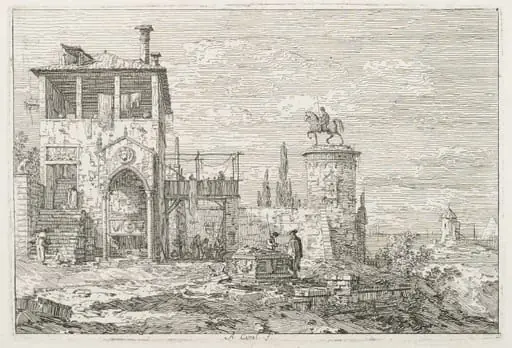 Views: The Equestrian Monument
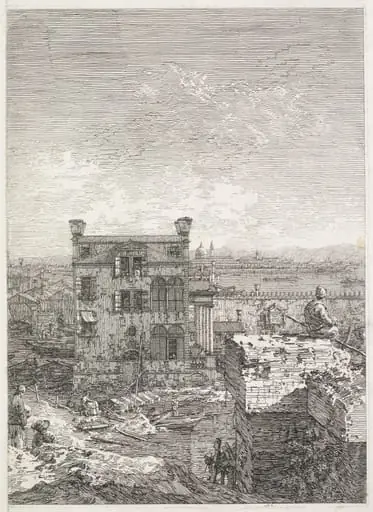 Views: A House Surrounded by Six Columns
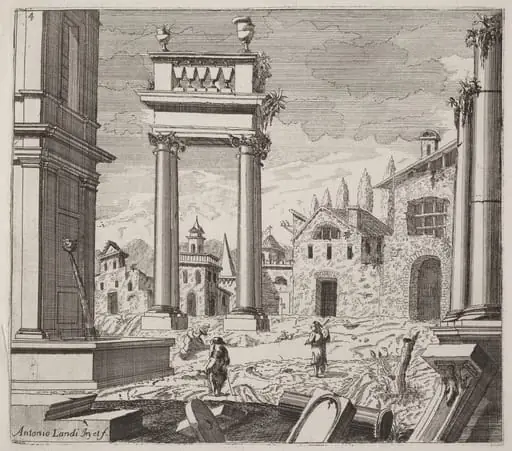 Architectural Fantasy with Classical Ruins and Vernacular Buildings
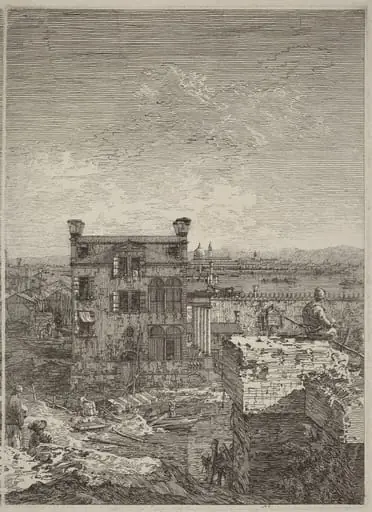 The House with the Peristyle
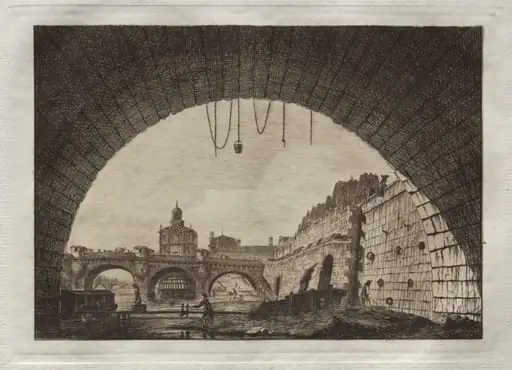 Le Pont Neuf et la Samaritaine
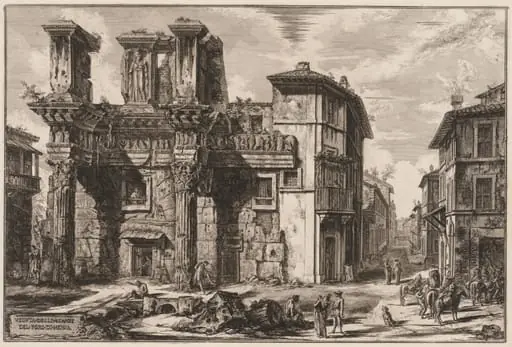 Views of Rome: Forum of Nerva
![The Equestrian Monument [upper right], by Canaletto](https://artifactworldgallery.com/img/canaletto--the-equestrian-monument-upper-right--de65338fbc3c54b7-w320.webp) The Equestrian Monument [upper right]
The Equestrian Monument [upper right]![St. Peter's Basilica from "Prospectus Locurum Urbis Romae Insign[ium]", by Lievin Cruyl](https://artifactworldgallery.com/img/lievin-cruyl--st-peter-s-basilica-from-prospectus-locurum-urbis-romae-insi--8f0dc2c2d6e2a83e-w320.webp) St. Peter's Basilica from "Prospectus Locurum Urbis Romae Insign[ium]"
St. Peter's Basilica from "Prospectus Locurum Urbis Romae Insign[ium]"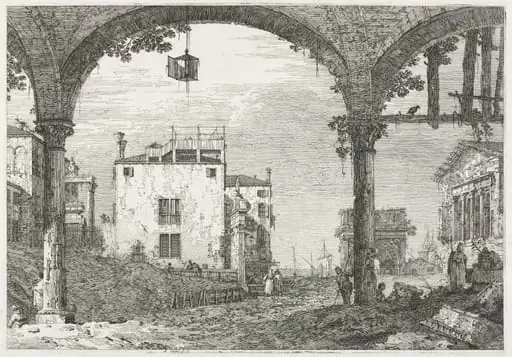 Views: The Portico with the Lantern
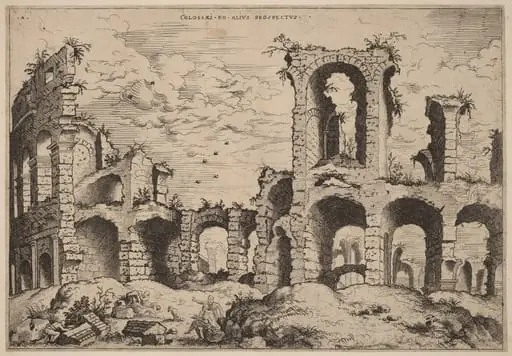 Second View of the Colosseum