Artwork
Interior de biserică
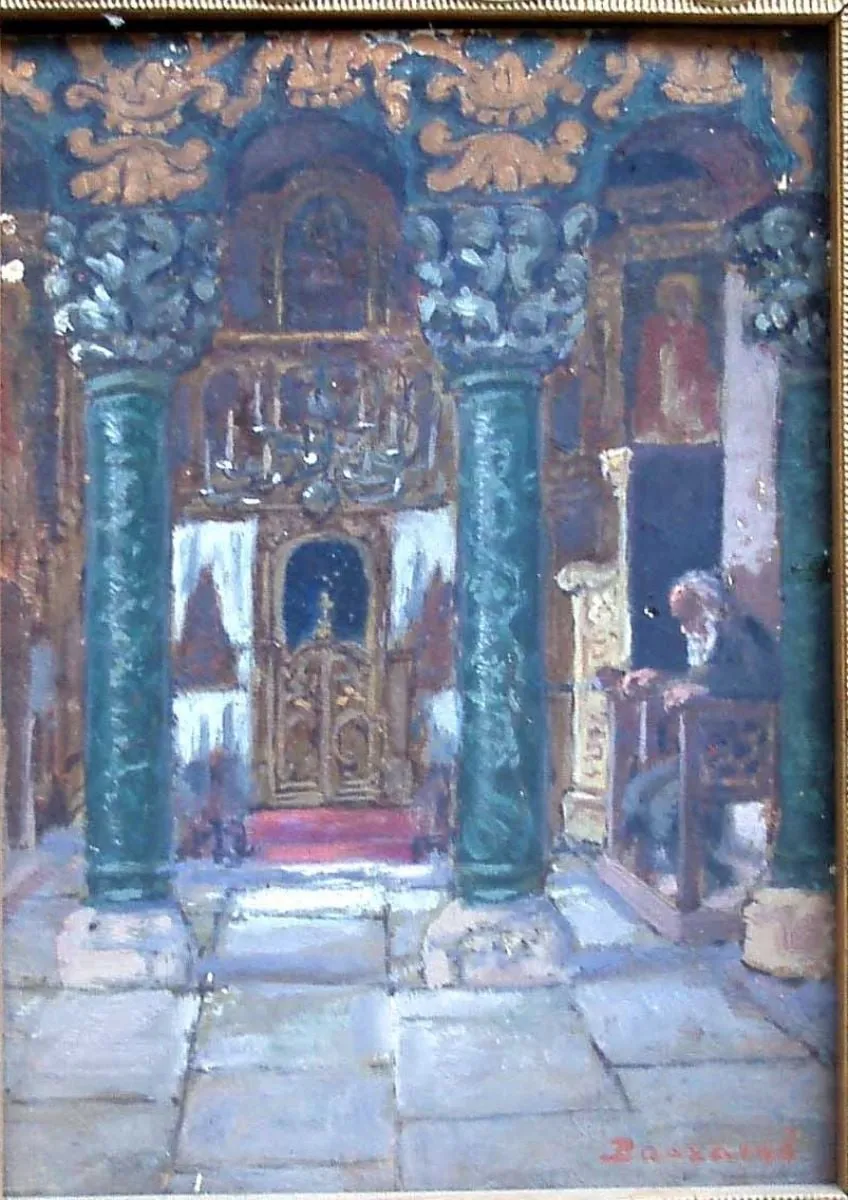
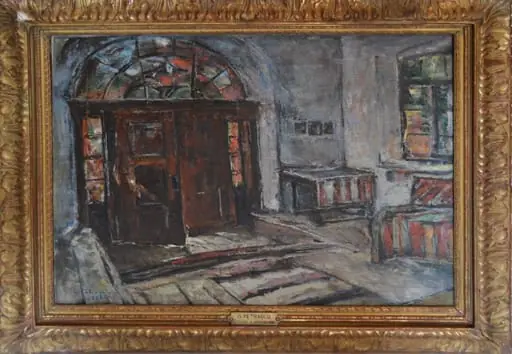
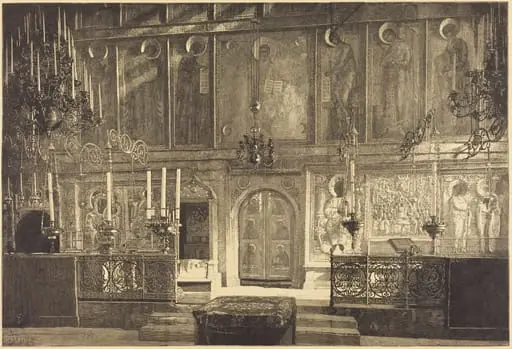
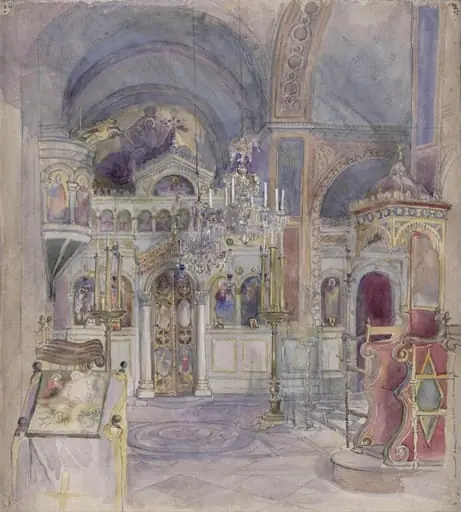
Interior de biserică is a print by Ludovic Bassarab. It is held in the collection of the Bucharest Municipality Museum. This print depicts the interior of a modest, aging church, rendered with muted tones and subtle wear.
About this work
Overview
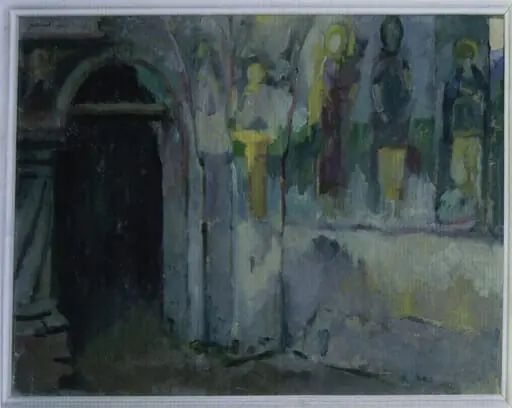
The floor, composed of uneven stone tiles, and the plain wooden door with a small upper window contribute to an atmosphere of quiet decay.
This print depicts the interior of a modest, aging church, rendered with muted tones and subtle wear. The composition centers on a simple altar flanked by tall columns, set against dark blue walls adorned with faint gold detailing. The floor, composed of uneven stone tiles, and the plain wooden door with a small upper window contribute to an atmosphere of quiet decay. The artist’s signature, 'Bassarab,' appears in one corner, identifying Ludovic Bassarab as the creator.
Subject & Meaning
The scene captures a quiet, unadorned place of worship, stripped of grandeur. The dim lighting and faded decorations suggest a space once more vibrant, now softened by time and use. The absence of figures or ceremonial objects emphasizes solitude and stillness, evoking contemplation rather than ritual. It reflects a personal, perhaps nostalgic, view of religious space rather than an idealized ecclesiastical setting.
Technique & Style
The work employs a restrained palette dominated by deep blues and muted golds, with textures suggesting age through softened edges and partial pigment loss. Lines are deliberate but not overly detailed, favoring atmosphere over precision. The rendering of light is subtle, hinting at natural sources filtering through the small window. The style leans toward quiet realism, prioritizing mood over narrative or dramatic effect.
History & Provenance
The print is attributed to Ludovic Bassarab, a Romanian artist active in the early to mid-20th century, known for documenting regional architecture and religious interiors. While specific details of its creation or early ownership are not widely recorded, its condition suggests it was produced during a period when Bassarab focused on preserving the visual character of rural churches undergoing decline.
Context
In early 20th-century Romania, many rural churches were maintained with limited resources, their decorations fading as communities changed. Bassarab’s work emerged amid broader cultural efforts to document vernacular heritage before modernization erased it. This interior reflects a common architectural type in Moldavia and Bessarabia, where wooden structures and simple stone floors persisted long after urban churches adopted more ornate styles.
Legacy
Ludovic Bassarab’s prints, including this one, serve as quiet records of a vanishing architectural and spiritual landscape. Though not widely exhibited internationally, his work holds value within Romanian art history for its unembellished documentation of ecclesiastical spaces. These images remain references for scholars studying regional religious culture and the material conditions of rural worship in the 20th century.
Artist & collection
Artist
Ludovic Bassarab kept sketching the same church long after the priest asked him to stop.