Artwork
Ein kleiner Abriss von denen Irr= und Abwegen, derer von Gott gerufenen Seelen
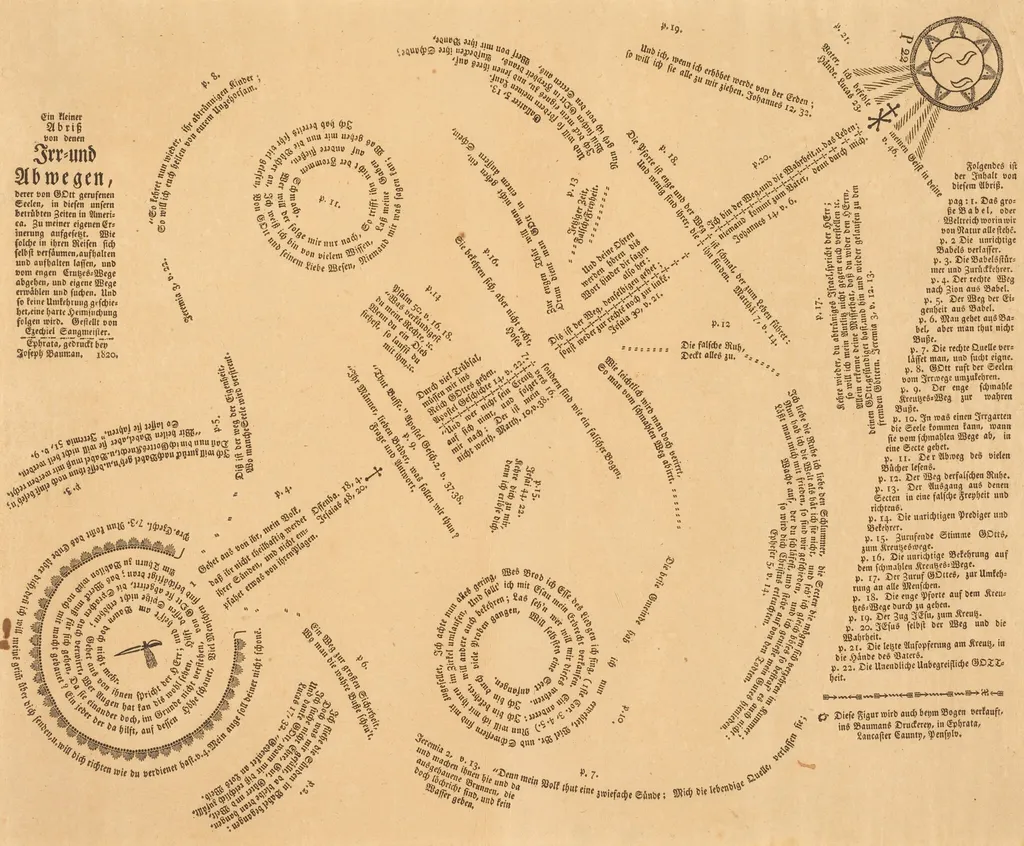
Ein kleiner Abriss von denen Irr= und Abwegen, derer von Gott gerufenen Seelen is a print by the Romanticist artist Joseph Bauman. It dates from 1820 and is held in the collection of the National Gallery of Art.
About this work
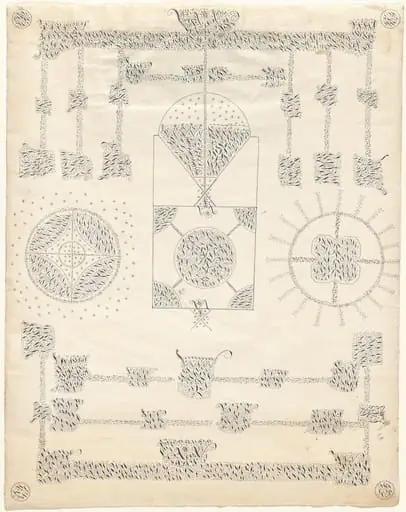
This image looks like a page torn from a book, but it’s not just text—it’s packed with tiny drawings and symbols.
This image looks like a page torn from a book, but it’s not just text—it’s packed with tiny drawings and symbols. Words twist around each other in circles, arrows, and zigzags, filling every inch of the page. There’s a clock face with a cross inside, a skull, and a bird, all mixed into the dense writing. The colors are faded, mostly browns and blacks, with some red and blue accents.
The page seems to warn about wrong paths, using both words and pictures to guide the eye. The artist, Joseph Bauman, made this in 1820, and it’s not just a book—it’s a visual puzzle.
Next, look up Romanticism to see how this fits into that artistic movement.
Overview
Ein kleiner Abriss von denen Irr= und Abwegen, derer von Gott gerufenen Seelen is an ornamental letterpress print on laid paper, created by Joseph Bauman in 1820. At first glance, it appears as a densely packed, illustrated book page, combining intricate typography with symbolic drawings.
Subject & Meaning
The work visually warns of erroneous paths, guiding the viewer through a labyrinthine composition of twisted text, arrows, and symbolic elements—a clock face with a cross, a skull, and a bird. These elements converge to convey a cautionary message, blending the spiritual with the cautionary.
Technique & Style
Characterized by dense, circular, zigzagging text and minute illustrations, the print showcases Bauman's mastery of letterpress. The predominantly faded brown and black palette, accented with red and blue, adds depth to the intricate, puzzle-like design.
History & Provenance
Created in 1820 by Joseph Bauman, specific details regarding the print's original context, ownership history, or exhibition record are not provided in the available information.
Context
This work aligns with elements of the Romantic movement, notable for its emphasis on the emotional, the symbolic, and the complex interplay of text and image. Further exploration of Romanticism reveals how Bauman's piece fits within this broader artistic and philosophical context.
Legacy
The legacy of 'Ein kleiner Abriss...' is not explicitly detailed in the provided sources, leaving its impact on subsequent artistic movements or its reception over time unspecified.
Artist & collection