Artwork
Dead Scottish Soldiers on the Battlefield near Ypres
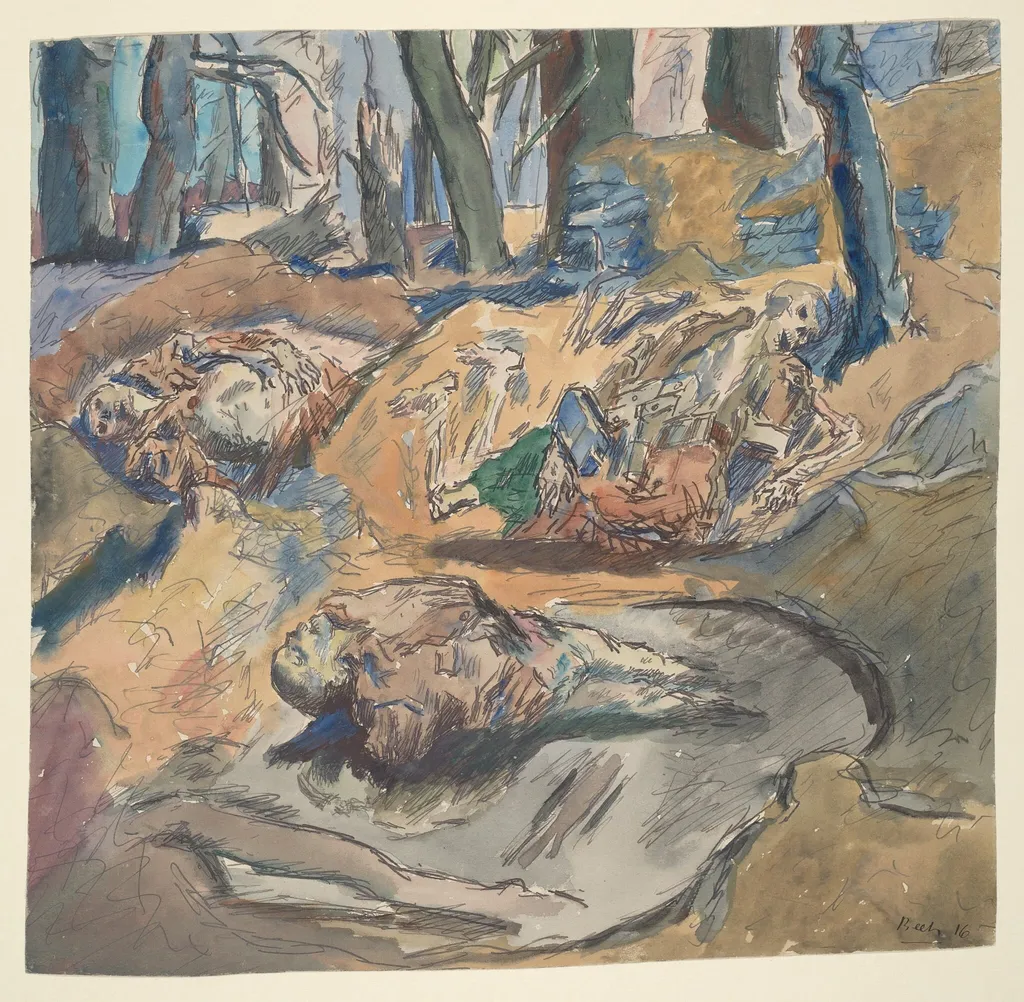
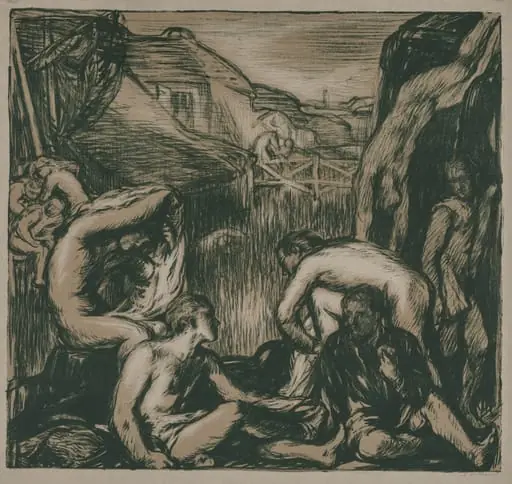
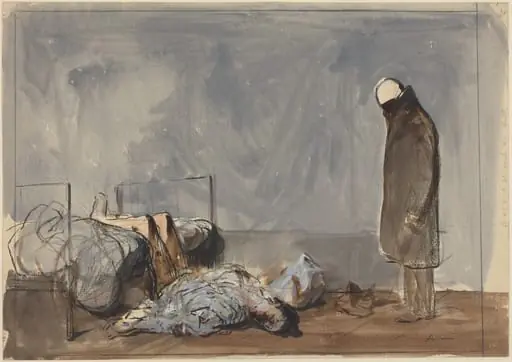
Dead Scottish Soldiers on the Battlefield near Ypres is an ink drawing by René Beeh. It dates from 1916 and is held in the collection of the National Gallery of Art.
About this work
Overview
René Beeh’s 1916 watercolor depicts three Scottish soldiers killed in action near Ypres during the First World War. Executed on wove paper with pen and ink over translucent washes, the work captures the immediacy of combat through rapid, unpolished strokes. The composition balances human loss with the desolate landscape, emphasizing the physical and emotional toll of warfare.
Subject & Meaning
The drawing presents three lifeless figures strewn across a ravaged battlefield. Their contorted postures—one arm outstretched, another body half-buried in mud—convey the abrupt violence of their deaths. Bare trees and churned earth in the background reinforce the absence of vitality, framing the soldiers as casualties of both conflict and environment.
Technique & Style
Beeh employed loose, gestural lines in pen and ink to define the figures, while watercolor glazes layered over one another suggest depth and atmosphere. The medium’s fluidity allows for rapid execution, mirroring the chaos of battle. Thin washes of pigment build tonal variation without obscuring the paper’s surface, preserving a sense of spontaneity.
History & Provenance
Created in 1916, the work reflects Beeh’s direct or secondhand experience of the Western Front. As a visual record of the war’s brutality, it circulated within artistic and private collections before entering institutional holdings. Its status as a wartime sketch rather than a finished composition underscores its documentary intent.
Context
The drawing emerges from the broader artistic response to World War I, where immediacy often took precedence over refinement. Unlike propagandistic or heroic depictions, Beeh’s work aligns with a growing tendency to document war’s grim realities. The muddy terrain and Scottish uniforms locate the scene within the Ypres Salient, a site of repeated, devastating offensives.
Artist & collection