Artwork
Artists' Evening
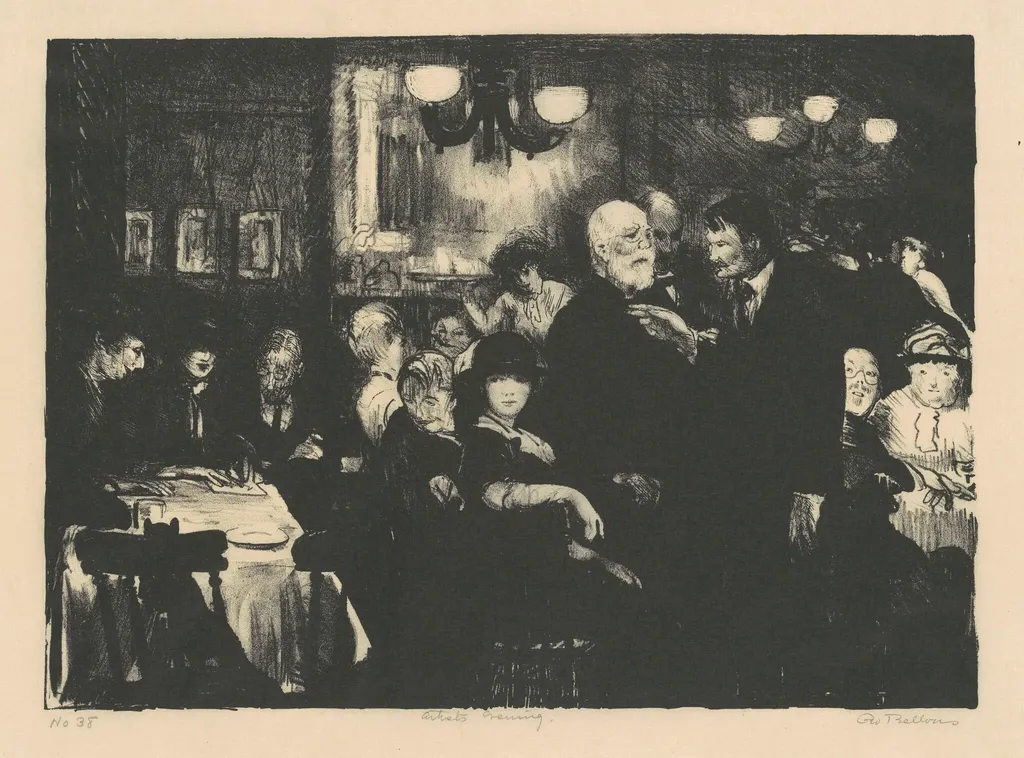
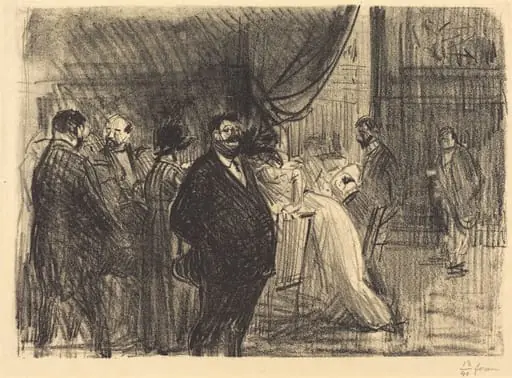
Artists' Evening is an ink print by George Bellows. It dates from 1916 and is held in the collection of the National Gallery of Art.
About this work
Overview
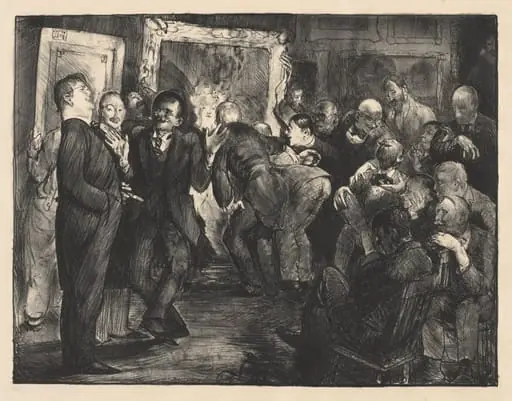
George Bellows created Artists' Evening in 1916 as a lithograph on laid paper, using only black ink to capture a moment among fellow artists.
George Bellows created Artists' Evening in 1916 as a lithograph on laid paper, using only black ink to capture a moment among fellow artists. The work belongs to the print medium, emphasizing tonal contrast and spontaneous line work. Unlike his oil paintings, this piece relies on the immediacy of lithography to convey atmosphere rather than detailed realism, reflecting Bellows’ interest in capturing candid social moments.
Subject & Meaning
The scene portrays a group of artists gathered around a table in a dim interior, their postures and gestures suggesting informal conversation. No single figure dominates; instead, the composition emphasizes collective energy and shared creative space. The absence of color and the focus on interaction imply a celebration of artistic community, where ideas flow as freely as the shadows that envelop them.
Technique & Style
Bellows employed lithography to achieve bold contrasts and textured surfaces, using rough, gestural lines to suggest form and movement. The black ink on paper creates a graphic intensity, with areas of dense shadow contrasting against lighter, scraped-out zones that imply lamplight and facial features. The technique allows for a sense of spontaneity, mirroring the unrehearsed nature of the gathering it depicts.
History & Provenance
Executed in 1916, the print was likely made for distribution among Bellows’ circle or as part of a limited edition. It was produced during a period when Bellows was deeply engaged with New York’s artistic community, frequenting gatherings at studios and clubs. The work remained within private collections for much of the 20th century before entering institutional holdings, where it is now studied as a record of early 20th-century artist life.
Context
In the 1910s, American artists increasingly formed networks outside academic institutions, meeting in informal settings to exchange ideas. Bellows, associated with the Ashcan School, documented these gatherings as part of a broader interest in urban realism. Artists’ Evening reflects this cultural shift—artistic identity was no longer confined to the studio but lived in conversation, critique, and shared space.
Legacy
The print stands as a quiet but significant document of artistic camaraderie in early 20th-century America. While less known than Bellows’ boxing scenes or cityscapes, it reveals his sensitivity to human interaction and his mastery of printmaking. It continues to be referenced in studies of artist communities, offering insight into the social fabric that sustained modern American art beyond the canvas.
Artist & collection
Artist
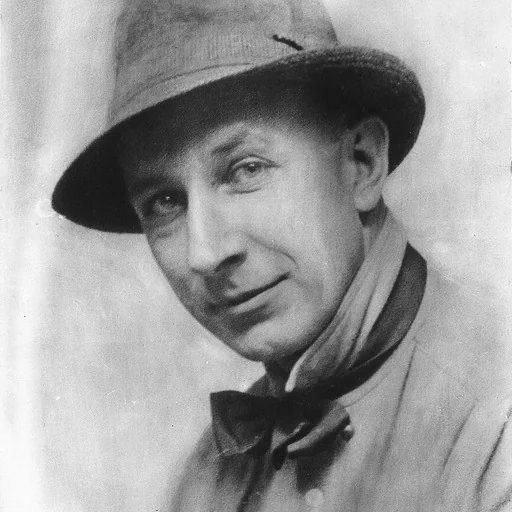
George Wesley Bellows (August 12 or August 19, 1882 – January 8, 1925) was an American realist painter, known for his bold depictions of urban life in New York City.

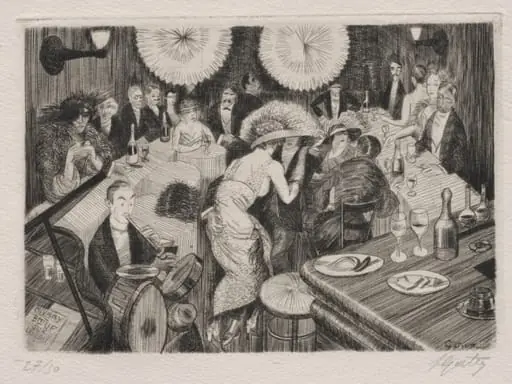 Boeuf sur le Toit
 Salle de jeu (Gambling Room)
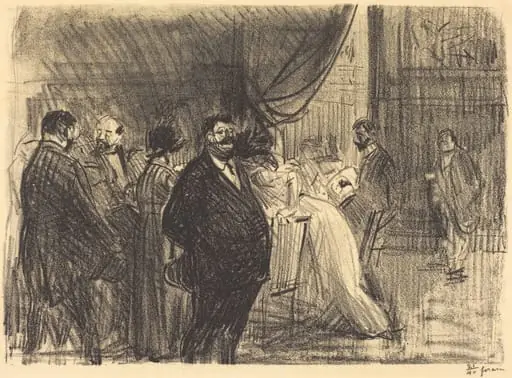 Salle de jeu (Gambling Room)
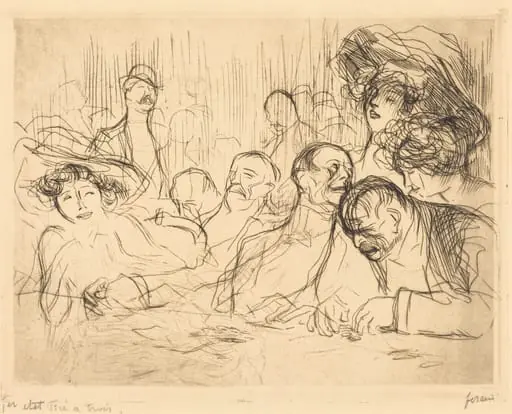 A la table de jeu (1ère planche) (At the Gambling Table) (first plate)
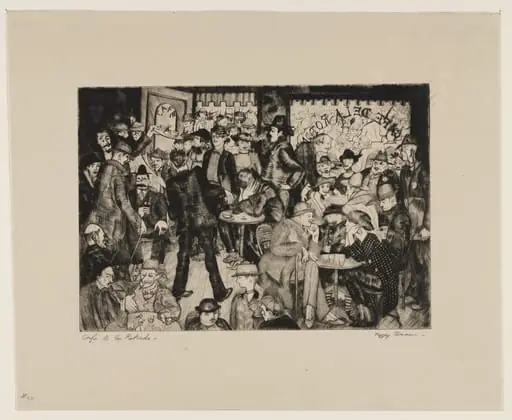 Untitled
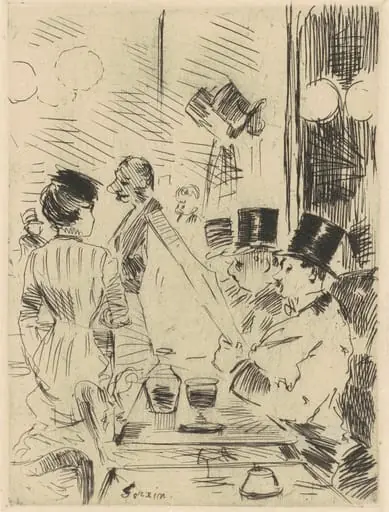 Le Cafe
 Artists Judging Works of Art
 A la table de jeu (1ère planche) (At the Gambling Table) (first plate)
 Le decavé (Cleared Out)
 Backstage of the Ballet