Artwork
Man carrying a child
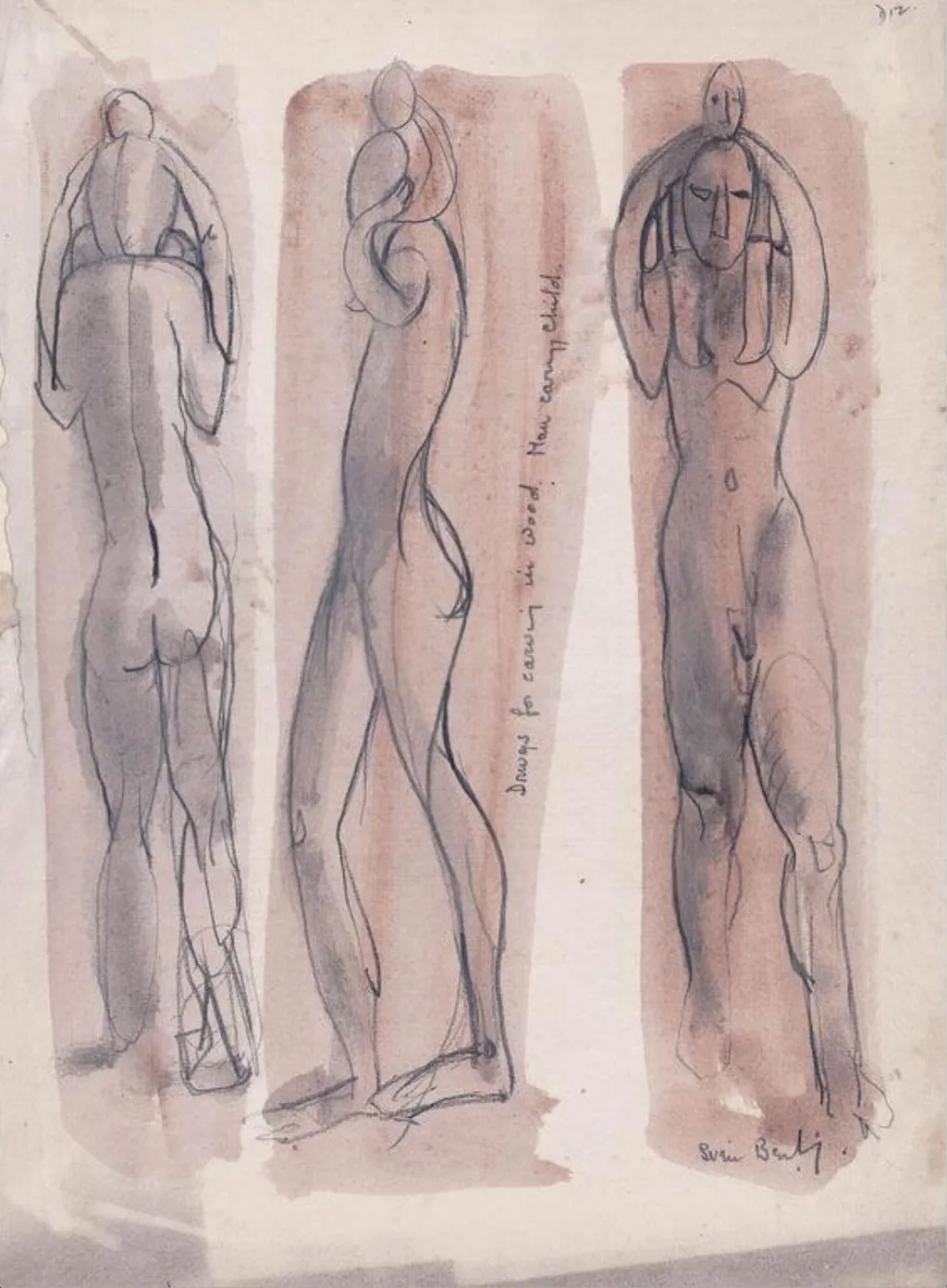
Man carrying a child is a watercolor work on paper by Sven Berlin. It dates from 1950 and is held in the collection of the Victoria and Albert Museum.
About this work
Overview
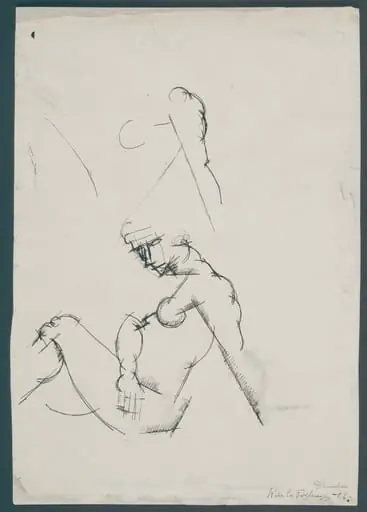
This watercolour and set of preparatory sketches depict a man carrying a child, likely part of a series of studies for a larger wooden carving. The works are executed in loose, rapid strokes, emphasizing movement and posture over detail. The watercolour serves as a refined version, while the sketches reveal the artist’s process of refining form through incremental additions.
Subject & Meaning
The subject centers on physical care and familial connection, rendered without narrative context or setting. The focus on the act of carrying—rather than facial expressions or environment—suggests an interest in universal gestures of support. The child’s placement on the man’s shoulders implies trust and dependence, conveyed through posture alone.
Technique & Style
The artist used watercolour for its fluidity to suggest volume and weight, while the preparatory drawings employ minimal, hurried lines to explore composition. Three sequential sketches show progressive refinement: from outline to added limbs, then torso and arms. The middle sketch bears a handwritten note indicating its function as a study for wood carving, revealing a practical, working method.
History & Provenance
These works are part of a known group of preparatory studies held by the Victoria and Albert Museum, associated with 19th-century British artists engaged in decorative carving. Their survival suggests they were preserved not as finished art but as functional records of craft practice, offering insight into the transition from sketch to carved object.
Context
During the mid-1800s, artists working in applied arts often produced such sketches to translate designs into woodcarving for furniture, architectural elements, or ecclesiastical objects. This group reflects a broader trend of integrating fine art drawing into craft production, where rapid studies served as essential tools for planning complex three-dimensional forms.
Legacy
These studies remain valuable for understanding the working methods of Victorian-era craftsmen. Their informal nature contrasts with finished carvings, yet they preserve the immediacy of creative decision-making. Today, they are referenced in studies of design process, illustrating how artistic ideas evolved from sketch to material form.
Artist & collection
Artist
Sven Paul Berlin was an English painter, writer and sculptor. He is now best known for his controversial fictionalised autobiography The Dark Monarch, which was withdrawn just days after publication in 1962 following…