Artwork
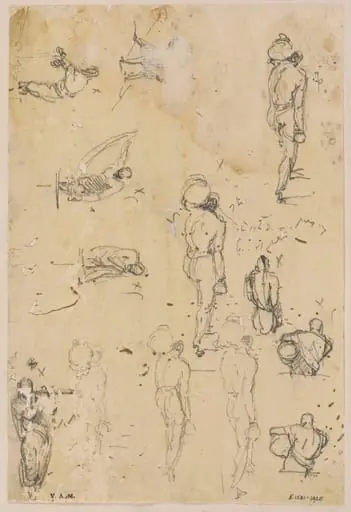
Figure studies and a head fot the mosaic decoration of the dome of St. Paul's Cathedral
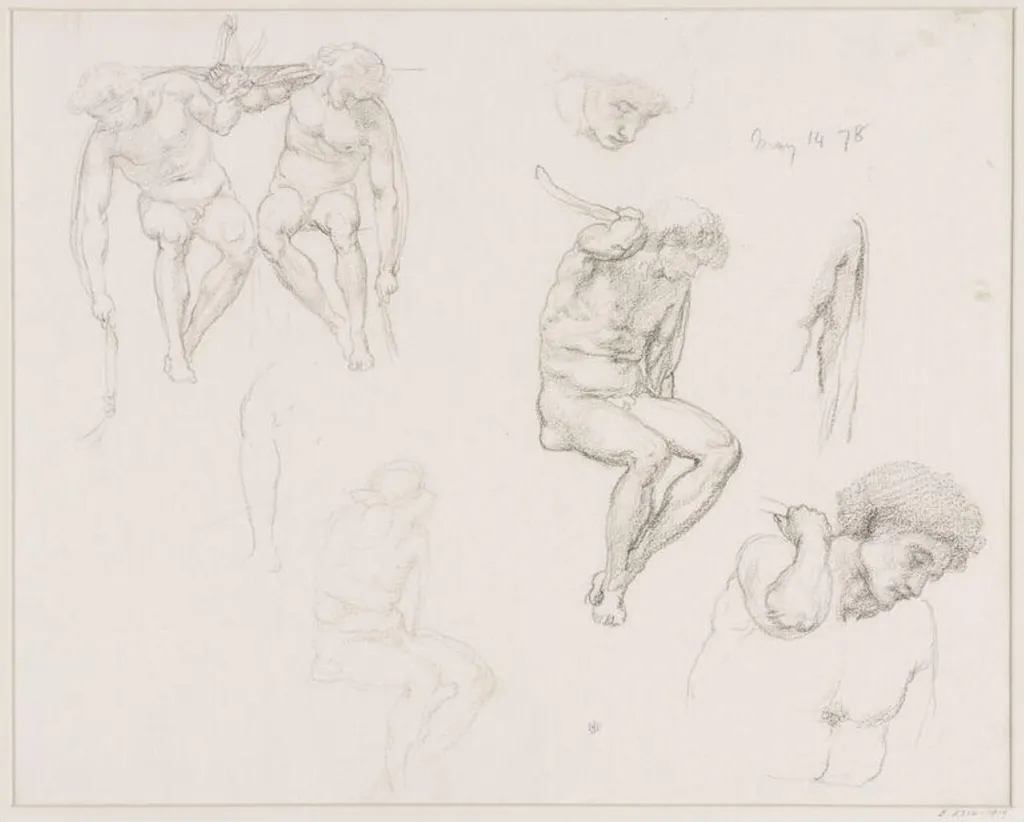
Figure studies and a head fot the mosaic decoration of the dome of St. Paul's Cathedral is a drawing by the Impressionist artist Edward John, Sir Poynter. It dates from 10 and is held in the collection of the Victoria and Albert Museum. Sir Edward John Poynter produced a series of chalk sketches in May 1878 as preparatory studies for a mosaic to be placed in the dome of St.
About this work
The lines are rough and shaky, like hurried notes—no smooth shapes, just quick strokes to catch the body’s movement.
This sketch shows four loose, quick drawings of nude figures. Two are standing, one is crouching, and the last is a head turned sideways. The lines are rough and shaky, like hurried notes—no smooth shapes, just quick strokes to catch the body’s movement.
The date in the corner says May 14, 1878, and these were practice drawings for a bigger project. The artist was working out poses for a mosaic in a cathedral dome, so these are just rough ideas, not finished work.
If you like sketchy, fast drawings, check out stippling next.
Overview
Sir Edward John Poynter produced a series of chalk sketches in May 1878 as preparatory studies for a mosaic to be placed in the dome of St. Paul’s Cathedral. The sheets contain four separate figure studies—a pair of standing nude forms, a crouching figure, and a profile head—rendered in rapid, gestural lines. These drawings served as preliminary visual notes rather than finished compositions.
Subject & Meaning
The drawings focus on the human anatomy, exploring posture, balance and the play of light across the nude body. By isolating a head turned sideways, Poynter also examined facial profile and expression, likely intended to inform the facial features of a larger mosaic figure. The studies emphasize the sculptural quality required for a work that would be viewed from below within a grand ecclesiastical space.
Technique & Style
Executed in chalk, the sketches are characterized by loose, hurried strokes that capture the immediacy of movement. Lines are uneven and unrefined, suggesting a process of rapid observation rather than polished rendering. The lack of shading and the sketchy quality reflect a focus on gesture and proportion, typical of academic preparatory work in the late nineteenth century.
History & Provenance
After serving their purpose in the design phase, the studies were displayed publicly as part of Poynter’s completed dome design at the Royal Academy exhibition of 1882. Their inclusion in that show indicates their value as insight into the artist’s creative process and the broader project of decorating St. Paul’s dome.
Context
The commission for mosaic decoration in St. Paul’s dome formed part of a Victorian revival of monumental ecclesiastical art, where historicist designs were often preceded by extensive academic drawing. Poynter, a leading figure of the Royal Academy, applied his academic training to a public religious commission, bridging fine art drawing with architectural ornamentation.
Artist & collection
Artist
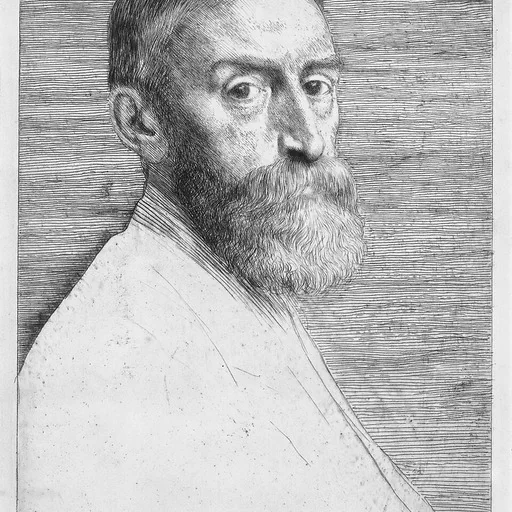
Sir Edward John Poynter, 1st Baronet (20 March 1836 – 26 July 1919) was an English painter, designer, and draughtsman, who served as President of the Royal Academy.

 Figure Studies
![Studies for "The Wise and Foolish Virgins" [recto], by William Blake, Sir Richmond](https://artifactworldgallery.com/img/william-blake-sir-richmond--studies-for-the-wise-and-foolish-virgins-recto--b7a433b90f3e6c54-w320.webp) Studies for "The Wise and Foolish Virgins" [recto]
Studies for "The Wise and Foolish Virgins" [recto] Studies for "Heaven" and "Hell"
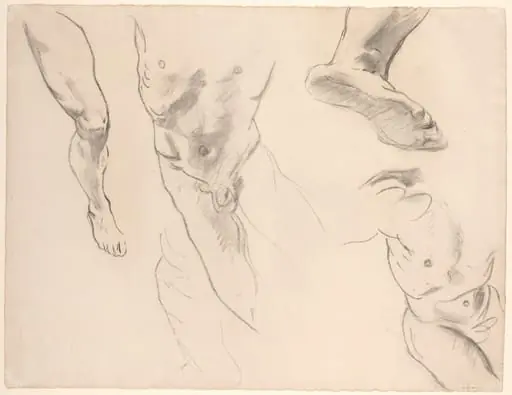 Figure Studies of a Nude Youth
![Studies of Male Nudes [verso], by John Singer Sargent](https://artifactworldgallery.com/img/john-singer-sargent--studies-of-male-nudes-verso--6a06b2ac3ad0c09a-w320.webp) Studies of Male Nudes [verso]
Studies of Male Nudes [verso]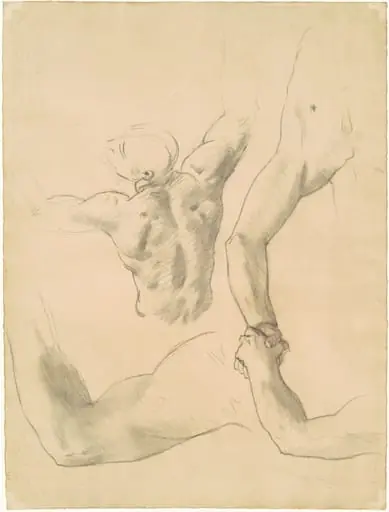 Studies for "Two Classical Male Figures Wrestling"
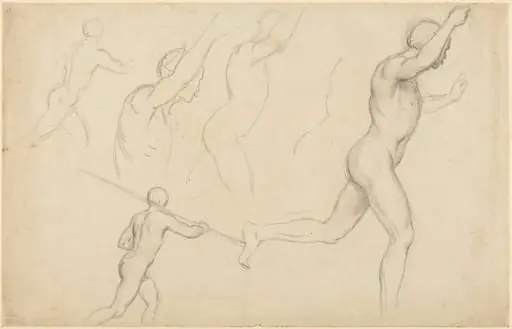 Studies of Men Running
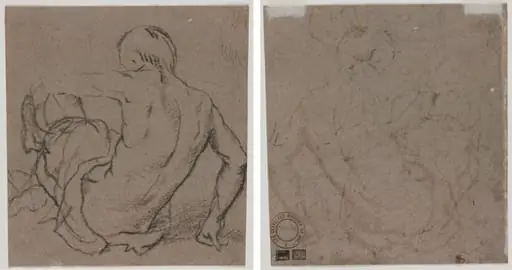 Man Seated on the Ground, Seen from Behind (recto); Sketch (verso)
 Sketches of Indian figures
 Studies for "Judgment"