Artwork
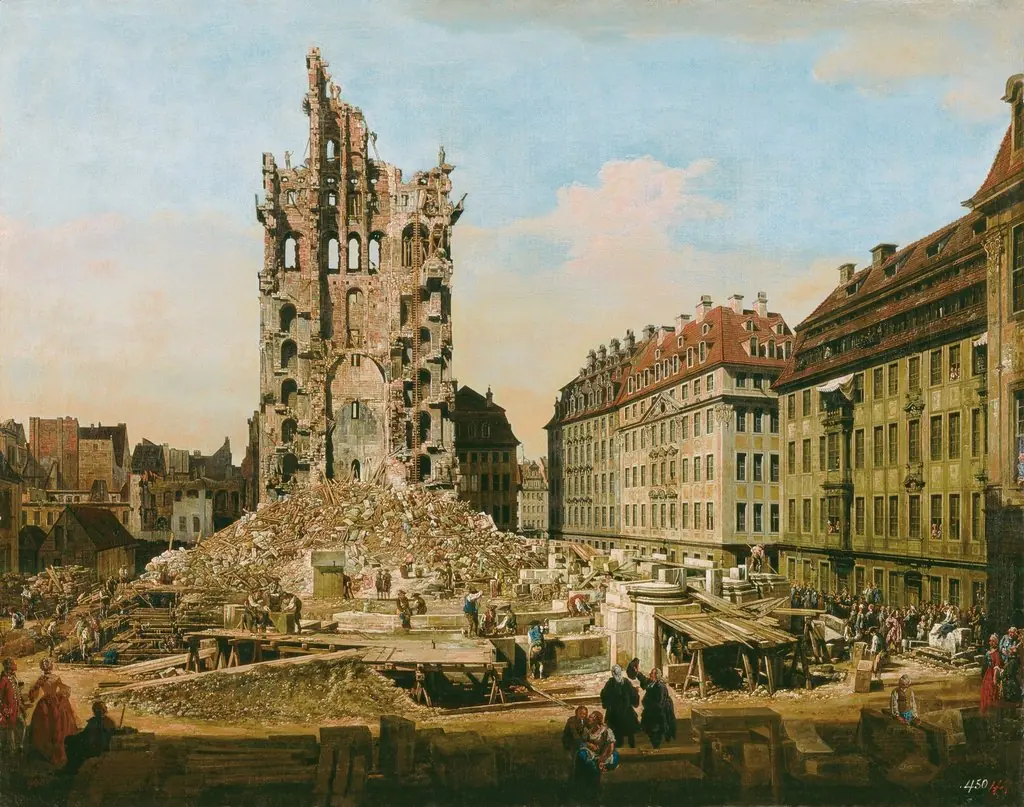
The Ruins of the old Kreuzkirche, Dresden
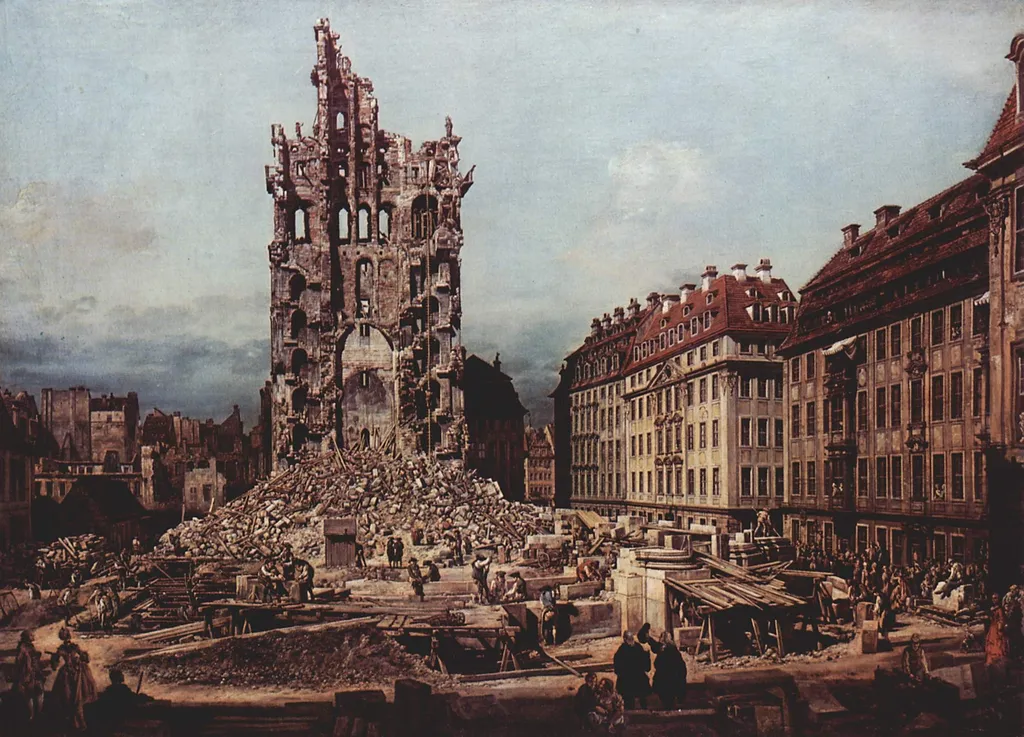
The Ruins of the old Kreuzkirche, Dresden is an oil painting by the Rococo painting artist Bernardo Bellotto. It dates from 1765 and is held in the collection of the Staatliche Kunstsammlungen Dresden.
About this work
Overview
Bellotto renders the scene with his characteristic topographical precision, capturing the interplay of light and shadow across the crumbling masonry.
Bernardo Bellotto's 'The Ruins of the old Kreuzkirche, Dresden,' painted in 1765, depicts the skeletal remains of the Gothic church in Dresden following its destruction during the Seven Years' War. The composition centers on the massive, hollowed-out shell of the church, its tall arches and broken walls dominating the urban landscape. Bellotto renders the scene with his characteristic topographical precision, capturing the interplay of light and shadow across the crumbling masonry. Small figures populate the foreground, some observing the devastation while others appear to be engaged in clearing debris or early reconstruction efforts, grounding the monumental ruin in human activity. The background reveals the surrounding cityscape of Dresden under a somber, overcast sky, emphasizing the contrast between the destroyed landmark and the surviving urban fabric. Created shortly after the artist's return to Dresden to serve as court painter to Augustus III, this work serves as both a historical document of the war's impact and a testament to Bellotto's mastery of the veduta genre. It stands as a poignant record of a specific moment in the city's history, balancing architectural accuracy with a melancholic atmosphere that reflects the trauma of the recent conflict.
Subject & Meaning
The scene portrays the Kreuzkirche after destruction, emphasizing the contrast between the once‑grand religious structure and its present ruin. Human figures—some observing, others repairing—suggest a narrative of loss and reconstruction within the urban environment, inviting reflection on the transience of monumental architecture amid everyday life.
Technique & Style
Bellotto employs a meticulous, almost photographic attention to detail, rendering textures of stone, timber, and sky with precise brushwork. A restrained palette of grays, earth tones, and subtle highlights creates a realistic atmosphere, while careful modeling of light and shadow evokes a chiaroscuro effect that enhances the three‑dimensionality of the ruined edifice.
History & Provenance
Executed in 1765, the painting reflects Bellotto’s interest in architectural subjects during his Dresden period. It entered the collection of the Gemäldegalerie Alte Meister, where it remains on display, serving as a documented visual record of the Kreuzkirche’s condition in the mid‑18th century.
Own this work as a print
Artist & collection

Artist
Bernardo Bellotto, was an Italian urban landscape painter or vedutista, and printmaker in etching famous for his vedute of European cities – Dresden, Vienna, Turin, and Warsaw.