Artwork
A Terrace and Garden on Capri [recto]
![A Terrace and Garden on Capri [recto], by François-Édouard Bertin, chalk, 1822](https://artifactworldgallery.com/img/francois-edouard-bertin--a-terrace-and-garden-on-capri-recto--8bd3839591b56d81-w1024.webp)
A Terrace and Garden on Capri [recto] is a chalk drawing by the Romanticist artist François-Édouard Bertin. It dates from 1822 and is held in the collection of the National Gallery of Art. Created around 1822, this charcoal and white chalk drawing on blue paper captures a tranquil terrace on the island of Capri.
About this work
Overview
Created around 1822, this charcoal and white chalk drawing on blue paper captures a tranquil terrace on the island of Capri. The composition centers on a modest architectural frame—columns and a low wall—opening to a garden beyond. The cool tone of the paper unifies the scene, while subtle contrasts in medium suggest soft light and quiet depth, evoking a still, midday atmosphere.
Subject & Meaning
The scene depicts a private, unoccupied space where architecture meets nature. A single palm tree rises above clustered shrubs, and a distant dome hints at a building, possibly a villa or chapel. The absence of figures emphasizes solitude and contemplation. The drawing conveys a sense of serene observation rather than narrative, reflecting the artist’s interest in quiet, everyday landscapes.
Technique & Style
Bertin employed charcoal for broad, muted tones and white chalk for highlights, enhancing the luminosity of the sky and architectural edges. The blue paper provides a consistent mid-tone, allowing subtle gradations to suggest form. Delicate, loose strokes define foliage and shadow, using scumbling to build texture without heavy line work, resulting in a soft, atmospheric quality.
History & Provenance
The drawing is attributed to François-Édouard Bertin, a French artist known for his topographical sketches during travels in southern Italy. Created during a visit to Capri around 1822, it likely served as a preparatory study or personal record. Its survival suggests it was retained within the artist’s circle, though its early ownership remains undocumented.
Context
In the early 1820s, French artists increasingly traveled to Italy to study classical ruins and rural landscapes. Capri, then relatively untouched by tourism, offered a retreat of natural beauty and architectural fragments. Bertin’s work aligns with this trend, focusing on modest, unidealized views that valued observation over grandeur.
Legacy
This drawing exemplifies a quiet strain of 19th-century French draftsmanship that prioritized atmospheric effect over dramatic composition. While not widely exhibited in its time, it contributes to a broader understanding of how artists engaged with Mediterranean landscapes through intimate, observational studies rather than monumental renderings.
Artist & collection


![View up a Street in Sorrento [verso], by François-Édouard Bertin](https://artifactworldgallery.com/img/francois-edouard-bertin--view-up-a-street-in-sorrento-verso--d628dffbf459271a-w320.webp)
 Houses and a Garden on a Hillside in Italy
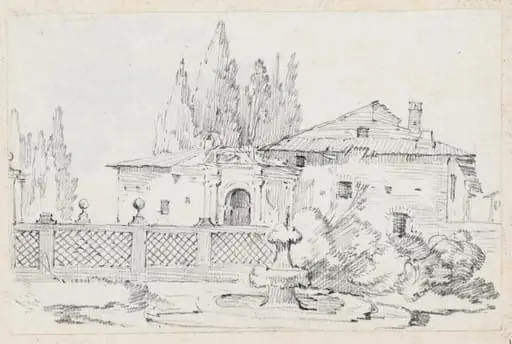 House and Trees across a Garden Wall
![The Ripetta in Rome [verso], by Augustin Pajou](https://artifactworldgallery.com/img/augustin-pajou--the-ripetta-in-rome-verso--4bc04e9c9476a91b-w320.webp) The Ripetta in Rome [verso]
The Ripetta in Rome [verso]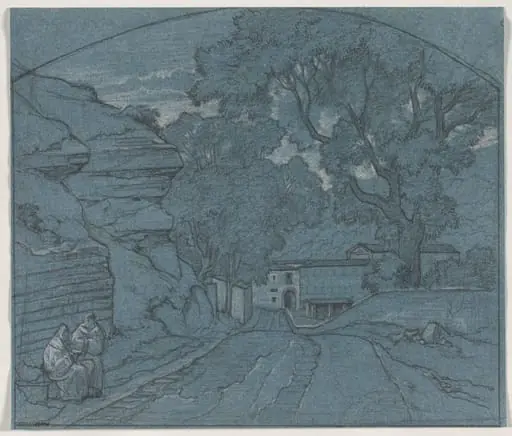 Landscape with Two Monks
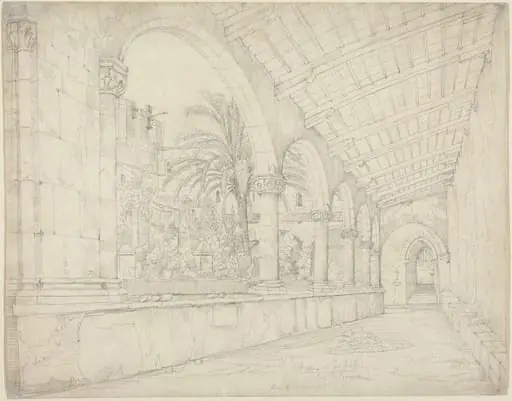 The Cloister of Santa Maria di Gesù at Palermo
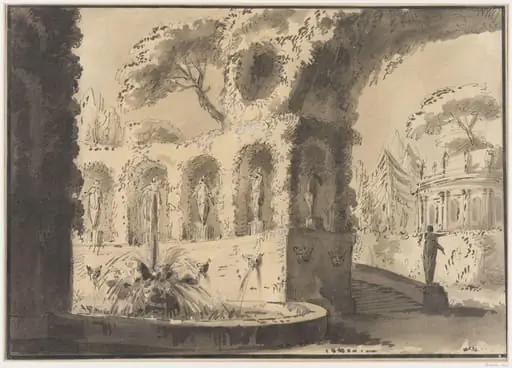 Landscape
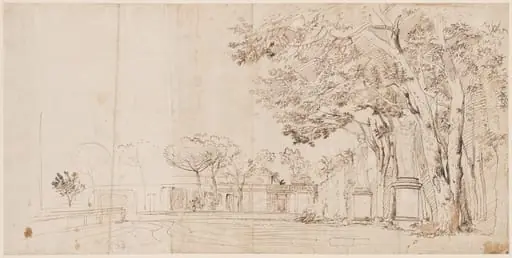 The Gardens of the Villa Medici
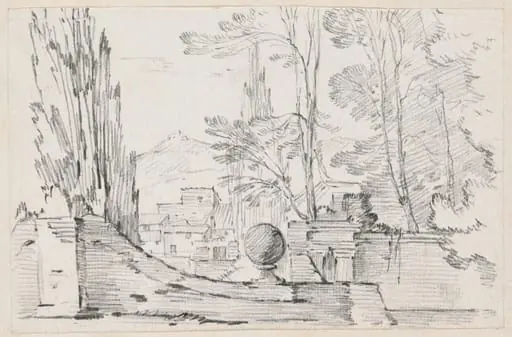 View across the Wall of an Italian Garden
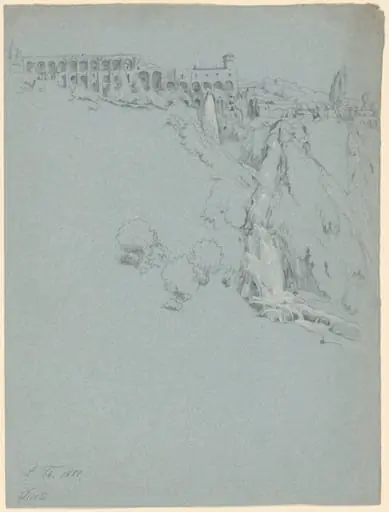 The Waterfall at Tivoli with the Villa of Maecenas