Artwork
The Cloister of Santa Maria di Gesù at Palermo
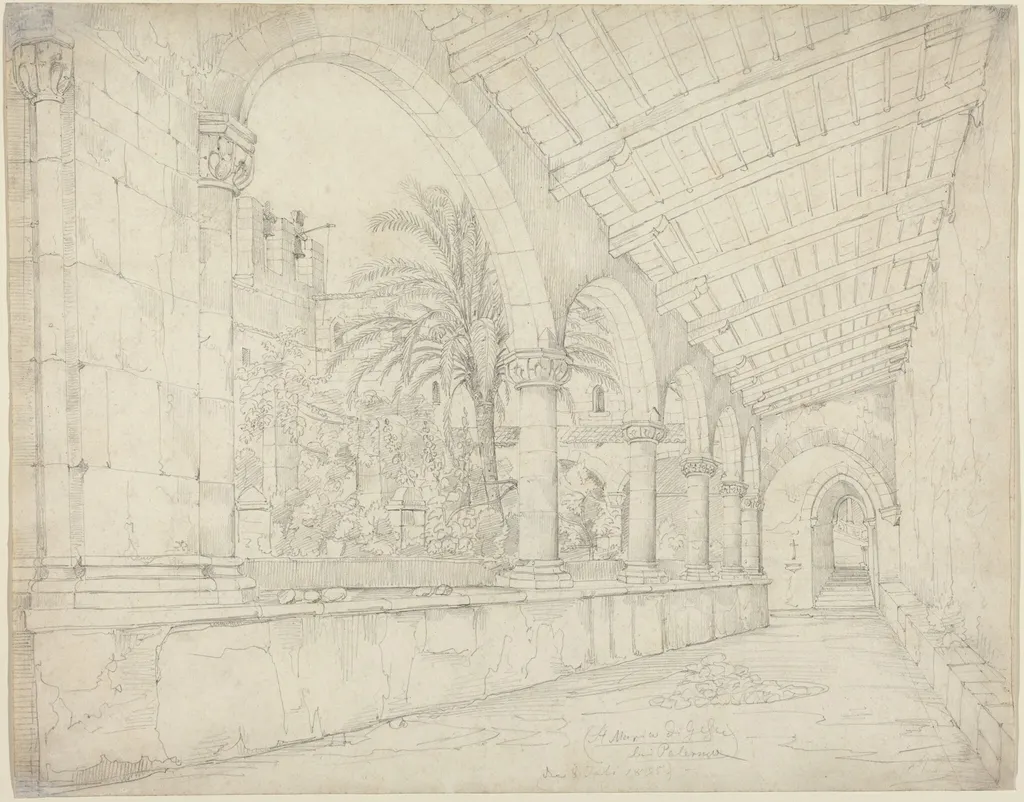
The Cloister of Santa Maria di Gesù at Palermo is a graphite drawing by the Romanticist artist Anton Hallmann. It dates from 1835 and is held in the collection of the National Gallery of Art.
About this work
Overview
Anton Hallmann’s 1835 graphite drawing portrays the cloister of Santa Maria di Gesù in Palermo. Executed on wove paper, the work records a tranquil courtyard framed by tall stone walls and arched openings. A solitary palm tree occupies the centre, its foliage casting subtle shadows across the paved ground, while a few figures move beneath the arches, suggesting everyday activity within the space.
Subject & Meaning
The composition captures the architectural serenity of the cloister, emphasizing the interplay between built form and natural elements. The palm tree, unusual in a Mediterranean monastic setting, serves as a focal point that draws the eye inward, while the sparse human presence hints at the cloister’s function as a place of contemplation and passage rather than bustling congregation.
Technique & Style
Rendered in graphite on smooth wove paper, Hallmann employs a nuanced range of hatching and cross‑hatching to model light and shadow.
Rendered in graphite on smooth wove paper, Hallmann employs a nuanced range of hatching and cross‑hatching to model light and shadow. The contrast between the darkened stone textures and the illuminated areas under the palm’s canopy creates a sense of depth. The drawing reflects the 19th‑century practice of on‑site sketching, where artists recorded architectural details and atmospheric effects directly from observation.
History & Provenance
Created during Hallmann’s travels in Sicily, the drawing was likely produced as part of a broader study of Italian architecture popular among European artists of the period. The work has remained in private collections before entering a museum archive, where it is cited as an example of early travel documentation and the artist’s interest in historic religious sites.
Artist & collection


![A Terrace and Garden on Capri [recto], by François-Édouard Bertin](https://artifactworldgallery.com/img/francois-edouard-bertin--a-terrace-and-garden-on-capri-recto--8bd3839591b56d81-w320.webp) A Terrace and Garden on Capri [recto]
A Terrace and Garden on Capri [recto]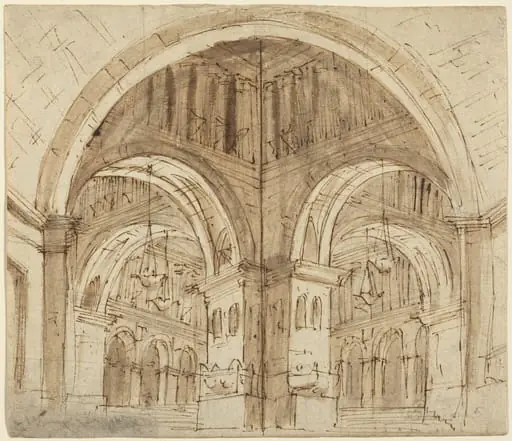 Design for a Vaulted Hall
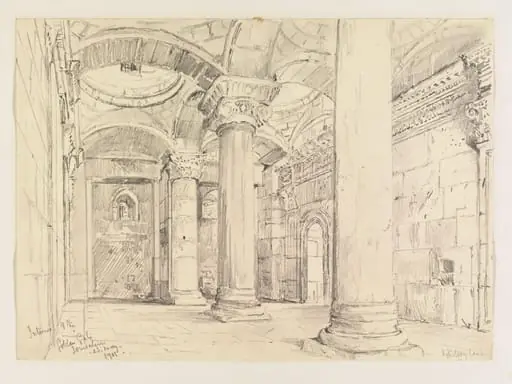 Interior of the Golden Gate Jerusalem
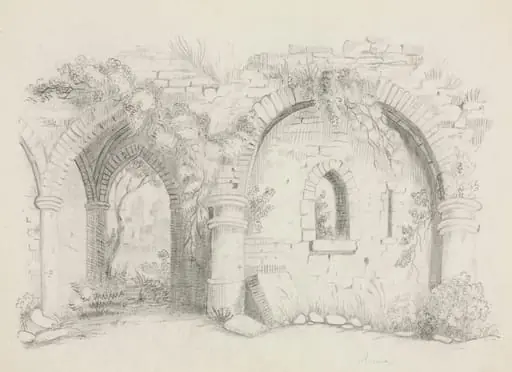 Ruins
Ruins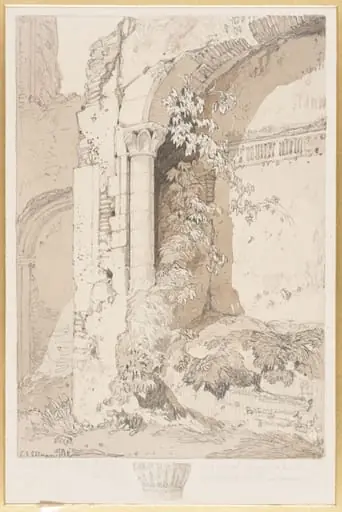 Ruins of the Abbey, Thetford, Norfolk
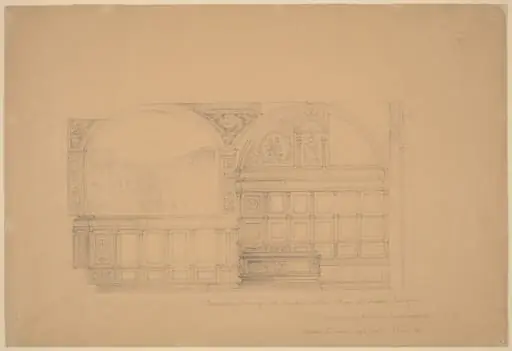 Perugino's Udienza del Cambio in the Collegio del Cambio, Perugia
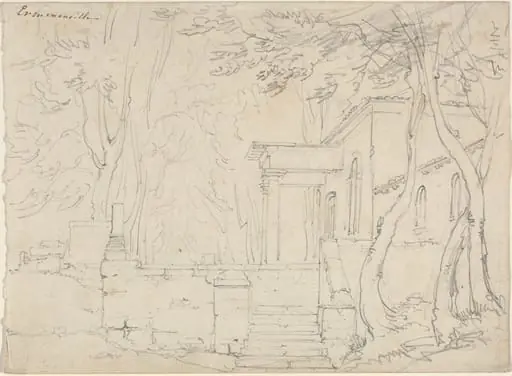 House with a Portico at Ermenonville
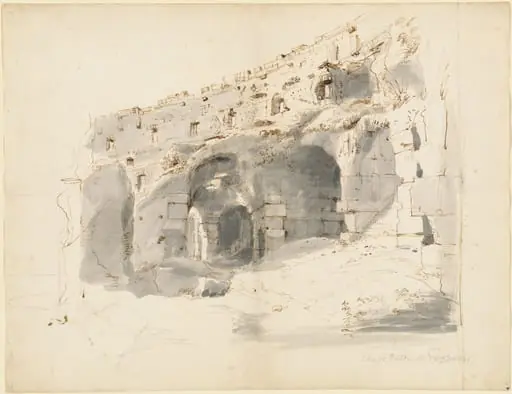 The Ruins of an Ancient Amphitheater
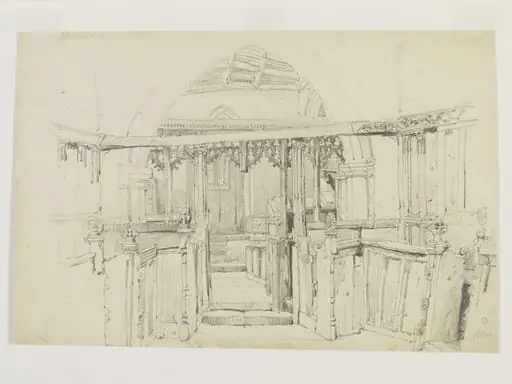 Blore-Ray Church in Staffordshire
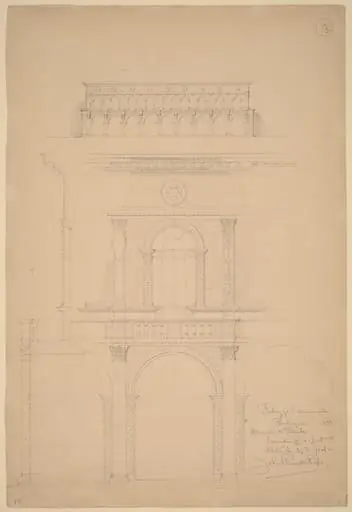 Palazzo Communale, Bologna
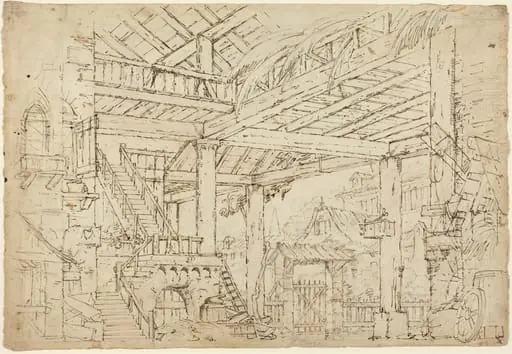 Interior of a Barn Built on Ancient Ruins
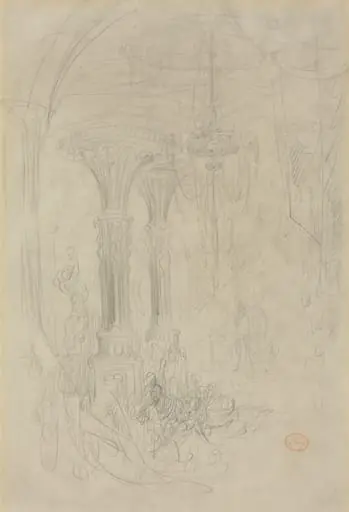 Cleopatra