Artwork
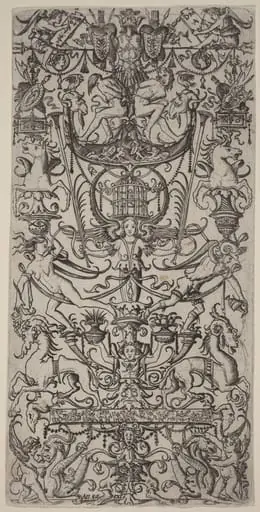
Ornament Panel: Two Sphinxes and Two Children Holding Palms

Ornament Panel: Two Sphinxes and Two Children Holding Palms is an ink print by the Renaissance artist Giovanni Pietro Birago. It dates from 1510 and is held in the collection of the National Gallery of Art.
About this work
Overview
Created around 1510 by Giovanni Pietro Birago, this engraving is a vertical decorative panel featuring mythological and botanical motifs. The composition is densely packed with intricate linear patterns, characteristic of early 16th-century Italian printmaking. Its narrow format suggests it was intended for architectural or furniture ornamentation, possibly as a model for craftsmen.
Subject & Meaning
Two sphinxes—winged lions with human heads—recline atop an ornate base, flanking two small figures holding palm branches. The sphinxes, drawn from Egyptian and classical traditions, symbolize guardianship, while the palms may reference victory or eternal life. The pairing of ancient iconography with youthful figures suggests a fusion of mythological authority and human virtue.
Technique & Style
Birago employed fine, controlled engraving lines to render every detail with precision. Shading is achieved through closely spaced hatching, giving volume to the figures and ornamental elements. The background is filled with scrolling foliage and floral motifs, creating a rhythmic, almost textile-like texture that enhances the panel’s decorative function without overwhelming its central forms.
History & Provenance
The work originates from the early Renaissance period in northern Italy, where engraved ornament panels were circulated among artisans as design templates. Though specific early ownership records are scarce, similar prints by Birago appear in collections linked to Milanese workshops, indicating its use in elite decorative arts production during the early 1500s.
Context
This piece reflects the revival of classical antiquity in Renaissance decorative arts, where Egyptian and Greco-Roman motifs were reinterpreted through contemporary aesthetics. Engraved panels like this were widely distributed among goldsmiths, woodcarvers, and stucco workers, serving as visual references that bridged fine art and applied design in northern Italian courts.
Legacy
Surviving examples remain important for understanding how Renaissance motifs traveled beyond painting and sculpture into everyday craftsmanship.
Birago’s ornament panels influenced the dissemination of Mannerist decorative vocabulary across Europe. Though not widely exhibited today, his precise engraving style contributed to the standardization of printed design sources, helping to unify regional artistic practices. Surviving examples remain important for understanding how Renaissance motifs traveled beyond painting and sculpture into everyday craftsmanship.
Artist & collection