Artwork
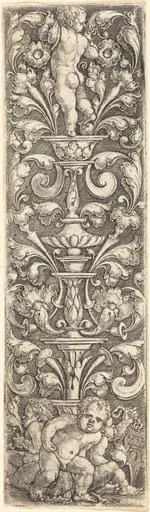
Nereid Ridden by Two Children

Nereid Ridden by Two Children is an ink print by the Renaissance artist Giovanni Pietro Birago. It dates from 1510 and is held in the collection of the National Gallery of Art.
About this work
Overview
Created around 1510 by Giovanni Pietro Birago, this engraving presents a vertical composition dominated by intricate linear patterns.
Created around 1510 by Giovanni Pietro Birago, this engraving presents a vertical composition dominated by intricate linear patterns. The scene centers on a sea-born figure bearing two small riders, framed by ornamental vases and swirling vegetal motifs. The work exemplifies Renaissance decorative printmaking, where mythological elements are woven into elaborate, non-narrative designs meant for aesthetic contemplation rather than storytelling.
Subject & Meaning
The central figure, likely a Nereid—a sea nymph from Greek myth—carries two children atop its fish-like form. Its serene expression contrasts with the playful posture of the riders, suggesting a calm guardianship over youthful energy. Surrounding vases and curling foliage evoke aquatic abundance, but no clear mythological narrative is depicted. The imagery leans toward symbolic harmony between nature, myth, and human playfulness.
Technique & Style
Executed in fine-line engraving, the work relies on precise, controlled incisions to build texture and depth. Swirling lines define the creature’s scales, the vase’s floral缠绕, and the background’s ornamental fills. The absence of shading emphasizes contour and pattern, characteristic of Northern Italian printmaking of the period. The composition’s verticality and density reflect a decorative rather than pictorial intent.
History & Provenance
The engraving is attributed to Birago, an Italian artist active in the early 16th century, known for ornamental prints. No documented early ownership records survive, but similar works circulated among collectors of decorative arts in Lombardy and Venice. Its survival in museum collections today reflects its status as a representative example of Renaissance print culture, valued for craftsmanship over narrative content.
Context
Produced during a period when engraved ornaments were widely used in book illustration and interior decoration, this print aligns with trends favoring mythological and natural motifs in Mannerist design. It shares affinities with the grotesque style popularized by Raphael’s followers, where fantastical elements blend with classical forms. Such prints were often reproduced on textiles, ceramics, and architectural surfaces.
Legacy
Though not widely known today, Birago’s engraving contributes to the broader understanding of how Renaissance artists translated myth into decorative language. Its emphasis on line and pattern influenced later ornamentalists in print and design. The work remains a quiet testament to the era’s fascination with combining classical imagery with intricate, non-narrative composition.
Artist & collection


 Ornament Panel: Triton and Two Infant Satyrs
 Ornament Panel: Two Children Wearing Helmets
 Ornament Panel: Nereid Ridden by Two Children
 Ornament Panel: Two Sphinxes and Two Children Holding Palms
 Ornament Panel: Nereid and Two Children Playing Musical Instruments
 Ornament Panel: Four Children with a Cat and a Dog