Artwork
Sun Dazzle
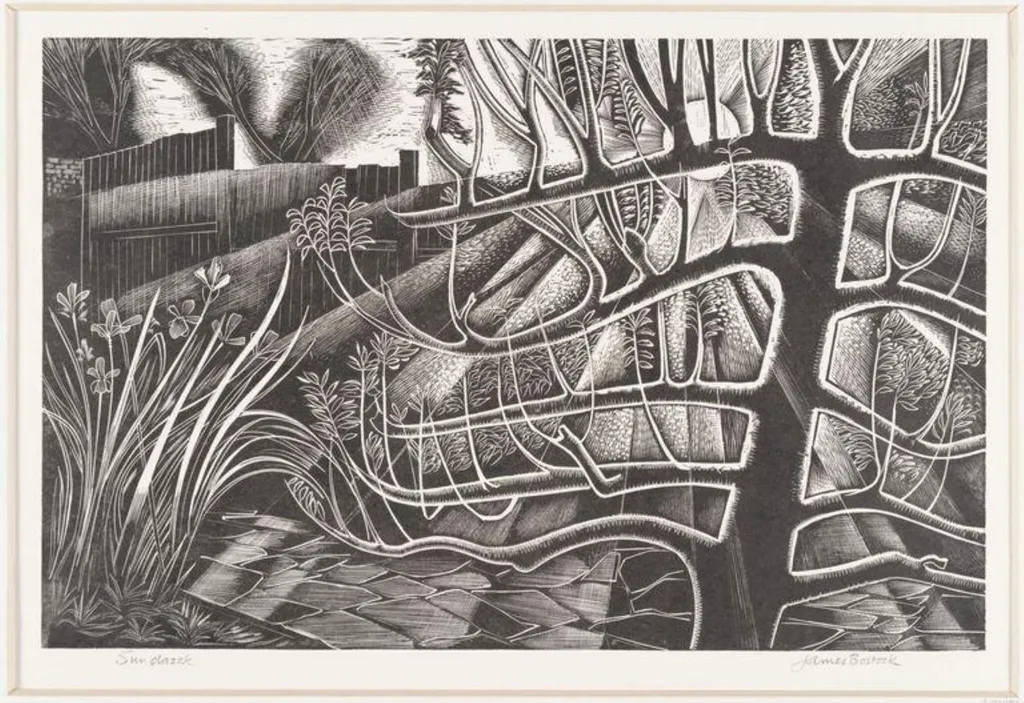
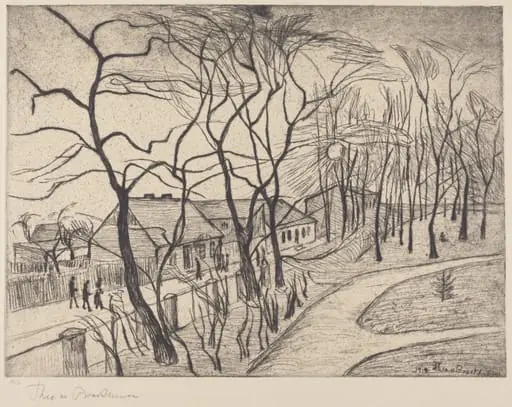
Sun Dazzle is a print by James Edward Bostock. It dates from 1962 and is held in the collection of the Victoria and Albert Museum.
About this work
Overview
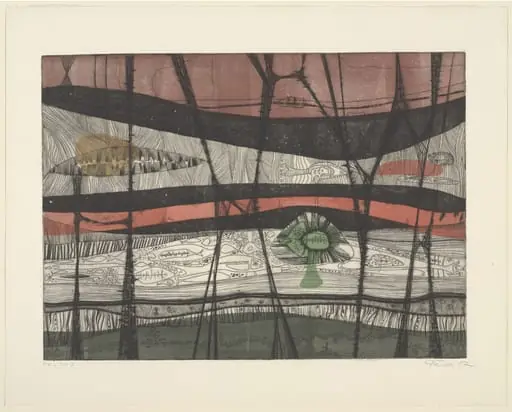
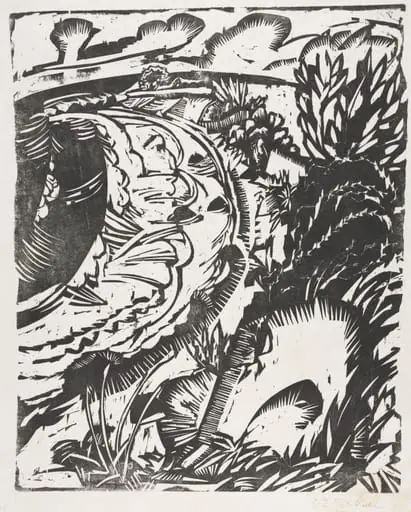
The work captures a landscape through an abstract, tactile lens, using only ink on paper to evoke atmosphere rather than literal representation.
Sun Dazzle is a 1962 black-and-white print by British artist James Edward Bostock. It is part of the collection at the Victoria and Albert Museum in London. The work captures a landscape through an abstract, tactile lens, using only ink on paper to evoke atmosphere rather than literal representation. Its composition avoids realism, favoring rhythmic line work and tonal variation to suggest movement and light.
Subject & Meaning
The scene depicts a river winding through a hazy, indistinct terrain of trees and shrubs. Rather than documenting a specific location, Bostock conveys the sensory experience of heat and light distorting vision. The irregular sky shapes and fluid forms suggest a mirage-like perception, as if the landscape is seen through trembling air or rippling water, evoking a psychological rather than topographical reality.
Technique & Style
Bostock employed a relief or intaglio printmaking method, using layered textures to build depth without color. Swirling, overlapping lines create a sense of motion, while areas of smooth ink contrast with scratched or stippled surfaces. The absence of tone gradation forces the viewer to interpret form through line density and rhythm, resulting in a dynamic, almost vibrating surface that mimics optical disturbance.
History & Provenance
Created in 1962, Sun Dazzle entered the Victoria and Albert Museum’s collection as part of its broader effort to document British printmaking in the mid-20th century. The work reflects Bostock’s engagement with post-war abstraction and his interest in translating natural phenomena into graphic form. It has remained in the museum’s holdings since acquisition, with no documented public exhibitions beyond institutional displays.
Context
In the early 1960s, British artists were exploring non-representational approaches to landscape, influenced by modernist abstraction and psychological interpretations of nature. Bostock’s work aligns with contemporaries who favored expressive mark-making over realism. Sun Dazzle reflects a broader shift in printmaking toward personal, tactile expression rather than commercial or illustrative aims.
Legacy
Sun Dazzle stands as a quiet example of Bostock’s contribution to British printmaking, illustrating how minimal means—black ink and paper—could convey complex sensory experiences. While not widely reproduced, it remains a reference point in studies of mid-century British abstraction. The work continues to be studied for its innovative use of texture and its subtle challenge to conventional landscape representation.
Artist & collection
Artist
English printmaker James Edward Bostock wrapped everyday light in color. In Sun Dazzle (1962), bold vertical bands of orange and yellow catch the eye like a sun-struck window in an Edwardian terrace. His prints feel…