Artwork
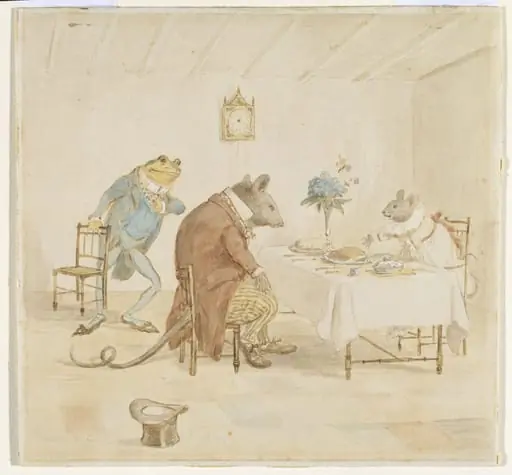
A Frog he would a-wooing go
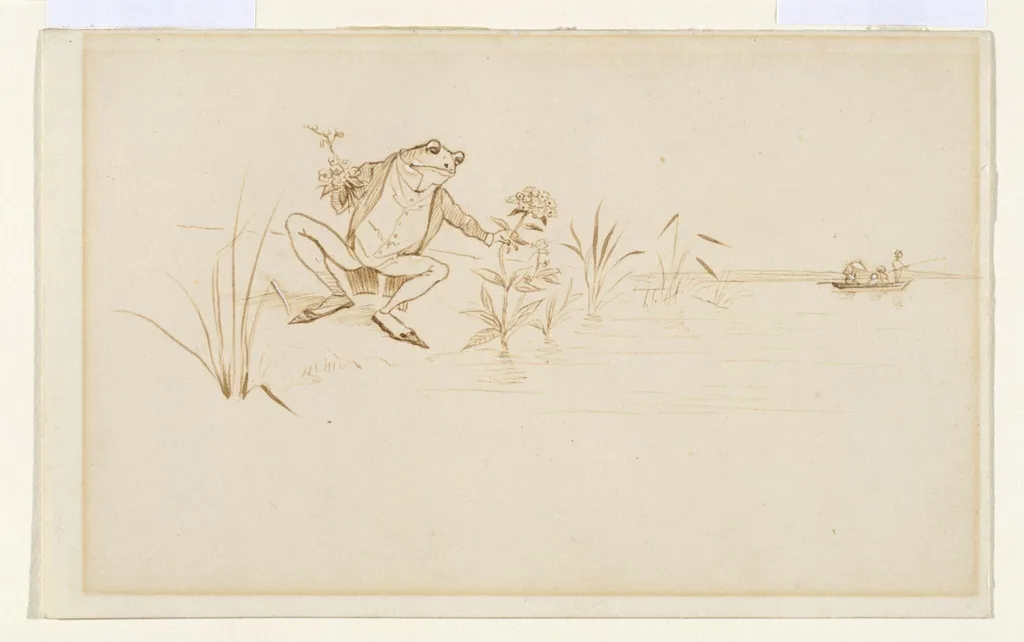
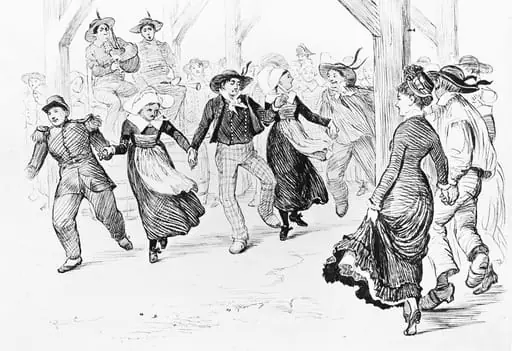
A Frog he would a-wooing go is a drawing by the Impressionist artist Randolph Caldecott. It dates from 1883 and is held in the collection of the Victoria and Albert Museum.
About this work
Overview
Created in 1883, this pen-and-ink drawing by Randolph Caldecott illustrates a whimsical scene drawn from a traditional English nursery rhyme.
Created in 1883, this pen-and-ink drawing by Randolph Caldecott illustrates a whimsical scene drawn from a traditional English nursery rhyme. Executed with minimal but expressive strokes and selective white highlights, the work captures a frog in human attire, poised in a moment of quiet courtship beside a still body of water. The composition balances simplicity with narrative charm, characteristic of Caldecott’s approach to illustrated storytelling.
Subject & Meaning
The frog, dressed in a coat and hat, holds a flower and walking stick as if preparing to court a distant beloved. Its posture and props suggest human social rituals, transforming an amphibian into a comical yet tender suitor. Behind it, a boat with two figures implies a world beyond the frog’s solitary gesture, hinting at the rhyme’s broader tale of unrequited affection and nature’s quiet absurdities.
Technique & Style
Caldecott employed fluid pen lines and subtle ink washes to suggest form without heavy detail. White gouache highlights add luminosity to the frog’s coat and the water’s surface, enhancing the sense of movement and atmosphere. The loose, sketch-like quality avoids rigidity, lending the scene a spontaneous, almost theatrical energy that mirrors the rhythm of folk verse.
History & Provenance
This drawing was made as part of Caldecott’s series of illustrations for children’s rhymes, published in the early 1880s. It was likely created for inclusion in a printed annual or book, though the original sheet survives as a standalone work. Its preservation reflects growing interest in illustrated verse as a legitimate art form during the Victorian era.
Context
Caldecott’s work emerged during a period when children’s literature was evolving beyond moral instruction toward imaginative play. His illustrations drew from folk traditions and rural English life, blending anthropomorphism with keen observation of nature. This piece aligns with contemporaneous efforts to elevate picture books through artistic sophistication and emotional nuance.
Legacy
The drawing exemplifies Caldecott’s influence on the development of modern picture books. His integration of visual rhythm with lyrical text set a precedent for future illustrators. Though created for ephemeral publication, such works are now recognized as foundational to the history of graphic narrative and children’s art.
Artist & collection


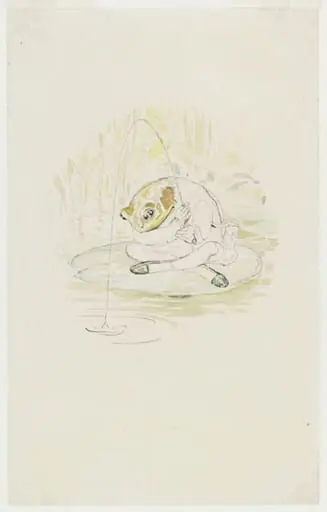 Jeremy Fisher sitting fishing on a waterlily leaf: preparatory drawing for The tale of Mr. Jeremy Fisher
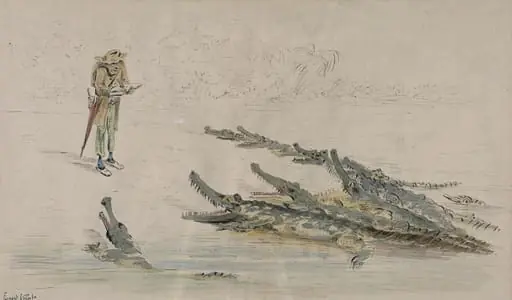 A traveller confronted by crocodiles
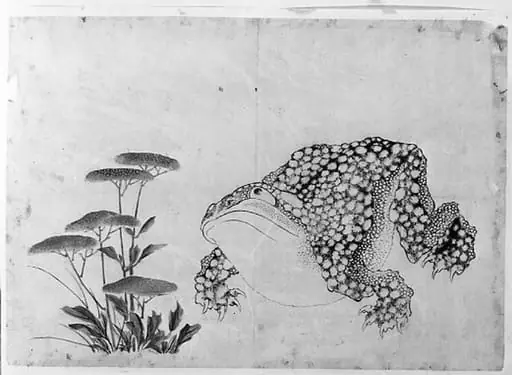 Untitled
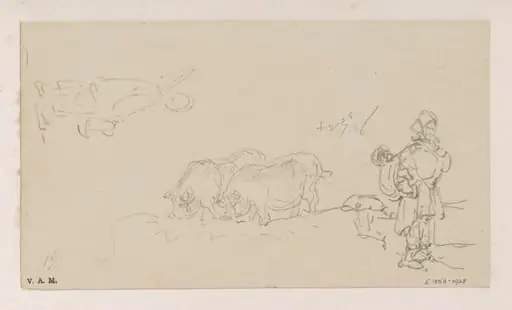 A boatwoman and child, two pigs, and a figure in outline
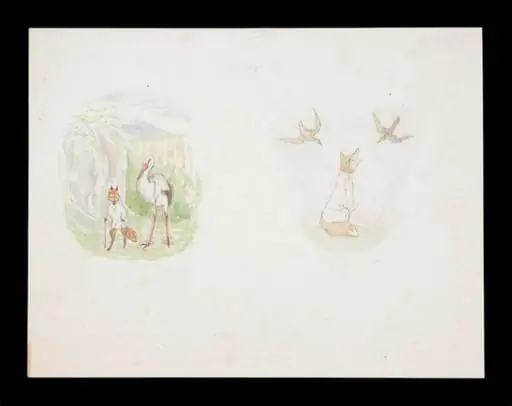 A fox in a glade with a stork; a fox looking up at two birds
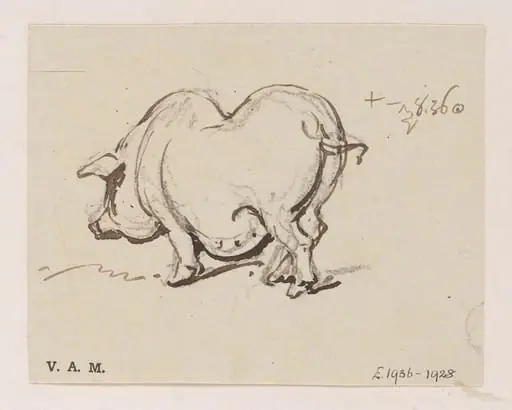 A pig
A pig Untitled
 Study of "The Roman Orator (Germanicus)"
 Bellows in Front of a Fireplace
 The fox looking over the stream at the stork
 A figure seated beside a portrait, and other sketches
 A Frog he would a-wooing go