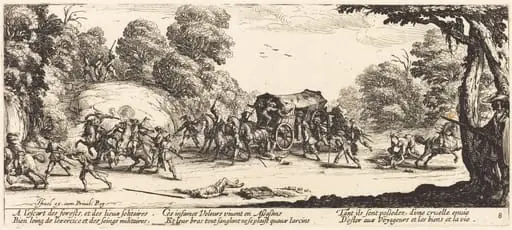
Artwork
Discovery of the Criminal Soldiers
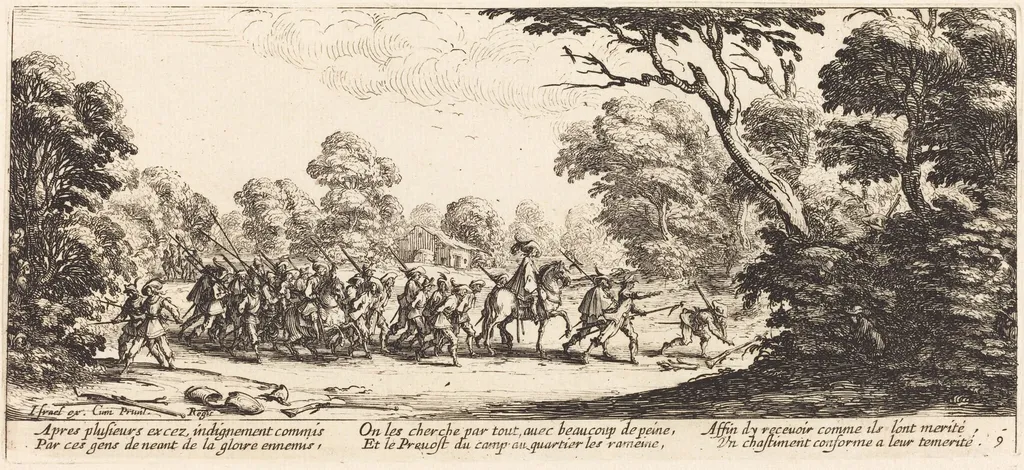
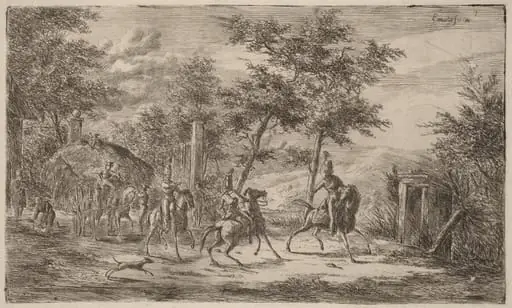
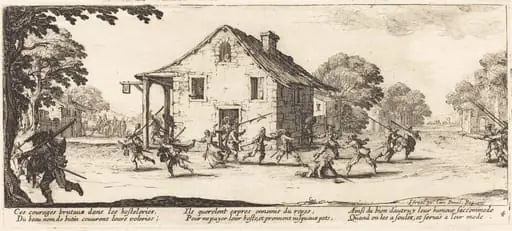
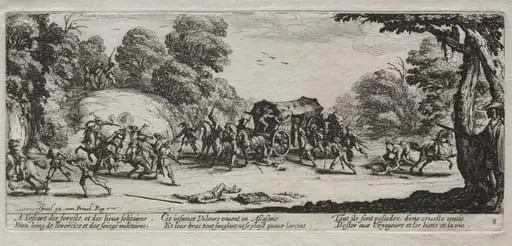
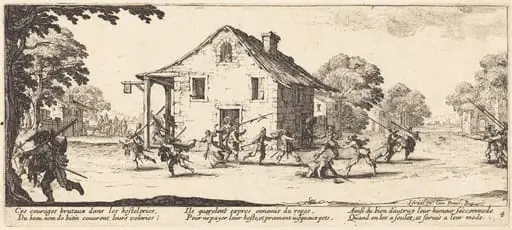
Discovery of the Criminal Soldiers is an ink print by the Baroque artist Jacques Callot. It dates from 1633 and is held in the collection of the National Gallery of Art.
About this work
Overview
Executed on laid paper, the piece reflects his mastery of fine-line etching and his interest in scenes of discipline and disorder within armies.
Jacques Callot, a printmaker from the Duchy of Lorraine, produced this etching around 1633 as part of a large body of work documenting military and civilian life. Executed on laid paper, the piece reflects his mastery of fine-line etching and his interest in scenes of discipline and disorder within armies. With over 1,400 prints to his name, Callot captured the textures and tensions of early 17th-century Europe with precision and narrative clarity.
Subject & Meaning
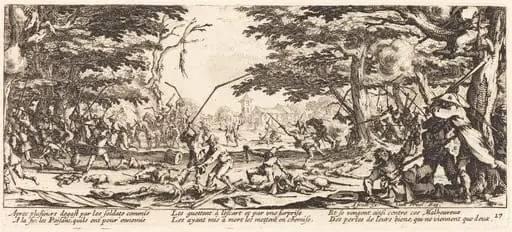
The scene depicts soldiers being interrogated before a wooden table, overseen by a seated official. Others stand in formation, their tall hats and long coats suggesting military rank or uniformity. A silent crowd observes from behind, heightening the sense of public scrutiny. Though no violence occurs, the atmosphere is charged with tension, implying the weight of judgment and the fragility of order in wartime society.
Technique & Style
Callot employed fine, controlled etching lines to render intricate details of clothing, facial expressions, and architectural elements. His use of dense hatching and delicate cross-contours gives texture to fabric and depth to the background figures. The composition is tightly framed, directing attention to the central interaction while maintaining a sense of spatial depth through subtle gradations of line weight and density.
History & Provenance
Created during Callot’s mature period, this print emerged from a time of widespread military conflict in Europe, including the Thirty Years’ War. It likely circulated among collectors and military observers, reflecting contemporary interest in the discipline and chaos of soldiering. The work’s survival in institutional collections, including the National Gallery of Art, attests to its enduring documentary value.
Context
Callot’s prints often responded to the realities of war, portraying soldiers not as heroes but as individuals caught in systems of authority and deprivation. His depictions of military life—interrogations, executions, encampments—offered a counter-narrative to glorified battle imagery. This etching aligns with his broader project of observing social hierarchies and the human cost of conflict.
Legacy
Callot’s detailed, unsentimental approach influenced later generations of printmakers and social commentators. His ability to convey psychological nuance through line alone set a standard for narrative printmaking. This work, like others in his oeuvre, remains a valuable record of how war permeated daily life, shaping perceptions of authority, guilt, and public accountability in early modern Europe.
Artist & collection
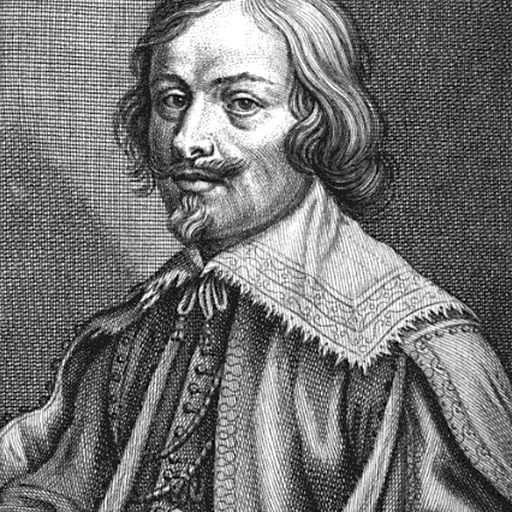
Artist
Jacques Callot was a baroque printmaker and draftsman from the Duchy of Lorraine.

 Holy Family at supper
 Restoration of the Aqueduct at Pisa
 Restoration of the Aqueduct at Pisa
 Square in Paris with Many Figures
 Square in Paris with Many Figures
 Horsemen Attacked by Robbers
 HOW WILL A COVERED PART BE CORRECTED?HOW WIKA A COVERED HEART DEED CORRECTED?
![Christ Walking on the Water [second plate], by Jacques Callot](https://artifactworldgallery.com/img/jacques-callot--christ-walking-on-the-water-second-plate--2069f3bfe4cb2126-w320.webp) Christ Walking on the Water [second plate]
Christ Walking on the Water [second plate]