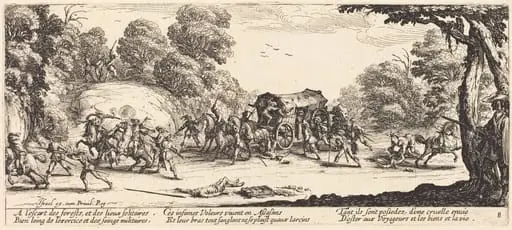
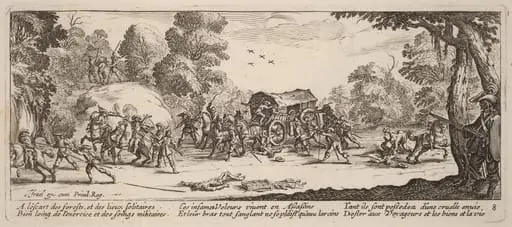
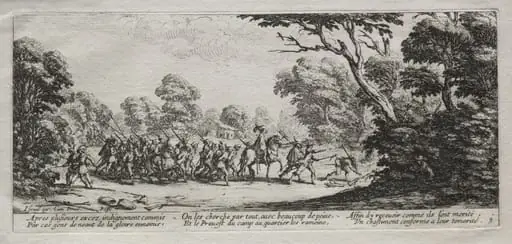
Artwork
The Peasants Avenge Themselves
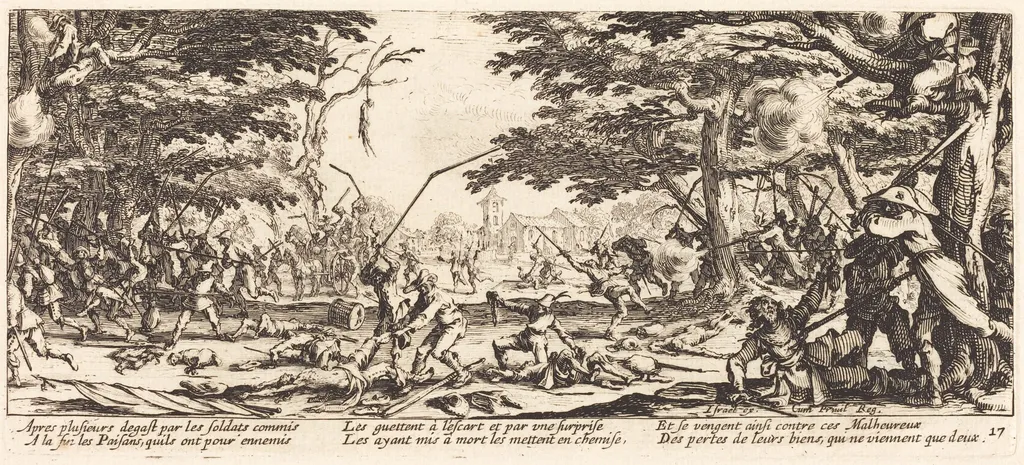
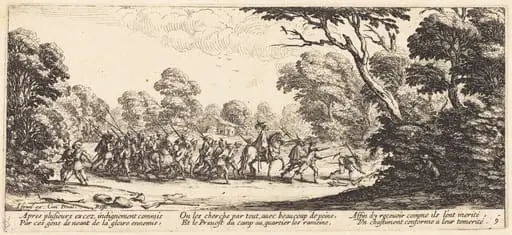
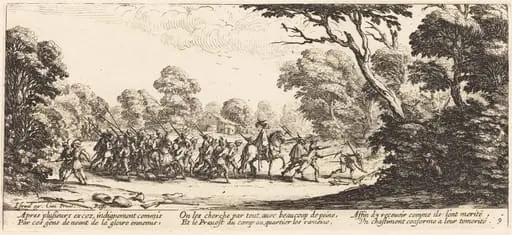
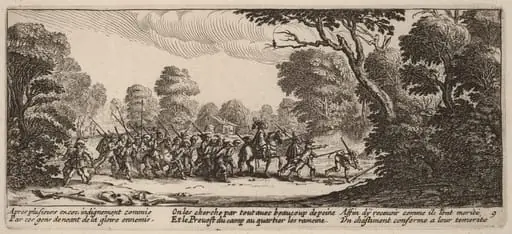
The Peasants Avenge Themselves is an ink print by the Baroque artist Jacques Callot. It dates from 1633 and is held in the collection of the National Gallery of Art.
About this work
Overview
Created around 1633 by Jacques Callot, this etching on laid paper is part of a larger body of work documenting the social tensions of early 17th-century Europe.
Created around 1633 by Jacques Callot, this etching on laid paper is part of a larger body of work documenting the social tensions of early 17th-century Europe. Callot, a printmaker from the Duchy of Lorraine, produced over 1,400 etchings, many capturing the lives of ordinary people and the disruptions of war. This piece stands as a rare depiction of civilian resistance, rendered with precision and immediacy through the etching technique.
Subject & Meaning
The scene portrays a group of peasants retaliating against soldiers, using agricultural tools as weapons. A man swings a hammer, women drag a fallen soldier by his feet, and others surround the chaos with fierce determination. The image inverts the usual power dynamic, presenting rural communities not as victims but as active agents of retribution. It reflects the volatile relationship between armed forces and civilian populations during wartime.
Technique & Style
Callot employed fine-line etching to capture intricate details of movement and expression. The plate was scratched with a sharp tool, allowing for sharp contrasts and dense textures in clothing, tools, and faces. Unlike idealized historical paintings, the composition feels unpolished and urgent, emphasizing raw motion over formal composition. His mastery of the medium enabled him to render complex scenes with remarkable clarity on a small scale.
History & Provenance
The print emerged during a period of widespread military conflict in Europe, including the Thirty Years' War, which devastated Lorraine and surrounding regions. Callot’s work was widely circulated among collectors and intellectuals, serving as both documentation and commentary. While the exact early ownership history is unclear, the print survives in multiple institutional collections, testifying to its enduring presence in print archives.
Context
In the early 1600s, printed images were a primary means of visual communication across social classes. Callot’s etchings, including this one, responded to the daily realities of war, displacement, and class conflict. Unlike court-sponsored art, his work gave voice to the marginalized, capturing moments of unrest that official histories often ignored. This print aligns with a growing trend of using prints to reflect, rather than glorify, social violence.
Legacy
Callot’s depiction of peasant resistance influenced later artists who sought to portray social injustice with unvarnished realism. The work is recognized as an early instance of visual protest, predating modern political imagery by centuries. Its endurance in museum collections underscores its value as a historical record of popular agency and the power of print to challenge dominant narratives.
Artist & collection
Artist
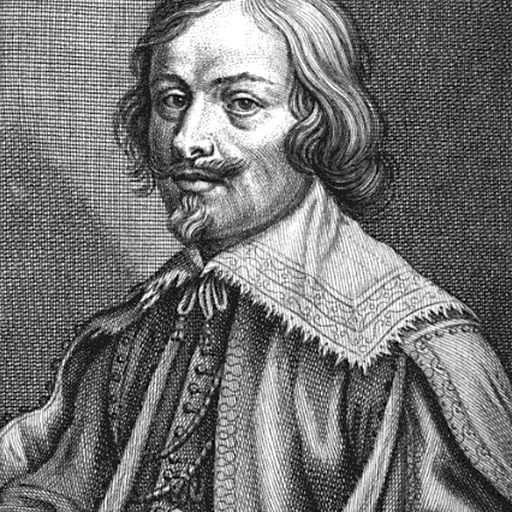
Jacques Callot was a baroque printmaker and draftsman from the Duchy of Lorraine.

 Holy Family at supper
 Restoration of the Aqueduct at Pisa
 Restoration of the Aqueduct at Pisa
 Square in Paris with Many Figures
 Square in Paris with Many Figures
 Horsemen Attacked by Robbers
 HOW WILL A COVERED PART BE CORRECTED?HOW WIKA A COVERED HEART DEED CORRECTED?
![Christ Walking on the Water [second plate], by Jacques Callot](https://artifactworldgallery.com/img/jacques-callot--christ-walking-on-the-water-second-plate--2069f3bfe4cb2126-w320.webp) Christ Walking on the Water [second plate]
Christ Walking on the Water [second plate]