Artwork
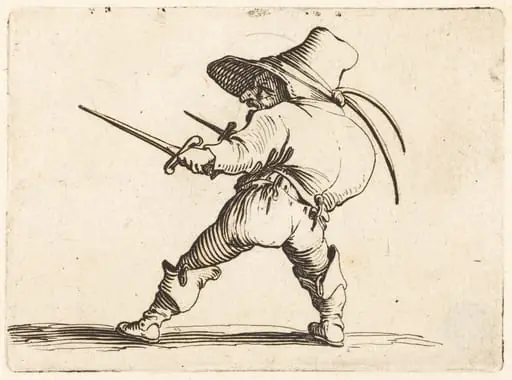
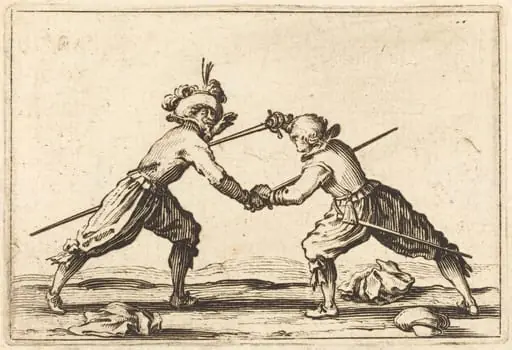
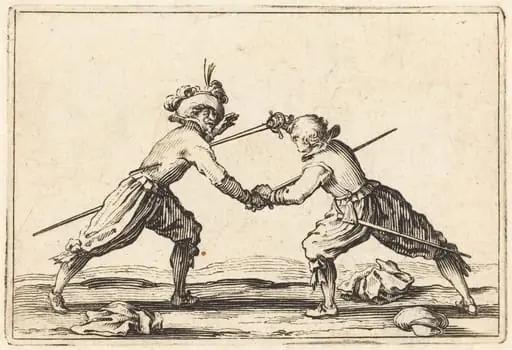
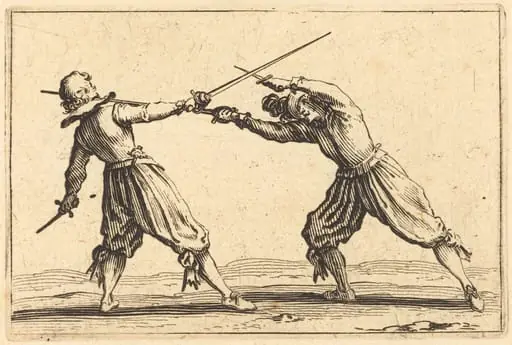
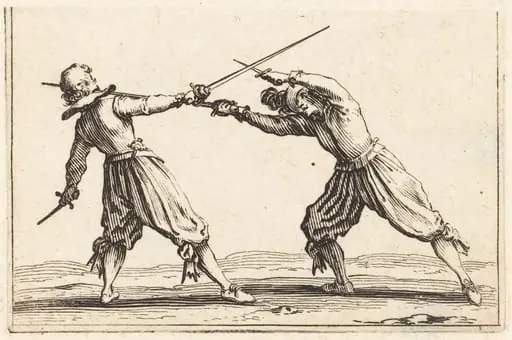
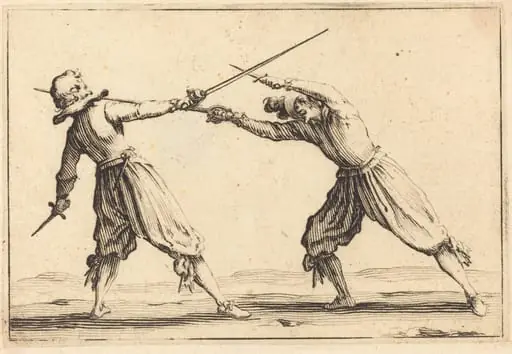
Duellist with Sword and Dagger
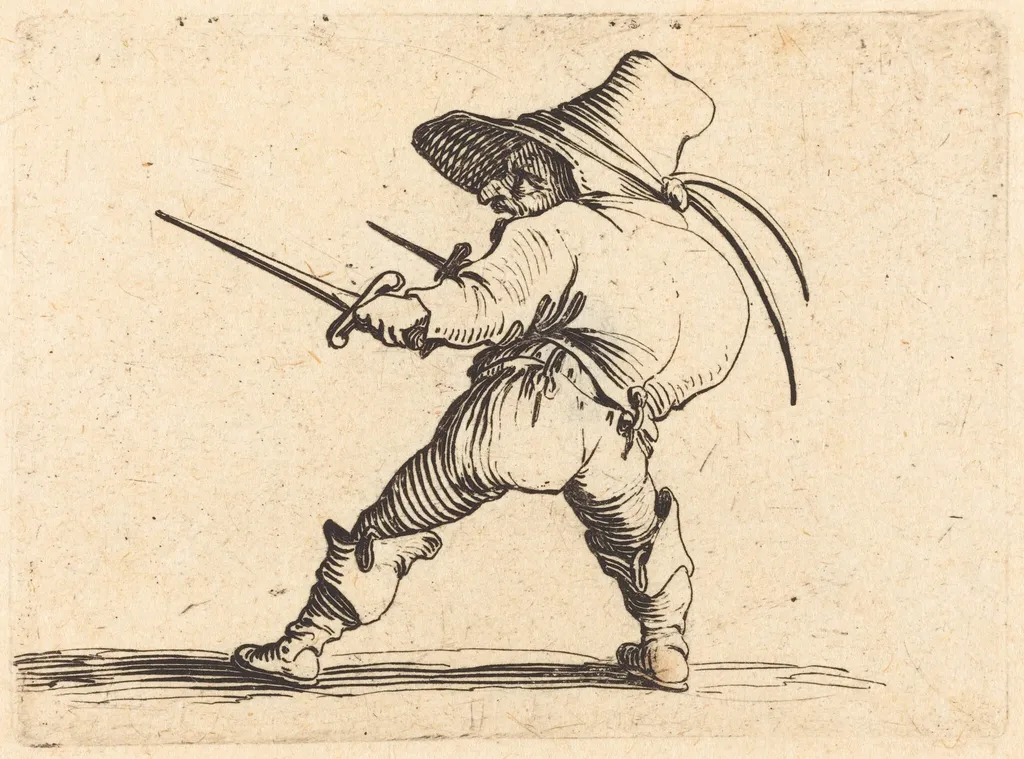
Duellist with Sword and Dagger is an ink print by the Baroque artist Jacques Callot. It dates from 1622 and is held in the collection of the National Gallery of Art.
About this work
Overview
Duellist with Sword and Dagger, created around 1622 by Jacques Callot, is an etching and engraving on a single, uncut sheet of Lorrainese paper, part of a set of three prints (1949.5.254.a-c). It captures a dynamic moment in a duel.
Subject & Meaning
The print depicts a duelist in mid-motion, lunging forward with a sword and dagger. His attire suggests armored clothing with visible straps and padding, indicating a focus on the intensity and realism of the duel scene.
Technique & Style
Callot employed quick, sketchy lines to convey movement and energy, characteristic of 17th-century techniques for depicting fast-paced, dramatic scenes. The etching and engraving methods allowed for detailed, expressive lines.
History & Provenance
Part of Jacques Callot's extensive oeuvre of over 1,400 etchings, this work is dated to his active period as a French Baroque printmaker and draftsman from the Duchy of Lorraine (c. 1592–1635). The piece is now part of a collection (1949.5.254.a-c).
Context
Created during the Baroque period, the print reflects the era's emphasis on capturing dynamic movement and intense emotional states. Callot's subject matter often included military and dramatic themes, aligning with contemporary interests.
Legacy
While specific legacy details of *Duellist with Sword and Dagger* are not highlighted, Callot's overall contribution to etching and engraving techniques influenced later generations of printmakers, ensuring his work remains significant in the history of Baroque art.
Artist & collection

Artist
Jacques Callot was a baroque printmaker and draftsman from the Duchy of Lorraine.

 Holy Family at supper
 Restoration of the Aqueduct at Pisa
 Restoration of the Aqueduct at Pisa
 Square in Paris with Many Figures
 Square in Paris with Many Figures
 Horsemen Attacked by Robbers
 HOW WILL A COVERED PART BE CORRECTED?HOW WIKA A COVERED HEART DEED CORRECTED?
![Christ Walking on the Water [second plate], by Jacques Callot](https://artifactworldgallery.com/img/jacques-callot--christ-walking-on-the-water-second-plate--2069f3bfe4cb2126-w320.webp) Christ Walking on the Water [second plate]
Christ Walking on the Water [second plate]