Artwork
Meeting of Margaret of Austria and Philip III [recto]
![Meeting of Margaret of Austria and Philip III [recto], by Jacques Callot, ink, 1612](https://artifactworldgallery.com/img/jacques-callot--meeting-of-margaret-of-austria-and-philip-iii-recto--2aafd0c5f9d0b247-w1024.webp)
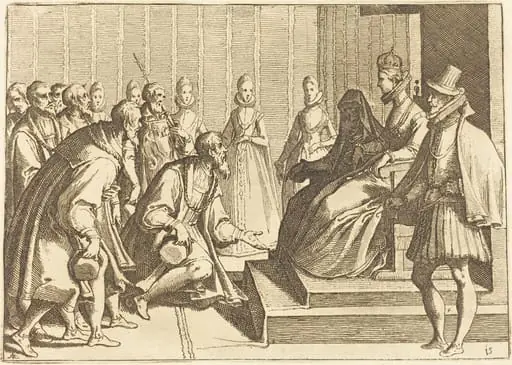
Meeting of Margaret of Austria and Philip III [recto] is an ink print by the Baroque artist Jacques Callot. It dates from 1612 and is held in the collection of the National Gallery of Art.
About this work
Overview
As one of over 1,400 etchings he created, it exemplifies his commitment to recording the visual language of power and ceremony in early 17th-century Europe.
Jacques Callot produced this etching in 1612, capturing a formal diplomatic meeting between Margaret of Austria and Philip III of Spain. Executed on laid paper, the work reflects his broader practice of documenting courtly and historical events through precise, finely detailed prints. As one of over 1,400 etchings he created, it exemplifies his commitment to recording the visual language of power and ceremony in early 17th-century Europe.
Subject & Meaning
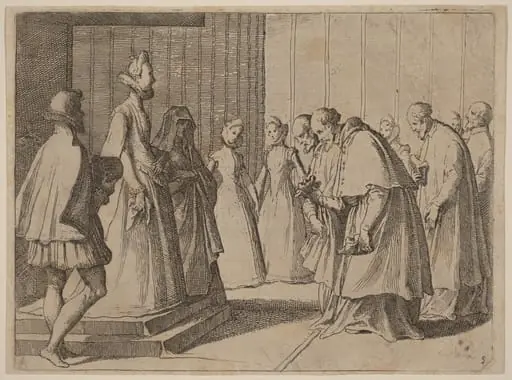
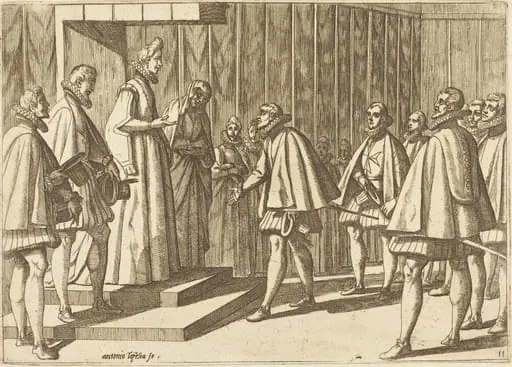
The scene depicts a ceremonial encounter between two European nobles, likely part of a political negotiation or state visit. Figures are arranged in a rigid, hierarchical line, with one individual elevated on a platform, signaling authority. Crowns, staffs, and rich garments denote status, while the composed stillness suggests the gravity of the occasion. Callot’s focus on protocol underscores the print’s function as a visual record of diplomatic ritual.
Technique & Style
Callot employed fine-line etching to render intricate textures in fabric, metal, and architecture. The precision of his lines captures the stiffness of ceremonial attire and the subtle contours of crowns and staffs. The background is simplified to architectural framing, directing attention to the figures. His technique prioritized clarity and detail over atmospheric effect, aligning with the documentary intent of the composition.
History & Provenance
Created in 1612, the print emerged during Callot’s early career in Nancy, then part of the Duchy of Lorraine. It likely circulated among courtly and artistic circles interested in contemporary political events. Though specific early ownership records are sparse, its survival in institutional collections reflects its recognition as a significant example of Baroque printmaking focused on historical subject matter.
Context
This work belongs to a period when European courts relied on visual media to assert legitimacy and record alliances. Callot, though not a court artist, frequently depicted such events with observational accuracy. His etchings responded to the growing demand for images that translated political ceremonies into accessible, reproducible forms, bridging elite events and broader public awareness.
Legacy
Callot’s detailed etching style influenced later generations of printmakers, particularly in the depiction of crowd scenes and architectural settings. While this specific print is not widely reproduced, it exemplifies his role in elevating etching as a medium for historical documentation. His commitment to recording the minutiae of social and political life left a lasting imprint on the genre of narrative printmaking.
Artist & collection
Artist
Jacques Callot was a baroque printmaker and draftsman from the Duchy of Lorraine.

 Holy Family at supper
 Restoration of the Aqueduct at Pisa
 Restoration of the Aqueduct at Pisa
 Square in Paris with Many Figures
 Square in Paris with Many Figures
 Horsemen Attacked by Robbers
 HOW WILL A COVERED PART BE CORRECTED?HOW WIKA A COVERED HEART DEED CORRECTED?
![Christ Walking on the Water [second plate], by Jacques Callot](https://artifactworldgallery.com/img/jacques-callot--christ-walking-on-the-water-second-plate--2069f3bfe4cb2126-w320.webp) Christ Walking on the Water [second plate]
Christ Walking on the Water [second plate]
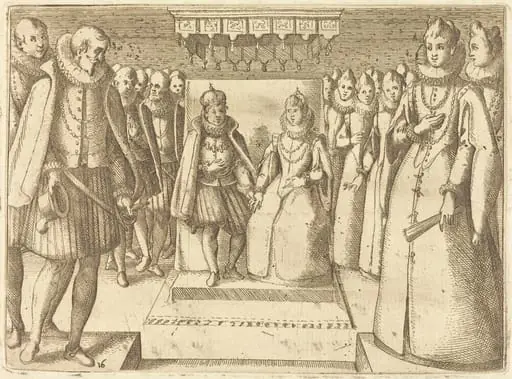 Meeting of Margaret of Austria and Philip III
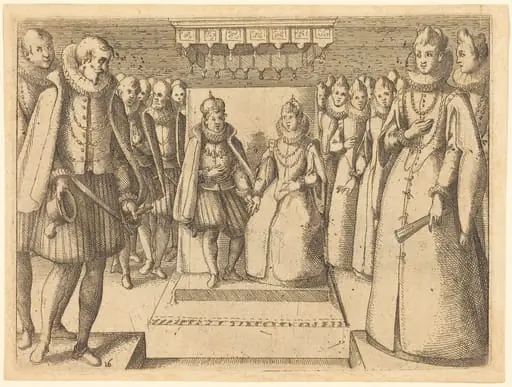 Meeting of Margaret of Austria and Philip III
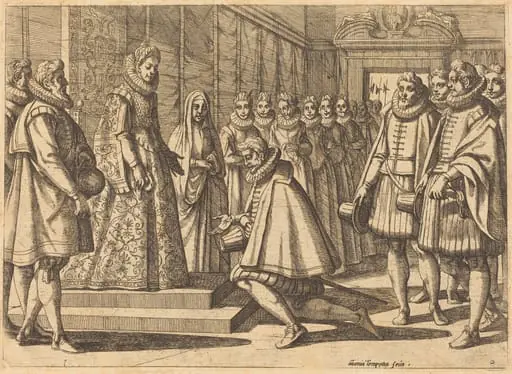 Philip of Spain before Margaret of Austria
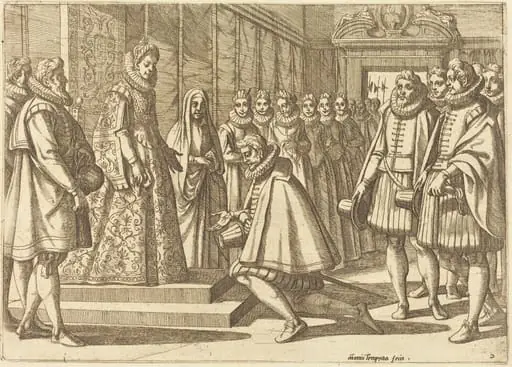 Philip of Spain Before Margaret of Austria
![Margaret of Austria Giving Audience to a Nobleman [verso], by Raffaello Schiaminossi](https://artifactworldgallery.com/img/raffaello-schiaminossi--margaret-of-austria-giving-audience-to-a-nobleman-verso--86ac2347af277f00-w320.webp) Margaret of Austria Giving Audience to a Nobleman [verso]
Margaret of Austria Giving Audience to a Nobleman [verso]![Spanish Duke Before Margaret of Austria [verso], by Antonio Tempesta](https://artifactworldgallery.com/img/antonio-tempesta--spanish-duke-before-margaret-of-austria-verso--9bdf15ebc4e5a042-w320.webp) Spanish Duke Before Margaret of Austria [verso]
Spanish Duke Before Margaret of Austria [verso]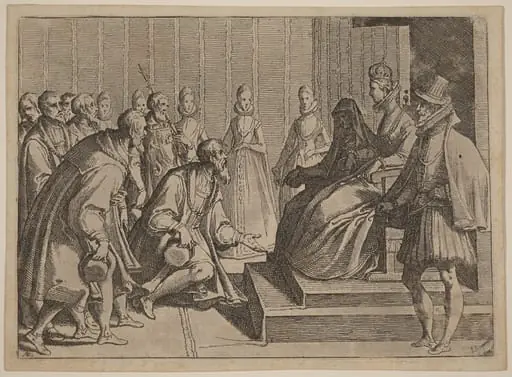 Margaret of Austria Giving Audience to a Nobleman
 Margaret of Austria Receiving the Homage of Cardinals and Prelates
 Margaret of Austria Giving Audience to a Nobleman
 Italian Prince before Margaret of Austria