Artwork
Noble Woman in Profile with her Hands in a Muff
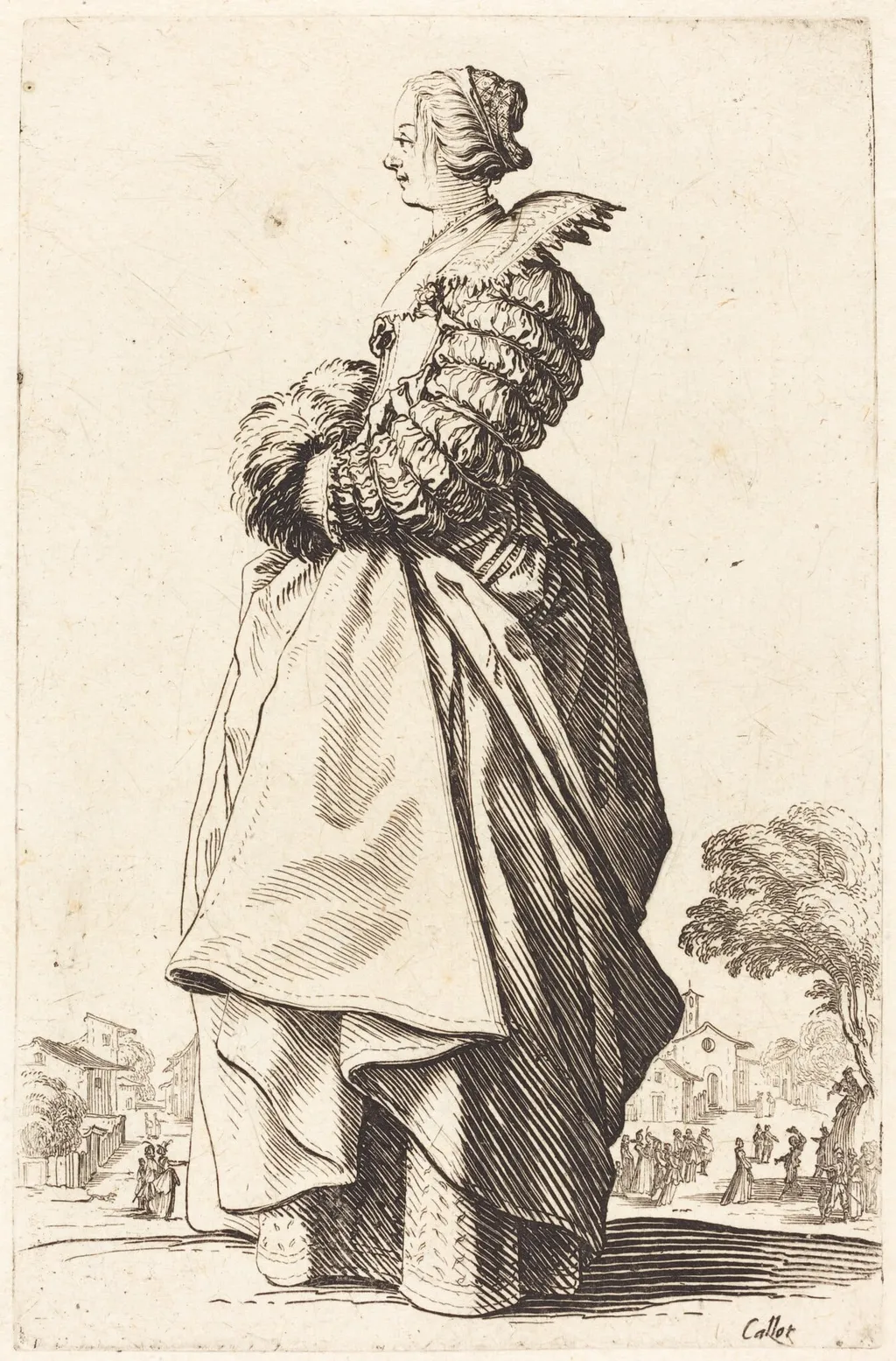
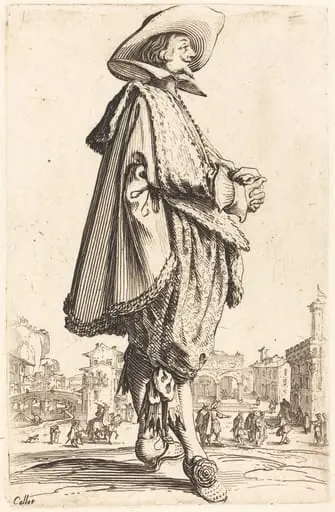
Noble Woman in Profile with her Hands in a Muff is an ink print by the Baroque artist Jacques Callot. It dates from 1622 and is held in the collection of the National Gallery of Art.
About this work
Overview
Created around 1622 by Jacques Callot, this etching on laid paper captures a noblewoman in profile, her hands concealed within a muff.
Created around 1622 by Jacques Callot, this etching on laid paper captures a noblewoman in profile, her hands concealed within a muff. As one of over 1,400 prints produced by the Lorrainer artist, it exemplifies his focus on everyday life among the elite. The work is rendered with precision, using fine linear detail to convey texture and form, characteristic of Callot’s mastery in printmaking during the early Baroque period.
Subject & Meaning
The subject is a woman of high social standing, identified by her elaborate attire: a fur-trimmed collar, matching hat, and voluminous gown. Her posture—hands nestled in a muff—suggests composure and refinement, common ideals among aristocratic women of the time. The inclusion of a distant townscape implies a connection between private elegance and the broader social world, subtly reinforcing her place within it.
Technique & Style
Callot employed fine-line etching to achieve intricate detail, particularly in the folds of fabric, the texture of fur, and the delicate rendering of the background village. His use of hatching and cross-hatching creates subtle gradations of light and shadow, lending depth without heavy tonal contrast. The composition balances the figure’s stillness with the faint activity behind her, demonstrating his skill in integrating figure and setting.
History & Provenance
The print originates from Callot’s prolific output during his years in Florence and Paris, where he served noble patrons and documented contemporary life. While the specific early ownership of this impression is undocumented, it aligns with other works from his 1620s period, which were widely circulated among collectors and artists across Europe. Its survival in good condition reflects its enduring appeal among print connoisseurs.
Context
In early 17th-century Europe, etching emerged as a favored medium for capturing portraiture and social scenes with greater accessibility than painting. Callot’s work responded to a growing market for images of aristocratic life, blending observation with idealization. The inclusion of a background landscape echoes Northern Renaissance traditions, while the focus on costume and demeanor reflects contemporary interest in social identity.
Legacy
Callot’s detailed etchings influenced generations of printmakers, particularly in their treatment of costume and spatial depth. Though not as widely known as his battle scenes or beggar series, works like this noblewoman’s portrait contributed to the genre of refined portraiture in print. His technical innovations helped elevate etching from a reproductive tool to a medium capable of nuanced expression.
Artist & collection

Artist
Jacques Callot was a baroque printmaker and draftsman from the Duchy of Lorraine.

 Holy Family at supper
 Restoration of the Aqueduct at Pisa
 Restoration of the Aqueduct at Pisa
 Square in Paris with Many Figures
 Square in Paris with Many Figures
 Horsemen Attacked by Robbers
 HOW WILL A COVERED PART BE CORRECTED?HOW WIKA A COVERED HEART DEED CORRECTED?
![Christ Walking on the Water [second plate], by Jacques Callot](https://artifactworldgallery.com/img/jacques-callot--christ-walking-on-the-water-second-plate--2069f3bfe4cb2126-w320.webp) Christ Walking on the Water [second plate]
Christ Walking on the Water [second plate]