Artwork
One of the Infantry Combats
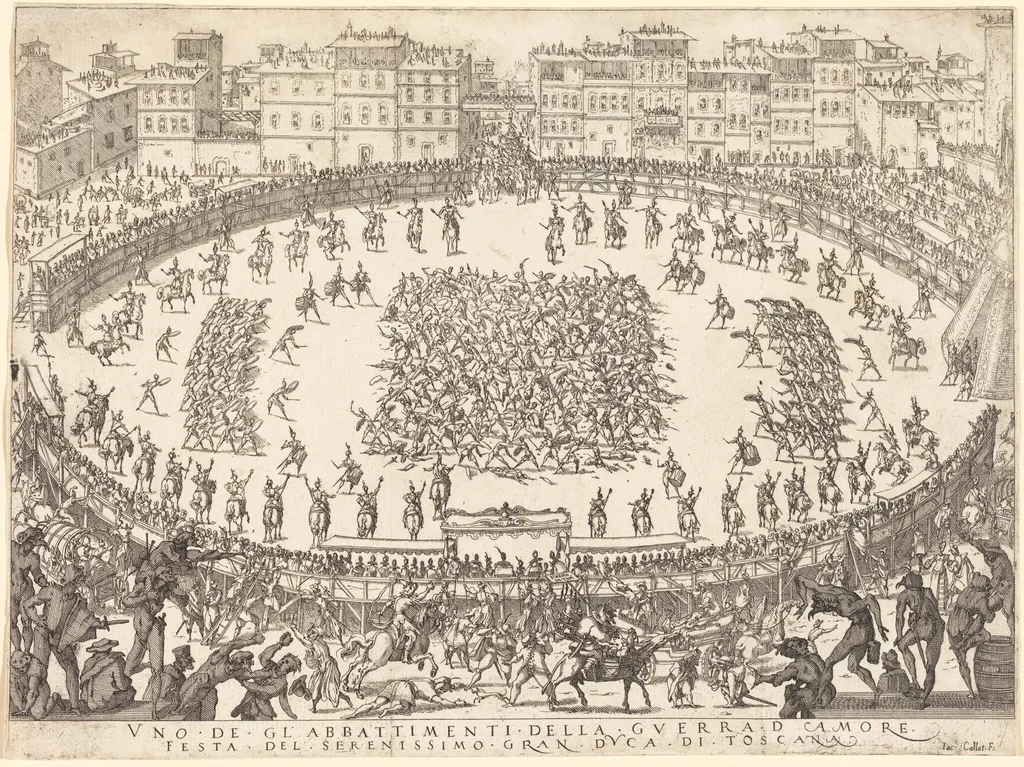
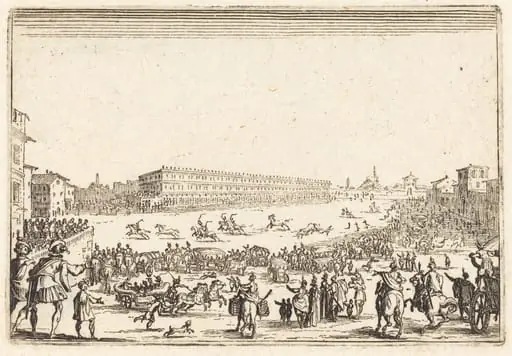
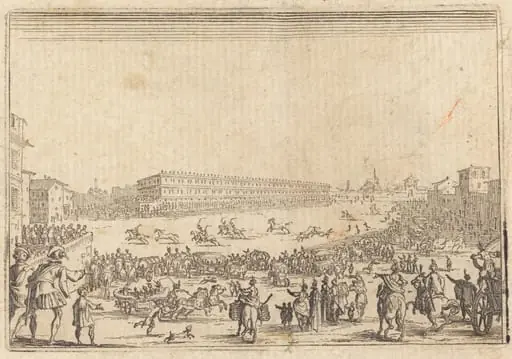
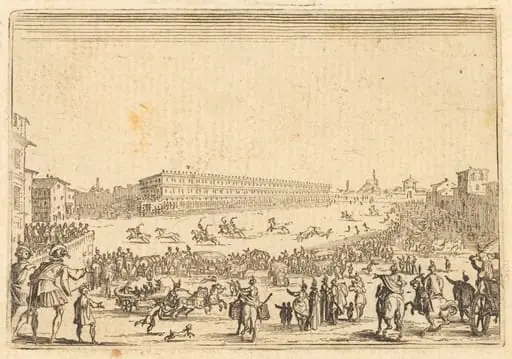
One of the Infantry Combats is an ink print by the Baroque artist Jacques Callot. It dates from 1616 and is held in the collection of the National Gallery of Art.
About this work
Overview
Created in 1616 by Jacques Callot, *One of the Infantry Combats* is an etching on laid paper that captures a moment of violent disorder among soldiers.
Created in 1616 by Jacques Callot, *One of the Infantry Combats* is an etching on laid paper that captures a moment of violent disorder among soldiers. Part of a larger series on military life, the work exemplifies Callot’s precision in rendering complex scenes with fine lines. Unlike painted narratives, this print relies on the tonal range of etching to convey depth and motion, reflecting his mastery of the medium and his interest in documenting the realities of war.
Subject & Meaning
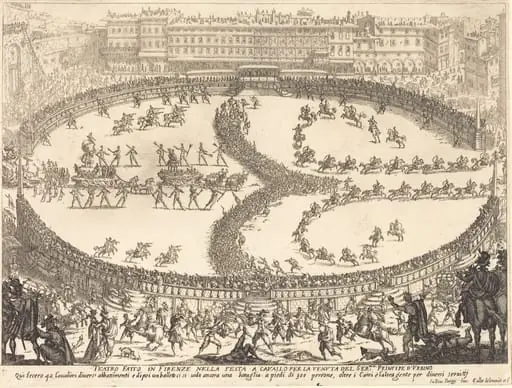
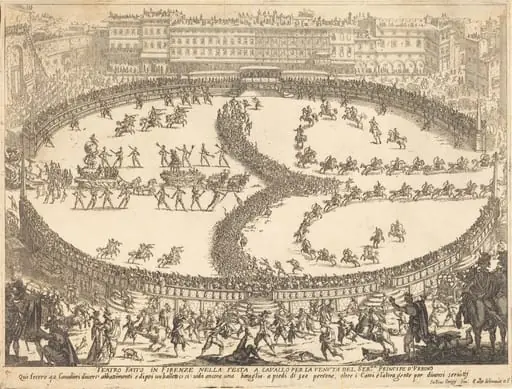
The scene portrays a chaotic infantry engagement within an enclosed urban space, likely a public square or arena. Figures are locked in close combat, some fallen, others raising weapons, while spectators line the periphery. The composition avoids glorification, instead emphasizing the confusion and brutality of ground-level warfare. Callot’s focus on ordinary soldiers rather than commanders suggests a documentary impulse, aligning with his broader interest in the human cost of conflict.
Technique & Style
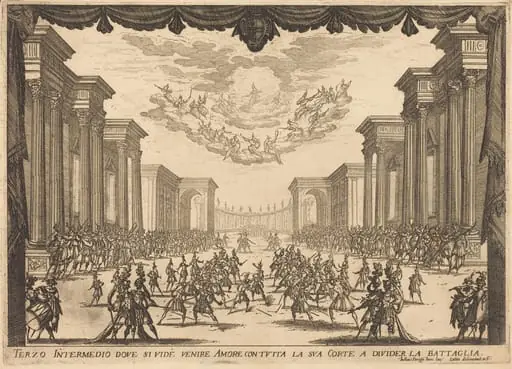
Callot employed fine-line etching to achieve exceptional detail, using a needle to incise the copper plate with remarkable control. The dense clustering of figures and architectural elements is rendered through layered hatching and cross-contour lines, creating texture and spatial recession. The absence of color heightens the starkness of the scene, while the intricate background—buildings, banners, distant figures—demonstrates his skill in compressing depth into a small format without sacrificing clarity.
History & Provenance
The print was produced during Callot’s early career in Florence, where he was influenced by Italian artistic traditions and the frequent military campaigns of the period. It formed part of a series documenting the Thirty Years’ War’s impact on civilian and soldier alike. Though originally circulated as individual sheets, many were later bound into albums, preserving them in private and institutional collections across Europe.
Context
Produced during the early stages of the Thirty Years’ War, the work reflects the widespread presence of mercenary armies in Central Europe and the disruption of civilian life. Callot, though from Lorraine—a contested region—avoided overt political messaging, instead offering observational records of troop behavior. His prints were widely disseminated, reaching audiences beyond military circles and contributing to public awareness of war’s daily realities.
Legacy
Callot’s detailed, unidealized depictions of war influenced later generations of printmakers, including Goya, who adopted similar thematic concerns. His technical innovations in etching—such as improved acid-resist methods—expanded the medium’s expressive range. *One of the Infantry Combats* remains a key example of how printmaking could serve as both art and historical testimony, bridging observation and artistic form in early modern Europe.
Artist & collection
Artist
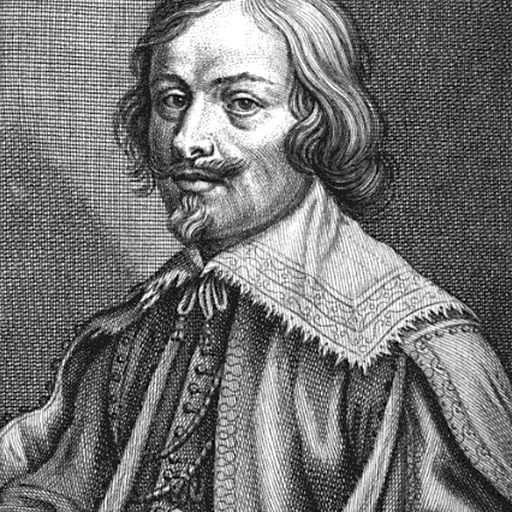
Jacques Callot was a baroque printmaker and draftsman from the Duchy of Lorraine.

 Holy Family at supper
 Restoration of the Aqueduct at Pisa
 Restoration of the Aqueduct at Pisa
 Square in Paris with Many Figures
 Square in Paris with Many Figures
 Horsemen Attacked by Robbers
 HOW WILL A COVERED PART BE CORRECTED?HOW WIKA A COVERED HEART DEED CORRECTED?
![Christ Walking on the Water [second plate], by Jacques Callot](https://artifactworldgallery.com/img/jacques-callot--christ-walking-on-the-water-second-plate--2069f3bfe4cb2126-w320.webp) Christ Walking on the Water [second plate]
Christ Walking on the Water [second plate]
![Monstra della Giostra [A Tournament in the Cortile Belvedere], by Monogrammist HCB](https://artifactworldgallery.com/img/monogrammist-hcb--monstra-della-giostra-a-tournament-in-the-cortile-belvedere--80edf45a76d301fc-w320.webp)