Artwork
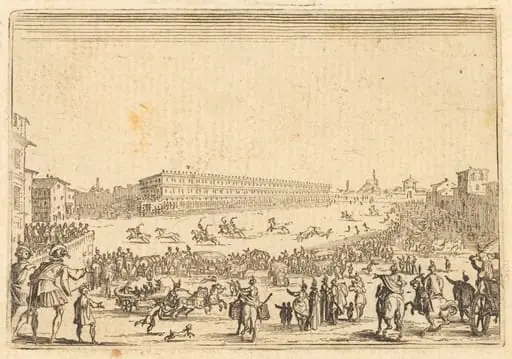
Parade in the Amphitheater
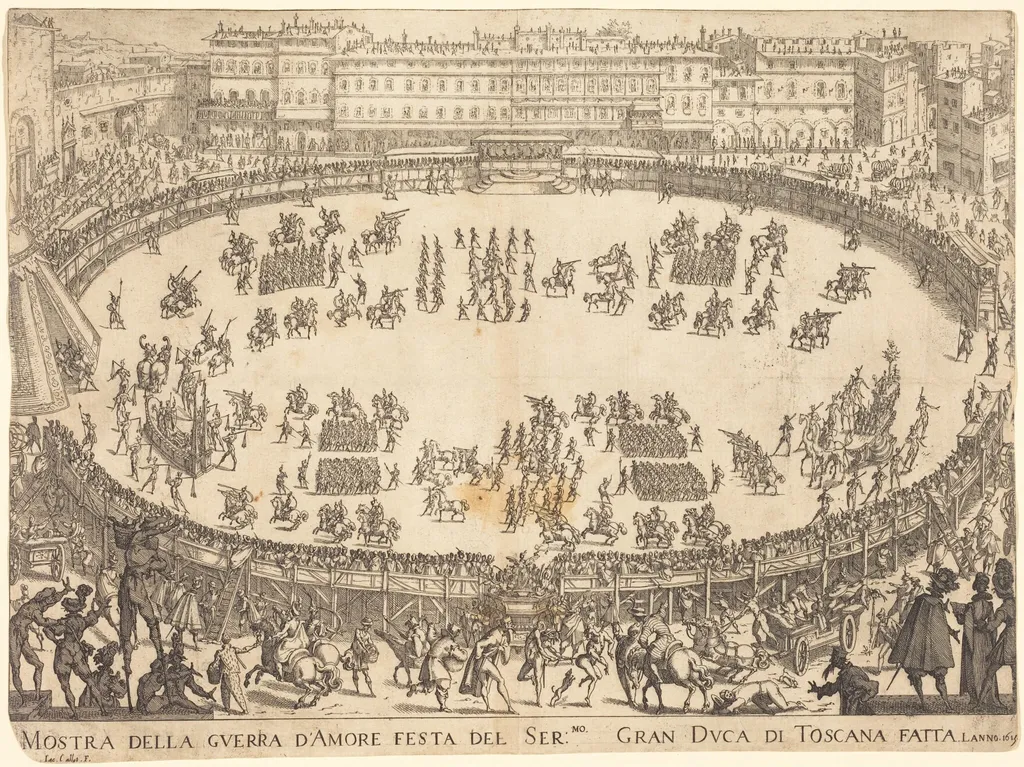
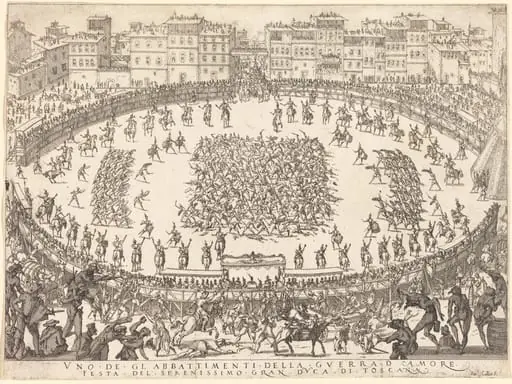
Parade in the Amphitheater is an ink print by the Baroque artist Jacques Callot. It dates from 1616 and is held in the collection of the National Gallery of Art.
About this work
Overview
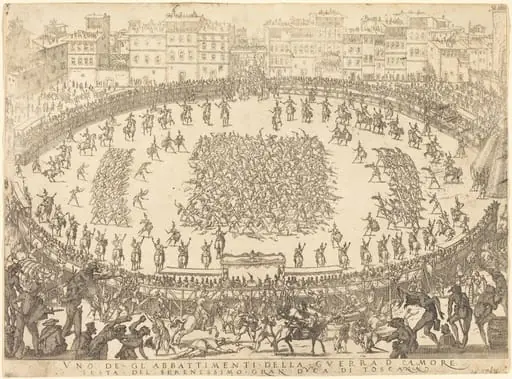
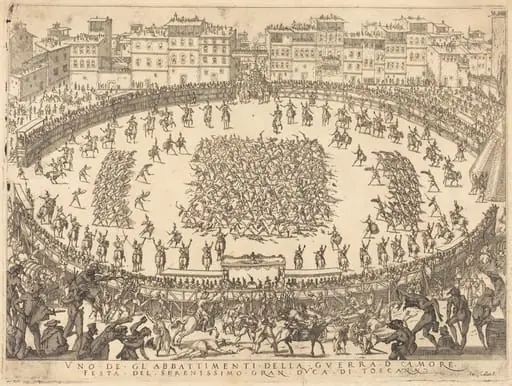
Created in 1616 by Jacques Callot, *Parade in the Amphitheater* is an etching on laid paper that captures a lively, staged public spectacle.
Created in 1616 by Jacques Callot, *Parade in the Amphitheater* is an etching on laid paper that captures a lively, staged public spectacle. As one of over 1,400 prints by the Lorrainer artist, this work exemplifies his focus on documenting contemporary events with precision. The scene unfolds within a vast oval arena, teeming with figures and architectural detail, reflecting Callot’s interest in the visual complexity of social gatherings.
Subject & Meaning
The scene, labeled 'Mostra della Guerra d’Amore'—'Show of the War of Love'—suggests a theatrical or ceremonial event rather than a military engagement. Soldiers, floats, and onlookers populate the space, implying a symbolic or allegorical performance, possibly tied to courtly entertainment. The title hints at romantic or chivalric themes, framing conflict as spectacle, a common trope in early 17th-century festivities.
Technique & Style
Callot employed fine-line etching to render dense crowds and intricate architecture with remarkable clarity. His use of layered lines and controlled cross-hatching created depth and texture, allowing individual figures and structures to remain legible even in crowded compositions. The precision of his technique enabled him to capture movement and hierarchy within the scene, distinguishing his work from coarser contemporary prints.
History & Provenance
The print was produced during Callot’s early career, likely in Florence, where he worked for the Medici court. Though no specific commission is documented, its Italian title and subject suggest it was made for a local audience familiar with ceremonial pageantry. The work entered broader European collections through the circulation of prints, becoming part of the growing market for illustrated narratives in the Baroque period.
Context
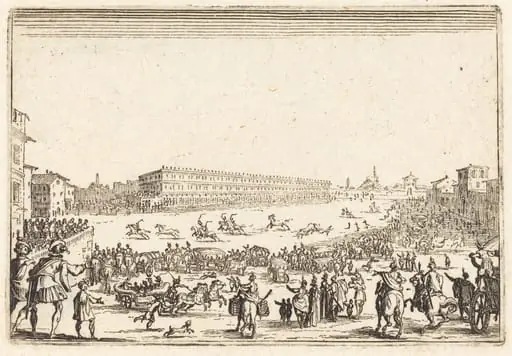
In early 17th-century Italy, elaborate public displays blending military display with allegory were common at royal courts. Callot’s print aligns with this tradition, reflecting the fusion of theater, politics, and spectacle. His attention to costume, architecture, and crowd dynamics mirrors the visual culture of festivals and tournaments, where social order was both performed and observed.
Legacy
Callot’s technical innovations in etching influenced generations of printmakers, particularly in the depiction of complex scenes. *Parade in the Amphitheater* stands as an early example of his ability to transform everyday spectacle into detailed visual narratives. While not widely exhibited today, it remains a key reference in studies of Baroque printmaking and the documentation of public life.
Artist & collection
Artist
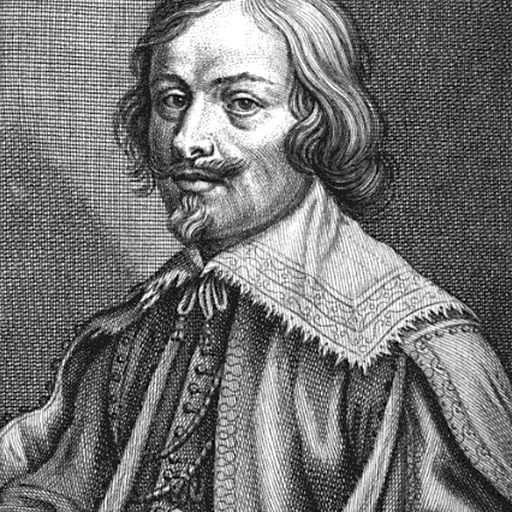
Jacques Callot was a baroque printmaker and draftsman from the Duchy of Lorraine.

 Holy Family at supper
 Restoration of the Aqueduct at Pisa
 Restoration of the Aqueduct at Pisa
 Square in Paris with Many Figures
 Square in Paris with Many Figures
 Horsemen Attacked by Robbers
 HOW WILL A COVERED PART BE CORRECTED?HOW WIKA A COVERED HEART DEED CORRECTED?
![Christ Walking on the Water [second plate], by Jacques Callot](https://artifactworldgallery.com/img/jacques-callot--christ-walking-on-the-water-second-plate--2069f3bfe4cb2126-w320.webp) Christ Walking on the Water [second plate]
Christ Walking on the Water [second plate]
![Monstra della Giostra [A Tournament in the Cortile Belvedere], by Monogrammist HCB](https://artifactworldgallery.com/img/monogrammist-hcb--monstra-della-giostra-a-tournament-in-the-cortile-belvedere--80edf45a76d301fc-w320.webp)