Artwork
Parade in the Amphitheater
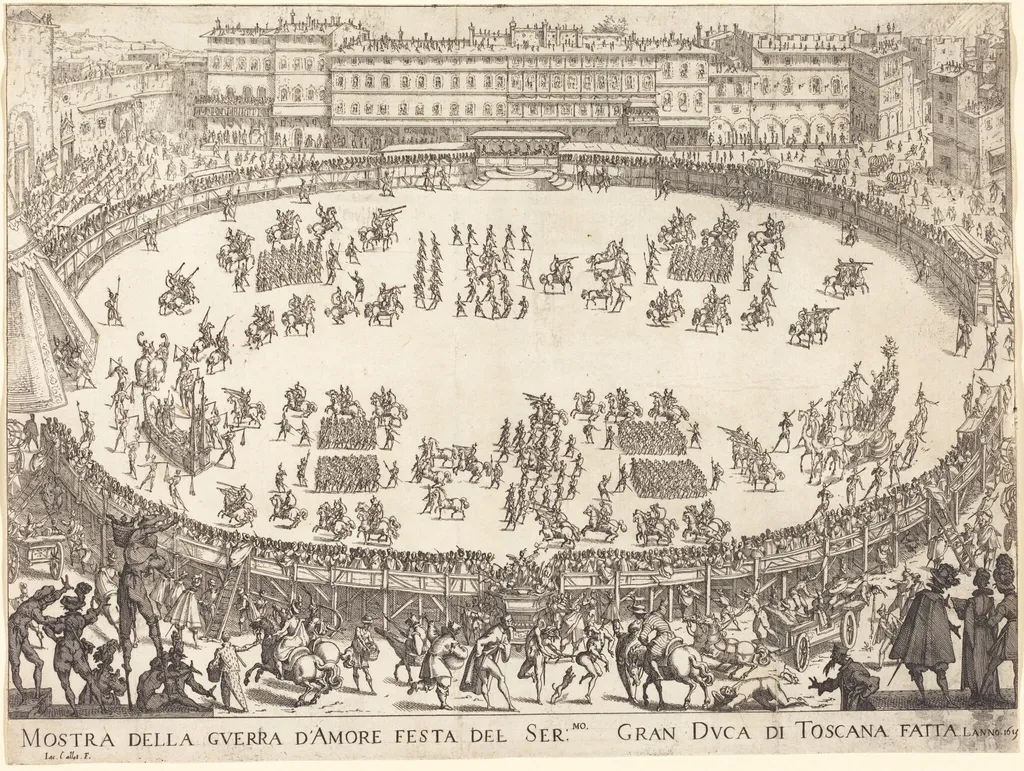
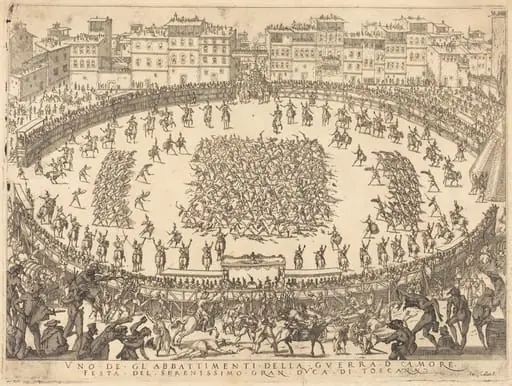
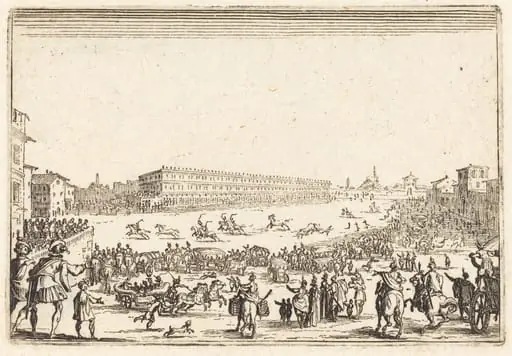
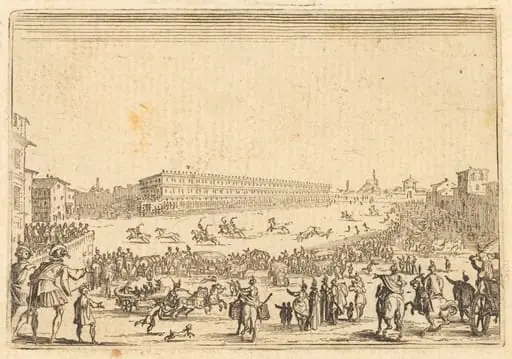
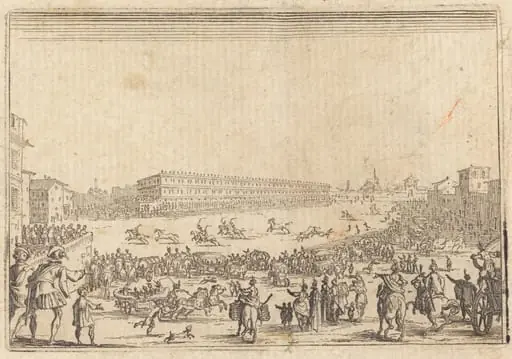
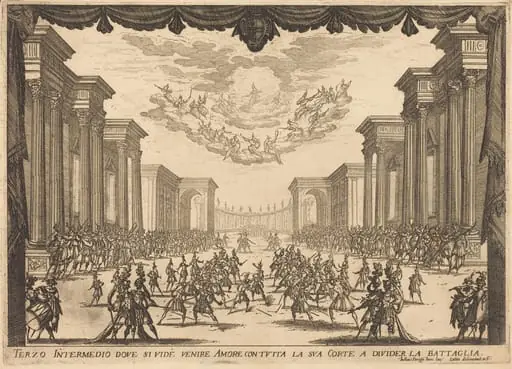
Parade in the Amphitheater is an ink print by the Baroque artist Jacques Callot. It dates from 1616 and is held in the collection of the National Gallery of Art.
About this work
Overview
Jacques Callot produced this etching in 1616, capturing a lively public spectacle within a grand amphitheater.
Jacques Callot produced this etching in 1616, capturing a lively public spectacle within a grand amphitheater. As a prolific printmaker from Lorraine, he specialized in detailed scenes of daily and ceremonial life. This work is one of over 1,400 etchings he created, all rendered in ink on laid paper. The composition presents a crowded, dynamic event, likely a military display or festive performance, rendered with meticulous line work characteristic of his technique.
Subject & Meaning
The scene depicts soldiers on horseback and foot engaged in coordinated maneuvers, combat drills, or a staged performance within a tiered arena. Above, spectators occupy balconies and seating, suggesting a formal occasion—perhaps a celebration of military prowess or a courtly entertainment. The absence of overt narrative markers leaves the event’s exact purpose ambiguous, but its scale and organization imply official patronage and public spectacle.
Technique & Style
Callot employed fine, controlled etching lines to build dense textures and spatial depth. The precision of his tool allowed him to render individual figures, armor, and architectural details with clarity despite the crowded composition. The use of cross-hatching and delicate stippling creates contrast and volume without wash or tone, relying entirely on ink lines pressed into paper. The result is a lively, almost kinetic energy, achieved through meticulous draftsmanship.
History & Provenance
Created during Callot’s early career in Florence, this print reflects his exposure to Italian court culture and military pageantry. It was likely part of a series documenting contemporary events, circulated among collectors and patrons. No specific early ownership records are documented, but its survival in multiple institutional collections suggests it was widely appreciated for its technical skill and observational detail.
Context
In early 17th-century Europe, military displays often blended training with public spectacle, especially under princely courts. Callot’s work aligns with a broader trend of printmakers documenting such events as both record and entertainment. His focus on crowds, architecture, and movement reflects an interest in social order and spectacle, mirroring the era’s fascination with organized spectacle and the visibility of power.
Legacy
Callot’s technical innovations in etching influenced generations of printmakers, particularly in his ability to render complex scenes with fine detail. 'Parade in the Amphitheater' exemplifies his role as a visual chronicler of early modern life. While not widely exhibited as a standalone work today, it remains a key example of how printmaking served as a medium for observing and disseminating contemporary events before photography.
Artist & collection
Artist
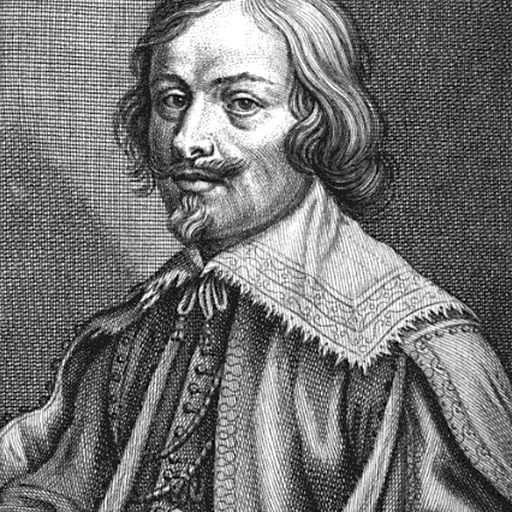
Jacques Callot was a baroque printmaker and draftsman from the Duchy of Lorraine.

 Holy Family at supper
 Restoration of the Aqueduct at Pisa
 Restoration of the Aqueduct at Pisa
 Square in Paris with Many Figures
 Square in Paris with Many Figures
 Horsemen Attacked by Robbers
 HOW WILL A COVERED PART BE CORRECTED?HOW WIKA A COVERED HEART DEED CORRECTED?
![Christ Walking on the Water [second plate], by Jacques Callot](https://artifactworldgallery.com/img/jacques-callot--christ-walking-on-the-water-second-plate--2069f3bfe4cb2126-w320.webp) Christ Walking on the Water [second plate]
Christ Walking on the Water [second plate]
![Monstra della Giostra [A Tournament in the Cortile Belvedere], by Monogrammist HCB](https://artifactworldgallery.com/img/monogrammist-hcb--monstra-della-giostra-a-tournament-in-the-cortile-belvedere--80edf45a76d301fc-w320.webp)