Artwork
Peasant with a Cup
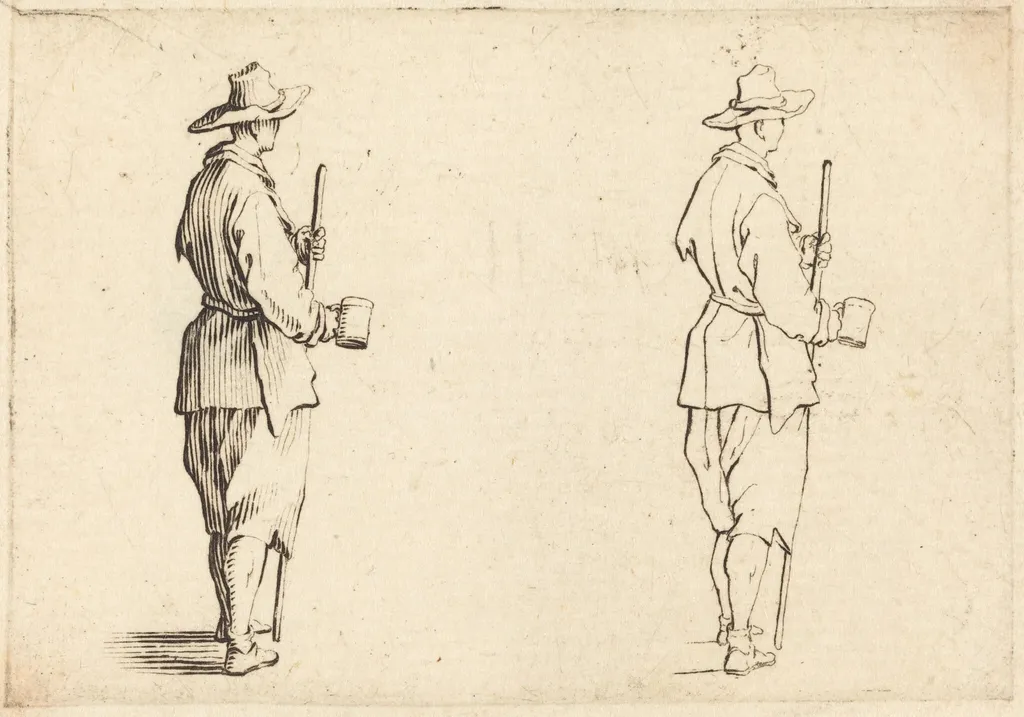
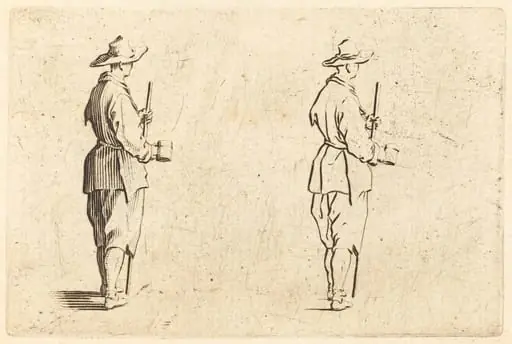
Peasant with a Cup is an ink print by the Baroque artist Jacques Callot. It dates from 1617 and is held in the collection of the National Gallery of Art.
About this work
Overview
It belongs to a series documenting everyday life in early 17th-century Lorraine, focusing on rural laborers and common figures often overlooked in art.
Created around 1617 by Jacques Callot, *Peasant with a Cup* is a small etching on laid paper, one of more than 1,400 prints he produced in his career. It belongs to a series documenting everyday life in early 17th-century Lorraine, focusing on rural laborers and common figures often overlooked in art. The work exemplifies Callot’s dedication to capturing the textures and rhythms of ordinary existence through the medium of etching.
Subject & Meaning
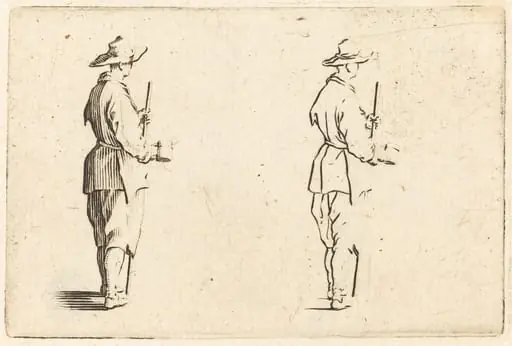
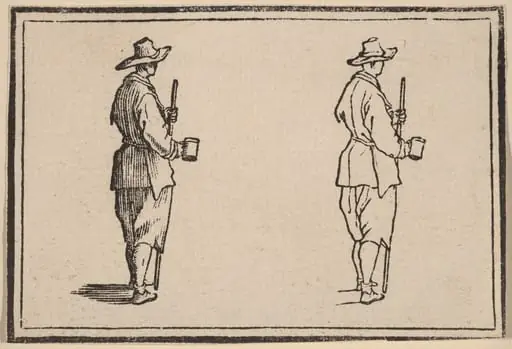
Two peasants stand side by side, their backs turned, each holding a cup and a staff. Their simple clothing—wide hats, loose shirts, and baggy trousers—suggests modest rural livelihoods. The posture and objects imply a moment of pause, perhaps after labor or during a break. Callot avoids idealization, presenting them with quiet dignity, reflecting his interest in the lives of the working class without overt narrative or moralizing.
Technique & Style
Callot employed fine, incised lines to create the etching, allowing ink to settle into the plate’s grooves and produce sharp, dynamic strokes. The lines are loose and energetic, giving the figures a sense of motion despite their stillness. The rough, sketch-like quality enhances the immediacy of the scene, a hallmark of Callot’s approach: precision paired with spontaneity, capturing form through minimal yet deliberate marks.
History & Provenance
The print emerged during Callot’s early period in Nancy, before his move to Florence and later Paris. It was likely made for private collectors or as part of a thematic set, common among printmakers of the time. While its exact early ownership is undocumented, it survives in multiple institutional collections, testament to its enduring value as a representative example of Baroque printmaking.
Context
In early 1600s Europe, etching became a favored medium for artists seeking to explore secular subjects beyond religious or mythological themes. Callot’s focus on peasants aligned with broader regional interests in documenting social life, particularly in the contested territories of Lorraine. His prints circulated widely, influencing how everyday people were visually recorded in an age before photography.
Legacy
Callot’s etchings, including this small work, helped elevate printmaking from reproductive craft to a respected artistic discipline. His ability to convey character and movement with minimal lines inspired later artists in France and the Netherlands. *Peasant with a Cup* remains a quiet but significant record of how ordinary lives were observed and preserved in the visual culture of the Baroque era.
Artist & collection

Artist
Jacques Callot was a baroque printmaker and draftsman from the Duchy of Lorraine.

 Holy Family at supper
 Restoration of the Aqueduct at Pisa
 Restoration of the Aqueduct at Pisa
 Square in Paris with Many Figures
 Square in Paris with Many Figures
 Horsemen Attacked by Robbers
 HOW WILL A COVERED PART BE CORRECTED?HOW WIKA A COVERED HEART DEED CORRECTED?
![Christ Walking on the Water [second plate], by Jacques Callot](https://artifactworldgallery.com/img/jacques-callot--christ-walking-on-the-water-second-plate--2069f3bfe4cb2126-w320.webp) Christ Walking on the Water [second plate]
Christ Walking on the Water [second plate]