Artwork
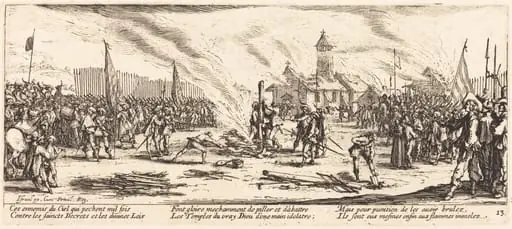
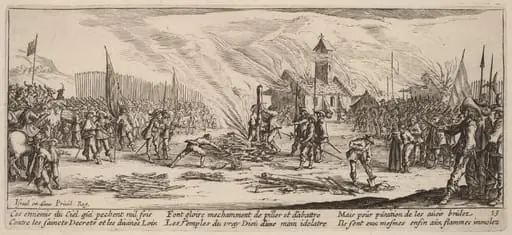
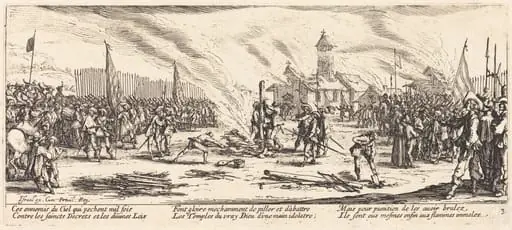
Plundering and Burning a Village
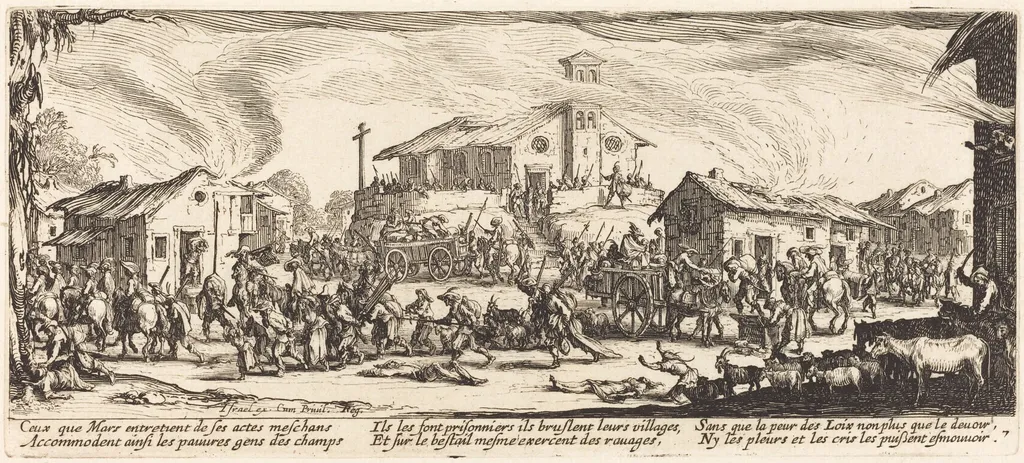
Plundering and Burning a Village is an ink print by the Baroque artist Jacques Callot. It dates from 1633 and is held in the collection of the National Gallery of Art.
About this work
Overview
As part of a larger series on war’s brutality, the work reflects Callot’s focus on military violence during the Thirty Years’ War.
Created around 1633 by Jacques Callot, this etching on laid paper captures the devastation of a village under attack. As part of a larger series on war’s brutality, the work reflects Callot’s focus on military violence during the Thirty Years’ War. His technical precision and attention to narrative detail distinguish it within early 17th-century printmaking, offering a sober record of civilian suffering rather than heroic glorification.
Subject & Meaning
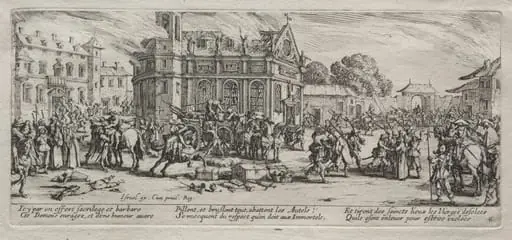
The scene portrays soldiers looting and setting fire to a rural settlement, with civilians fleeing, dying, or hiding in terror. Dead animals, overturned wagons, and smoke-filled skies amplify the chaos. The inclusion of French text beneath underscores the moral condemnation of wartime atrocities. Callot presents no heroes or victories—only the indiscriminate destruction inflicted on non-combatants, emphasizing the human cost of conflict.
Technique & Style
Callot employed fine-line etching to render intricate detail across a densely populated composition. His use of sharp, controlled incisions captures textures—from fabric to smoke—and individual expressions on dozens of figures, even in distant corners. The layered depth of the landscape and the controlled contrast between light and shadow demonstrate mastery of the medium, allowing narrative clarity amid apparent disorder.
History & Provenance
The print was produced during Callot’s time in Florence, where he worked for the Medici court. It likely circulated among educated European audiences as part of a broader series on war, possibly commissioned or inspired by firsthand reports of troop movements in the Rhineland. Its survival in multiple institutional collections suggests early recognition of its documentary value and technical achievement.
Context
Made during the height of the Thirty Years’ War, the image reflects widespread devastation across Central Europe. Callot, from the contested region of Lorraine, witnessed the movement of mercenary armies and their impact on civilian populations. His prints served as visual testimony, countering official narratives of glory with unflinching depictions of suffering, aligning with emerging humanist critiques of war.
Legacy
Callot’s etching influenced later artists, including Goya, who adopted similar themes of war’s horror. The work’s detailed realism and moral tone helped establish printmaking as a vehicle for social critique. Its enduring presence in museum collections underscores its role as a foundational image in the visual history of conflict, valued for its historical witness rather than aesthetic ornamentation.
Artist & collection

Artist
Jacques Callot was a baroque printmaker and draftsman from the Duchy of Lorraine.

 Holy Family at supper
 Restoration of the Aqueduct at Pisa
 Restoration of the Aqueduct at Pisa
 Square in Paris with Many Figures
 Square in Paris with Many Figures
 Horsemen Attacked by Robbers
 HOW WILL A COVERED PART BE CORRECTED?HOW WIKA A COVERED HEART DEED CORRECTED?
![Christ Walking on the Water [second plate], by Jacques Callot](https://artifactworldgallery.com/img/jacques-callot--christ-walking-on-the-water-second-plate--2069f3bfe4cb2126-w320.webp) Christ Walking on the Water [second plate]
Christ Walking on the Water [second plate]