Artwork
St. Albert of Sicliy, Carmelite; St. Martinus;St. Demetrius and Companions; St. Lawrence
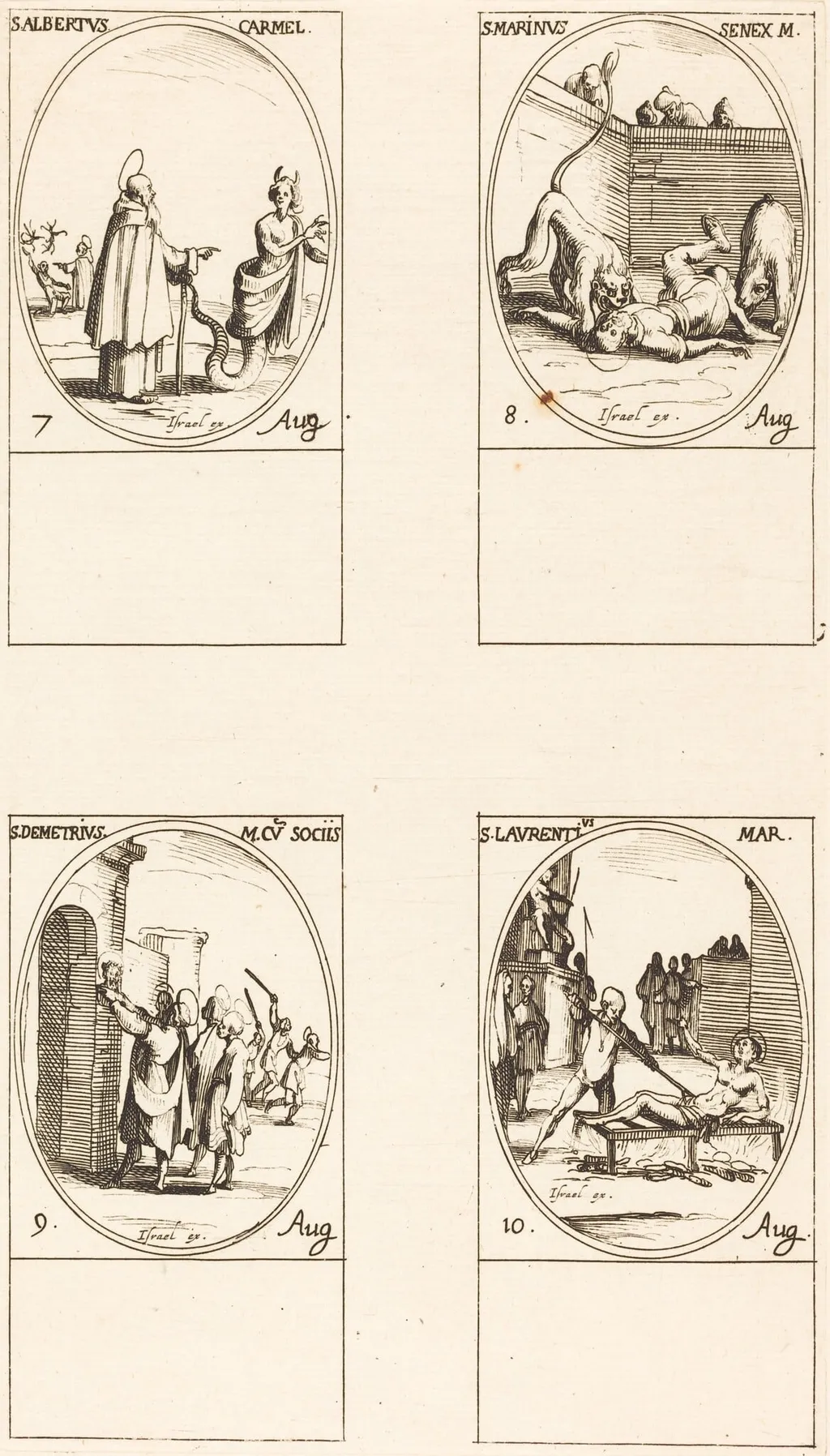
St. Albert of Sicliy, Carmelite; St. Martinus;St. Demetrius and Companions; St. Lawrence is an ink print by the Baroque artist Jacques Callot. It dates from 1634 and is held in the collection of the National Gallery of Art.
About this work
Overview
Created around 1634, this etching on laid paper presents four distinct oval scenes, each illustrating a different saint: Albert of Sicily, a Carmelite; Martinus; Demetrius with his companions; and Lawrence. The composition unites the figures within a single sheet, reflecting the artist’s systematic approach to religious narrative while maintaining the precise line work typical of early‑17th‑century French printmaking.
Subject & Meaning
Together they convey themes of sacrifice, steadfast faith, and the triumph of spiritual conviction over violence.
Each oval vignette portrays a moment from the martyrdom or legend of its saint. Albert stands beside a woman entwined with a serpent, suggesting a symbolic battle with evil; Martinus appears in a contemplative pose; Demetrius is shown amid a group confronting a sword‑wielding assailant; Lawrence lies mortally wounded by a sword. Together they convey themes of sacrifice, steadfast faith, and the triumph of spiritual conviction over violence.
Technique & Style
The work exemplifies Jacques Callot’s meticulous etching method, employing fine, bold lines and nuanced shading to render intricate details in both figures and landscape backgrounds. Laid paper provides a textured surface that accentuates the depth of the incised lines. Callot’s characteristic attention to architectural and natural elements creates a richly layered setting that enhances the narrative without overwhelming the central saints.
History & Provenance
Attributed to the Lorraine‑born printmaker Jacques Callot, the piece belongs to his prolific output of over a thousand etchings produced for both secular and devotional markets. While the original collector’s record is unclear, the print has circulated among European collections since the 17th century, appearing in several catalogues of Baroque prints and serving as a reference for later artists studying complex multi‑scene compositions.
Context
During the early Baroque period, French artists like Callot responded to Counter‑Reformation demands for vivid, didactic religious imagery. This etching aligns with that climate, offering visual instruction on saintly virtues while also showcasing Callot’s capacity to merge narrative depth with technical virtuosity. Its format—four related yet independent scenes—mirrors contemporary devotional books that presented saints’ lives in sequential panels.
Artist & collection
Artist
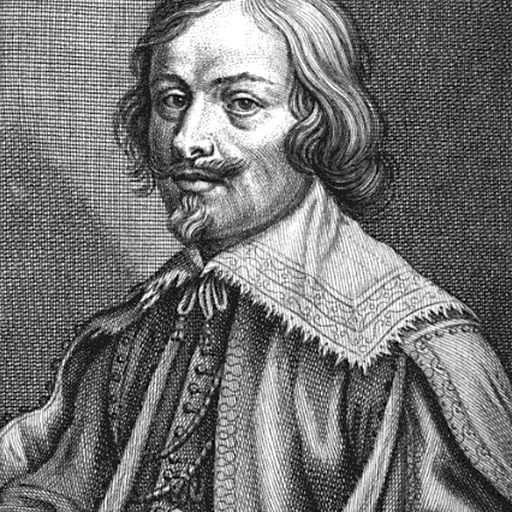
Jacques Callot was a baroque printmaker and draftsman from the Duchy of Lorraine.

 Holy Family at supper
 Restoration of the Aqueduct at Pisa
 Restoration of the Aqueduct at Pisa
 Square in Paris with Many Figures
 Square in Paris with Many Figures
 Horsemen Attacked by Robbers
 HOW WILL A COVERED PART BE CORRECTED?HOW WIKA A COVERED HEART DEED CORRECTED?
![Christ Walking on the Water [second plate], by Jacques Callot](https://artifactworldgallery.com/img/jacques-callot--christ-walking-on-the-water-second-plate--2069f3bfe4cb2126-w320.webp) Christ Walking on the Water [second plate]
Christ Walking on the Water [second plate]
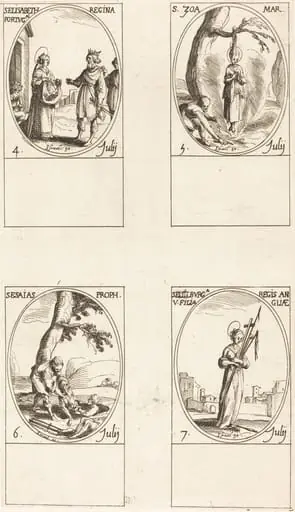 St. Elizabeth of Portugal; St. Zoe; St. Isaiah, Prophet; St. Edelburge
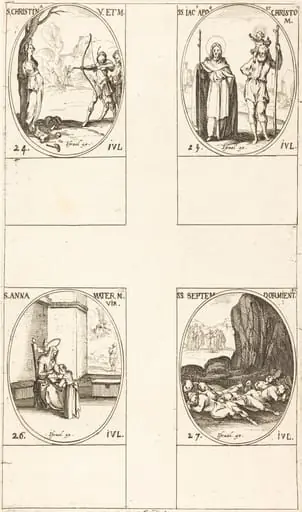 St. Christina; St. James, Apostle, and St. Christopher; St. Anne; Seven Sleepers of Ephesus
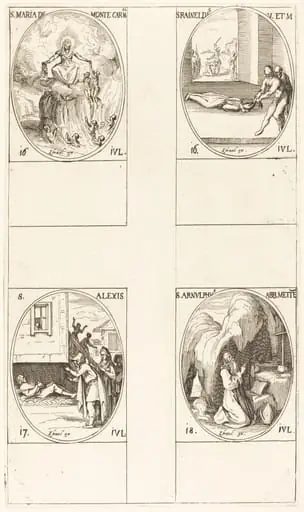 St. Mary of Mont Carmel; St. Raineldis; St. Alexis; St. Arnold of Metz
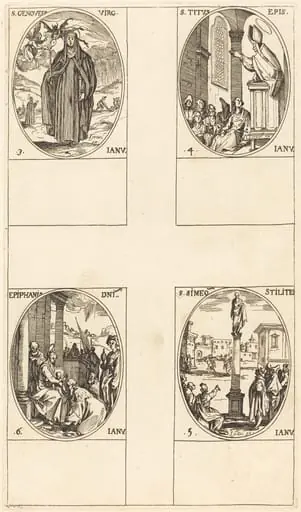 St. Genevieve; St. Titus; St. Simeon Stylites; Epiphany
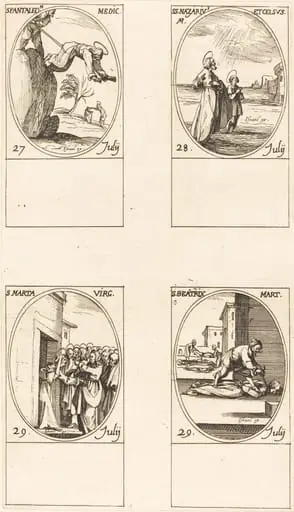 St. Pantaleon; Sts. Nazarius and Celsus; St. Martha; St. Beatrice
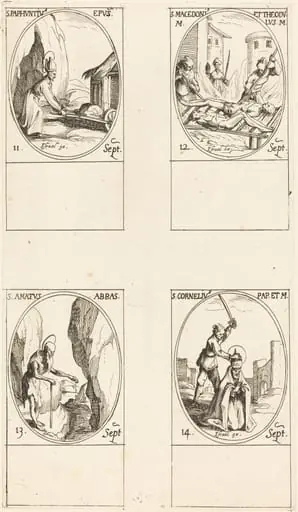 St. Paphnutius; Sts. Macedonius and Theodulus; St. Amatus; St. Cornelias
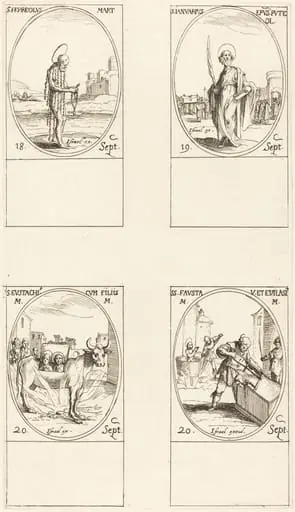 St. Ferreolus; St. Januarius; St. Eustachius & his Children; Sts. Fausta & Evelasius
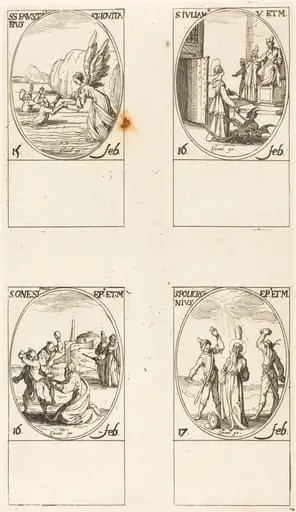 Sts. Faustinus and Jovita; St. Juliana; St. Onesimus; St. Policronius