Artwork
Stag in the Water
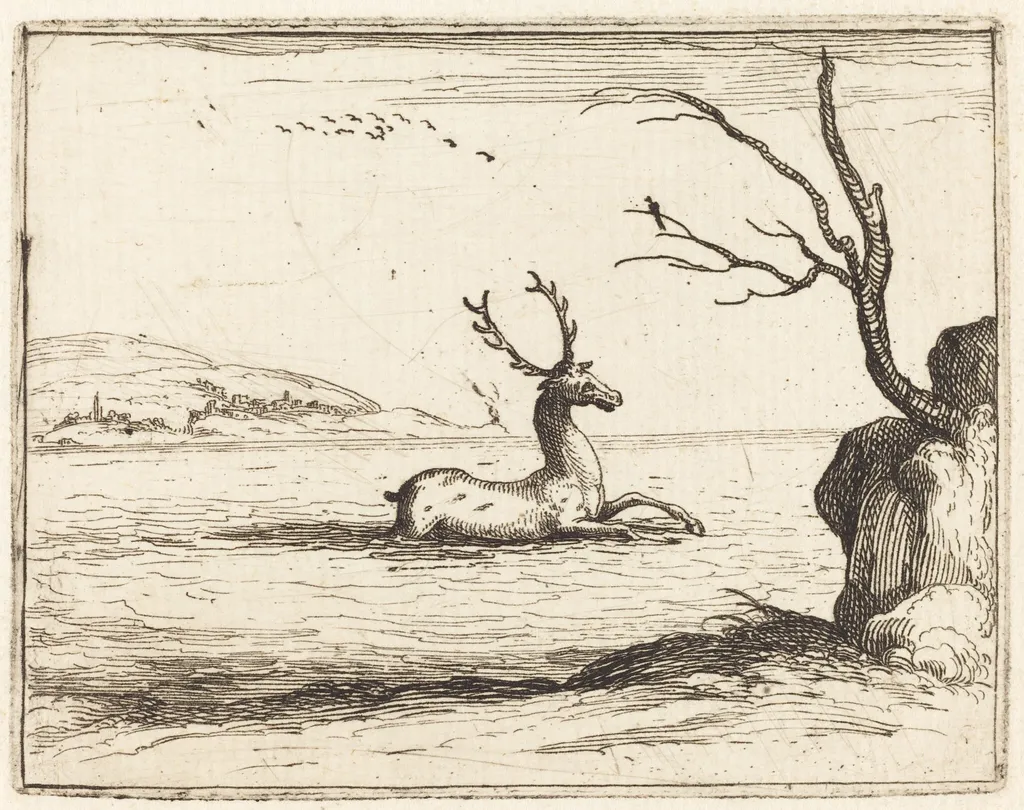
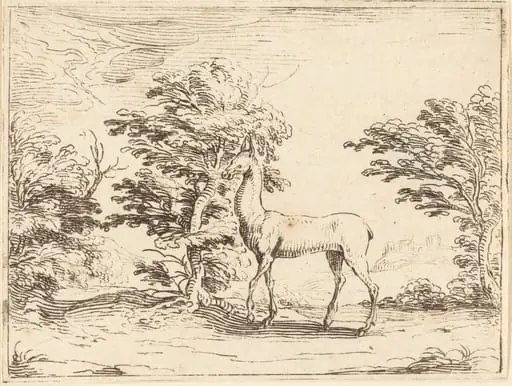
Stag in the Water is an ink print by the Baroque artist Jacques Callot. It dates from 1628 and is held in the collection of the National Gallery of Art.
About this work
Overview
Created in 1628, Jacques Callot’s *Stag in the Water* is an etching on laid paper that exemplifies his mastery of fine-line technique.
Created in 1628, Jacques Callot’s *Stag in the Water* is an etching on laid paper that exemplifies his mastery of fine-line technique. As one of over 1,400 prints produced by the Lorrainer artist, this work reflects his interest in natural subjects alongside his more commonly documented human scenes. The composition captures a solitary stag in a tranquil aquatic setting, rendered with precision and quiet observation.
Subject & Meaning
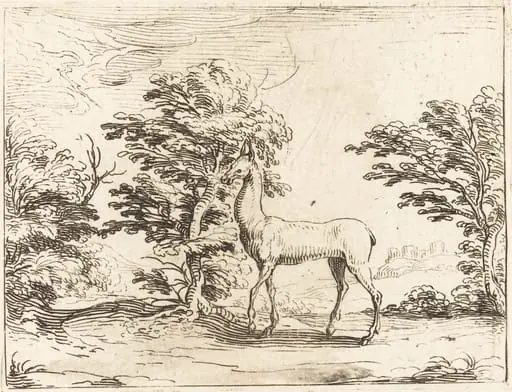
The stag, standing motionless in shallow water, is depicted with anatomical accuracy and calm presence. Its raised antlers and directed gaze suggest alertness rather than flight. The surrounding landscape—distant hills, a clustered settlement, and airborne birds—extends the scene beyond the animal, implying a harmonious coexistence between wildlife and human habitation. No overt symbolism is evident; the image prioritizes quiet observation over narrative.
Technique & Style
Callot employed fine, controlled etching lines to model form and texture, using varying densities to create tonal gradations. The stag’s dark silhouette contrasts deliberately with the lighter washes of water and sky, enhancing spatial depth. Delicate cross-hatching defines fur and foliage, while the distant town is suggested with minimal strokes. The technique aligns with Baroque sensitivity to light and detail, yet avoids theatricality in favor of restrained realism.
History & Provenance
The print was made during Callot’s mature period, after his return to Nancy from Florence and Rome, where he absorbed Italian compositional influences. Though specific early ownership records are sparse, the work entered major collections in the 18th and 19th centuries, often grouped with his landscape and animal studies. Its survival in multiple impressions suggests it was circulated among collectors interested in naturalistic printmaking.
Context
In early 17th-century Europe, printmaking increasingly turned to nature as a subject beyond religious or mythological themes. Callot’s focus on wildlife, alongside his depictions of soldiers and peasants, reflects a broader shift toward secular observation. This print aligns with growing scientific curiosity about the natural world, even as it retains the aesthetic discipline of Baroque draftsmanship.
Legacy
Callot’s *Stag in the Water* contributed to the elevation of animal subjects in printmaking, influencing later artists who sought to depict nature with precision rather than allegory. While not widely reproduced in popular culture, it remains a reference in academic studies of Baroque print technique and the evolution of natural history imagery in early modern Europe.
Own this work as a print
Artist & collection

Artist
Jacques Callot was a baroque printmaker and draftsman from the Duchy of Lorraine.

 Holy Family at supper
 Restoration of the Aqueduct at Pisa
 Restoration of the Aqueduct at Pisa
 Square in Paris with Many Figures
 Square in Paris with Many Figures
 Horsemen Attacked by Robbers
 HOW WILL A COVERED PART BE CORRECTED?HOW WIKA A COVERED HEART DEED CORRECTED?
![Christ Walking on the Water [second plate], by Jacques Callot](https://artifactworldgallery.com/img/jacques-callot--christ-walking-on-the-water-second-plate--2069f3bfe4cb2126-w320.webp) Christ Walking on the Water [second plate]
Christ Walking on the Water [second plate]