Artwork
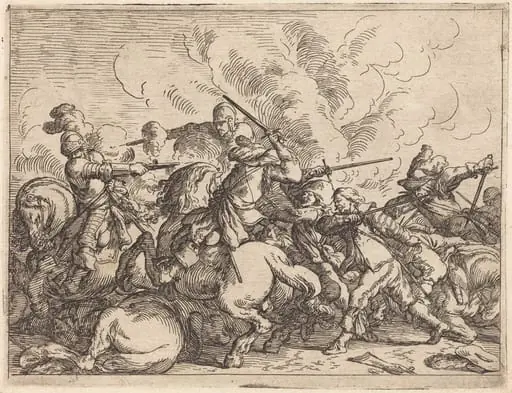
The Cavalry Combat with Swords
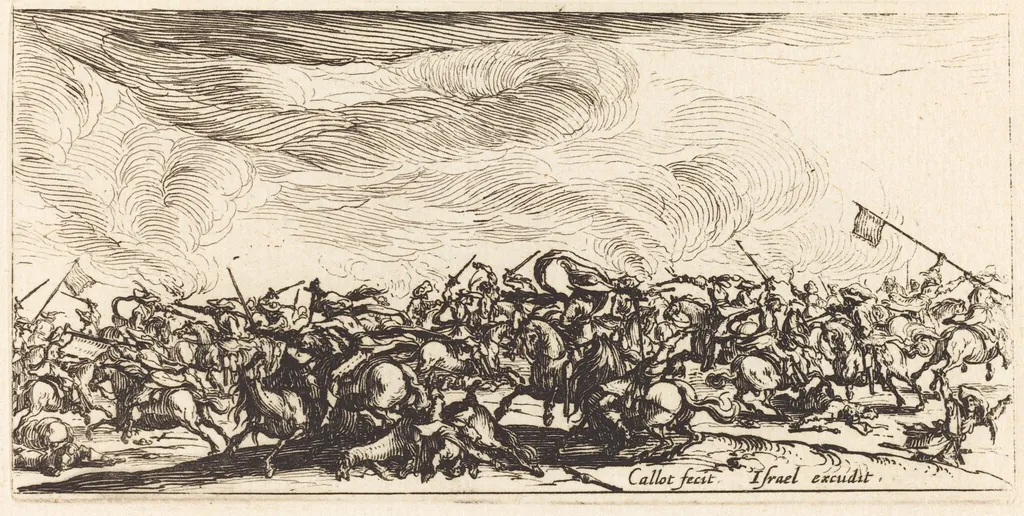
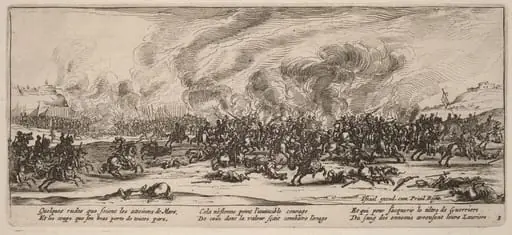
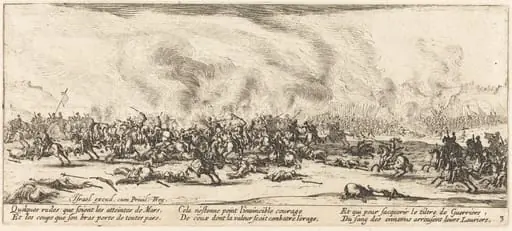
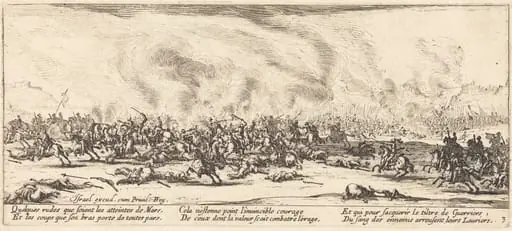
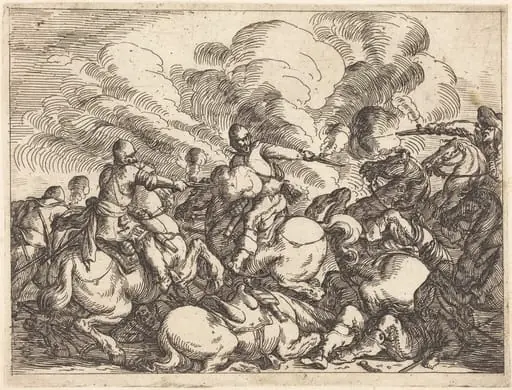
The Cavalry Combat with Swords is an ink print by the Baroque artist Jacques Callot. It dates from 1633 and is held in the collection of the National Gallery of Art.
About this work
Overview
This work exemplifies his focus on battlefield dynamics, rendered through intricate line work and tonal contrasts characteristic of his etching technique.
Created around 1633, *The Cavalry Combat with Swords* is an etching on laid paper by Jacques Callot, a French artist from the Duchy of Lorraine. Known for his prolific output of over 1,400 prints, Callot specialized in scenes of military life, capturing the turbulence of early modern warfare with precision. This work exemplifies his focus on battlefield dynamics, rendered through intricate line work and tonal contrasts characteristic of his etching technique.
Subject & Meaning
The print portrays a frenetic engagement between mounted soldiers wielding swords, reflecting the chaos of cavalry skirmishes common in the Thirty Years' War. Rather than glorifying combat, Callot presents it as a disordered, visceral event. The absence of clear heroes or narrative resolution underscores the brutality and confusion of war, aligning with his broader interest in documenting military reality without romanticization.
Technique & Style
Callot employed etching with drypoint to achieve sharp, angular lines and rich, dark shadows. The ink pools in recessed areas, enhancing depth and texture, particularly in armor and horse musculature. His dense, energetic linework conveys motion and tension, while the background landscape is rendered with meticulous detail, grounding the violence in a recognizable terrain. The technique allows for both precision and expressive spontaneity.
History & Provenance
The print was produced during Callot’s mature period, when he was widely recognized for his military scenes. It likely circulated among collectors and military observers in 17th-century Europe. The work is now held in the collection of the National Gallery of Art in Washington, D.C., where it remains part of a significant group of Callot’s prints documenting the era’s armed conflicts.
Context
Callot created this work amid the devastation of the Thirty Years' War, a conflict that ravaged Central Europe and deeply affected his native Lorraine. Having witnessed troop movements and siege conditions firsthand, he documented soldiers not as idealized figures but as individuals caught in systemic violence. His prints served as both records and critiques of the era’s militarization.
Legacy
Callot’s detailed depictions of warfare influenced later generations of printmakers and war artists. His technical innovations in etching, particularly the use of multiple biting and drypoint, expanded the medium’s capacity for realism. While not widely known to the public today, his works remain essential references for scholars studying early modern military culture and printmaking history.
Artist & collection

Artist
Jacques Callot was a baroque printmaker and draftsman from the Duchy of Lorraine.

 Holy Family at supper
 Restoration of the Aqueduct at Pisa
 Restoration of the Aqueduct at Pisa
 Square in Paris with Many Figures
 Square in Paris with Many Figures
 Horsemen Attacked by Robbers
 HOW WILL A COVERED PART BE CORRECTED?HOW WIKA A COVERED HEART DEED CORRECTED?
![Christ Walking on the Water [second plate], by Jacques Callot](https://artifactworldgallery.com/img/jacques-callot--christ-walking-on-the-water-second-plate--2069f3bfe4cb2126-w320.webp) Christ Walking on the Water [second plate]
Christ Walking on the Water [second plate]