Artwork
The Firing Squad
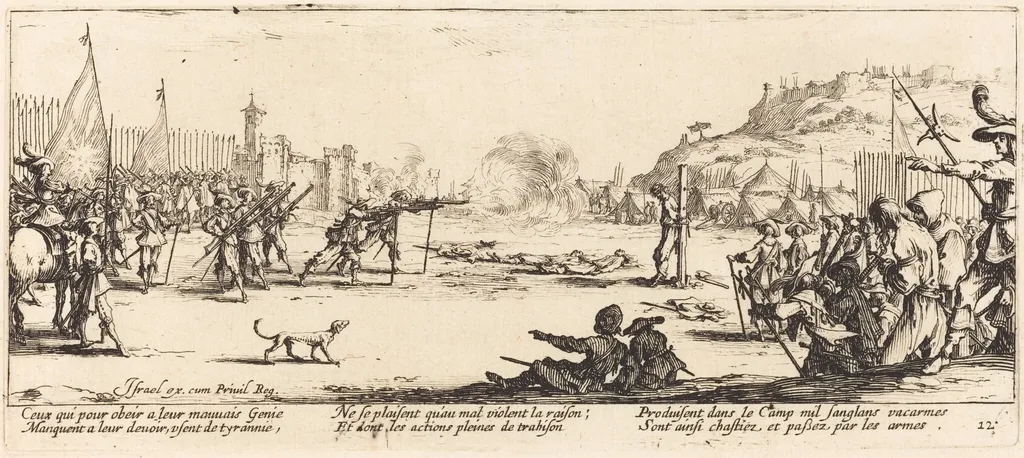
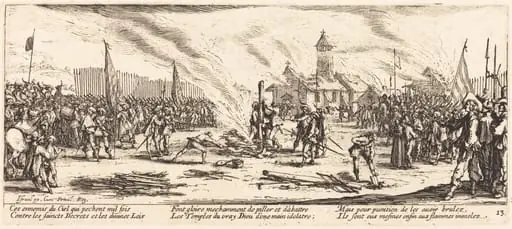
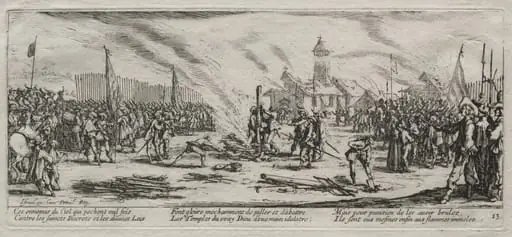
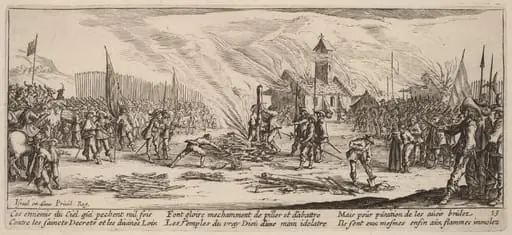
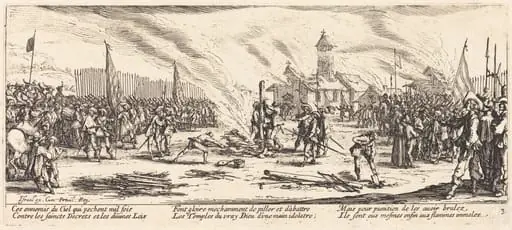
The Firing Squad is an ink print by the Baroque artist Jacques Callot. It dates from 1633 and is held in the collection of the National Gallery of Art.
About this work
Overview
It is one of more than 1,400 prints he produced during his career, reflecting his deep engagement with the visual culture of early 17th-century Europe.
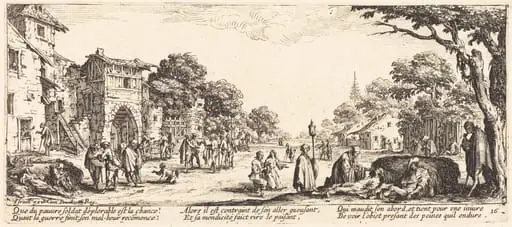
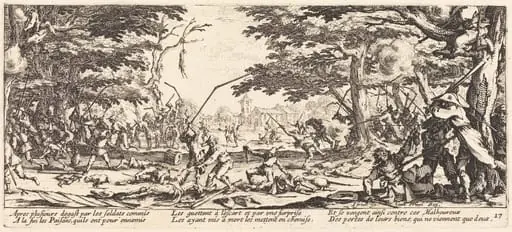
Created around 1633, *The Firing Squad* is an etching by Jacques Callot, a French artist from the Duchy of Lorraine. It is one of more than 1,400 prints he produced during his career, reflecting his deep engagement with the visual culture of early 17th-century Europe. The work belongs to a larger body of prints that record military and civic life with precision and emotional nuance, distinguishing Callot among his contemporaries for his technical mastery and observational depth.
Subject & Meaning
The scene depicts a line of soldiers preparing to execute a group of condemned individuals, their rifles leveled in unison. A small crowd gathers nearby, their postures suggesting unease or resignation. The moment captured is neither glorified nor sensationalized; instead, it presents an unflinching view of state-sanctioned violence. Callot’s focus on the quiet tension between perpetrator and witness underscores the gravity of the act, inviting contemplation rather than spectacle.
Technique & Style
Callot employed etching on laid paper, using fine, controlled lines to render texture, depth, and movement. His skill in managing multiple biting stages allowed for subtle tonal gradations, enhancing the realism of uniforms, faces, and landscape elements. The composition is tightly framed yet rich in detail—each figure is individually modeled, and the background recedes with atmospheric precision. This technique enabled him to achieve a documentary clarity rare in printmaking of the period.
History & Provenance
The print emerged during Callot’s mature period, when he was working in Florence and later Paris, producing series on war, justice, and peasant life. *The Firing Squad* likely circulated among collectors and military officials, serving both as artistic record and social commentary. While its early ownership is undocumented, it entered institutional collections in the 19th century, where it became part of broader studies of Baroque print culture and the representation of violence.
Context
Created during the Thirty Years’ War, the print reflects the widespread militarization and public executions that marked early 17th-century Europe. Callot, who witnessed troop movements and punitive actions firsthand, translated these realities into prints that reached a broad audience. Unlike idealized historical paintings, his etchings offered unvarnished glimpses into the daily brutality of war, aligning his work with emerging trends in observational art and civic documentation.
Legacy
Callot’s etchings, including *The Firing Squad*, influenced later artists such as Goya and Daumier, who adopted his unflinching approach to social themes. His technical innovations in etching—particularly his use of multiple biting and fine line control—became foundational for generations of printmakers. The work remains a reference point in studies of early modern visual culture, valued for its restraint, precision, and quiet moral weight.
Artist & collection

Artist
Jacques Callot was a baroque printmaker and draftsman from the Duchy of Lorraine.

 Holy Family at supper
 Restoration of the Aqueduct at Pisa
 Restoration of the Aqueduct at Pisa
 Square in Paris with Many Figures
 Square in Paris with Many Figures
 Horsemen Attacked by Robbers
 HOW WILL A COVERED PART BE CORRECTED?HOW WIKA A COVERED HEART DEED CORRECTED?
![Christ Walking on the Water [second plate], by Jacques Callot](https://artifactworldgallery.com/img/jacques-callot--christ-walking-on-the-water-second-plate--2069f3bfe4cb2126-w320.webp) Christ Walking on the Water [second plate]
Christ Walking on the Water [second plate]