Artwork
The Martyrdom of Saint Lawrence
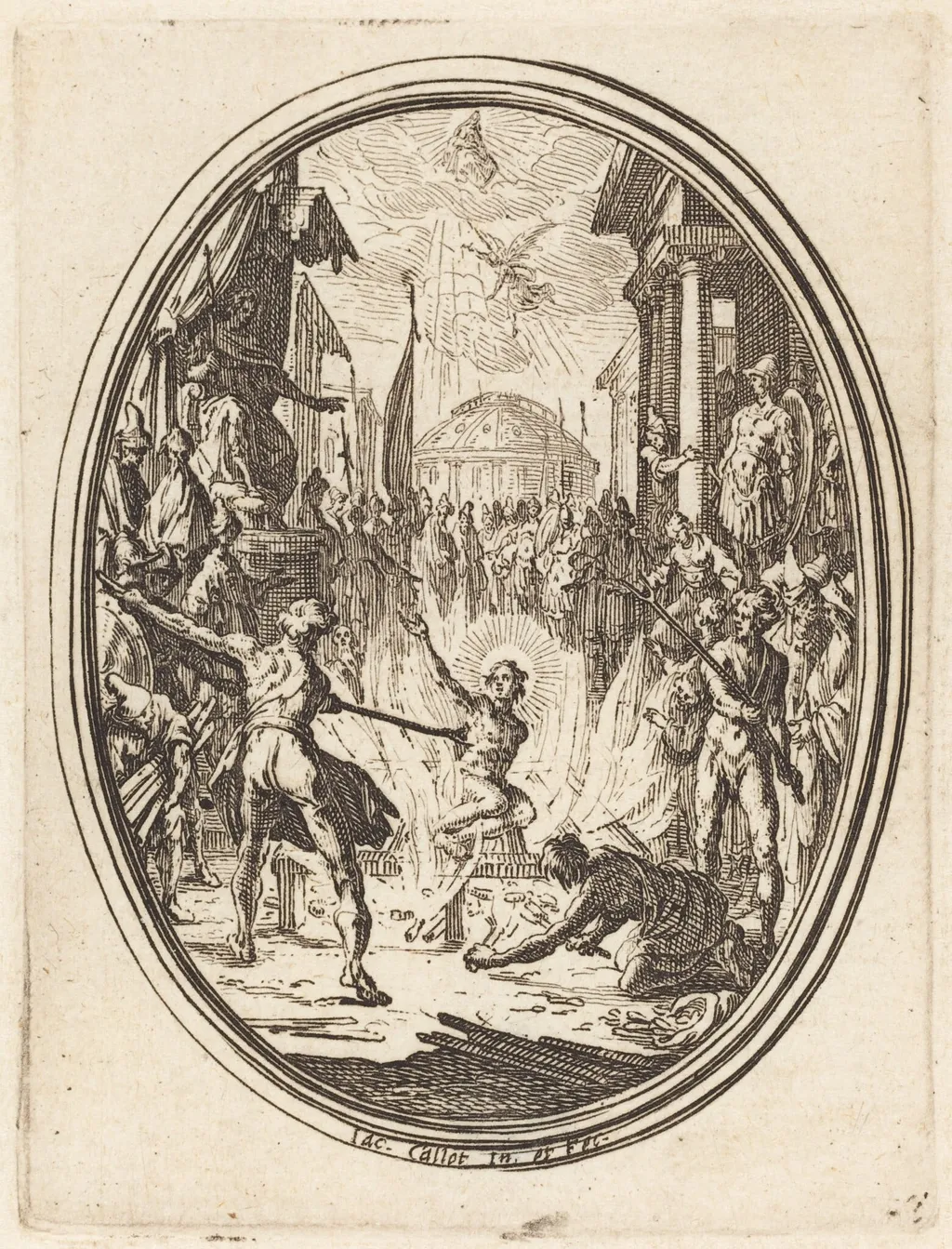
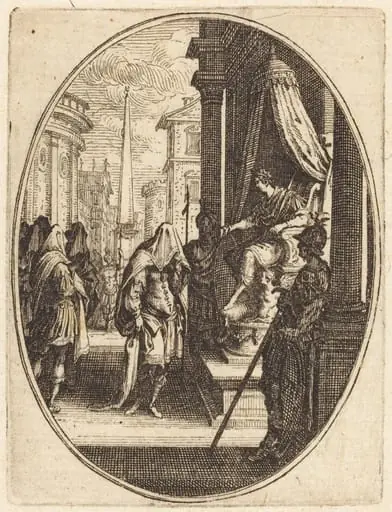
The Martyrdom of Saint Lawrence is an ink print by the Renaissance artist Jacques Callot. It dates from 1626 and is held in the collection of the National Gallery of Art.
About this work
Overview
Executed on laid paper, the work belongs to a vast body of over 1,400 prints by the Lorrainer artist, who specialized in intricate narrative scenes.
Created around 1626, this etching by Jacques Callot captures the execution of Saint Lawrence on a gridiron. Executed on laid paper, the work belongs to a vast body of over 1,400 prints by the Lorrainer artist, who specialized in intricate narrative scenes. Callot’s technical precision and command of line allowed him to translate complex moments of violence and emotion into small-scale compositions, making religious and historical subjects accessible through print.
Subject & Meaning
The scene illustrates the martyrdom of Saint Lawrence, a 3rd-century deacon who, according to tradition, was roasted alive on a metal grill for refusing to surrender church treasures. Callot emphasizes the saint’s physical torment amid a swirling crowd of soldiers and onlookers. The composition underscores themes of faith under persecution, with the saint’s contorted form serving as the emotional anchor amid chaos and indifference.
Technique & Style
Callot employed fine, controlled etching lines to render texture, motion, and atmosphere. The crowd’s agitation is conveyed through overlapping figures and abrupt gestures, while the saint’s body is rendered with acute anatomical tension. Smoke and flame are suggested not by shading alone but by dense, intersecting strokes that imply heat and movement. The background architecture recedes subtly, directing focus to the central agony without flattening spatial depth.
History & Provenance
The print was produced during Callot’s mature period in Florence, where he worked under the patronage of the Medici. Though created for a broad audience, it likely circulated among collectors and clergy interested in Counter-Reformation themes. Its survival in multiple impressions across European collections attests to its popularity and the demand for emotionally charged religious imagery in early 17th-century print markets.
Context
In the decades following the Council of Trent, Catholic Europe saw a surge in devotional imagery that emphasized suffering and martyrdom to reinforce faith. Callot’s etching aligns with this trend, drawing on both biblical narrative and contemporary visual language of violence. His detailed depictions of crowds and architecture reflect the influence of Italian Renaissance composition, filtered through Northern European attention to minute realism.
Legacy
Callot’s technical innovations in etching—particularly his use of the *échoppe* needle and precise biting techniques—influenced generations of printmakers. This work exemplifies his ability to fuse dramatic intensity with structural clarity, setting a standard for narrative printmaking. Though not widely reproduced today, its influence persists in the way later artists approached emotional gravity and compositional density in graphic media.
Artist & collection

Artist
Jacques Callot was a baroque printmaker and draftsman from the Duchy of Lorraine.

 Holy Family at supper
 Restoration of the Aqueduct at Pisa
 Restoration of the Aqueduct at Pisa
 Square in Paris with Many Figures
 Square in Paris with Many Figures
 Horsemen Attacked by Robbers
 HOW WILL A COVERED PART BE CORRECTED?HOW WIKA A COVERED HEART DEED CORRECTED?
![Christ Walking on the Water [second plate], by Jacques Callot](https://artifactworldgallery.com/img/jacques-callot--christ-walking-on-the-water-second-plate--2069f3bfe4cb2126-w320.webp) Christ Walking on the Water [second plate]
Christ Walking on the Water [second plate]
![The Challenge [right], by Gabriel de Saint-Aubin](https://artifactworldgallery.com/img/gabriel-de-saint-aubin--the-challenge-right--75162e00e6876b27-w320.webp)