Artwork
The Strappado
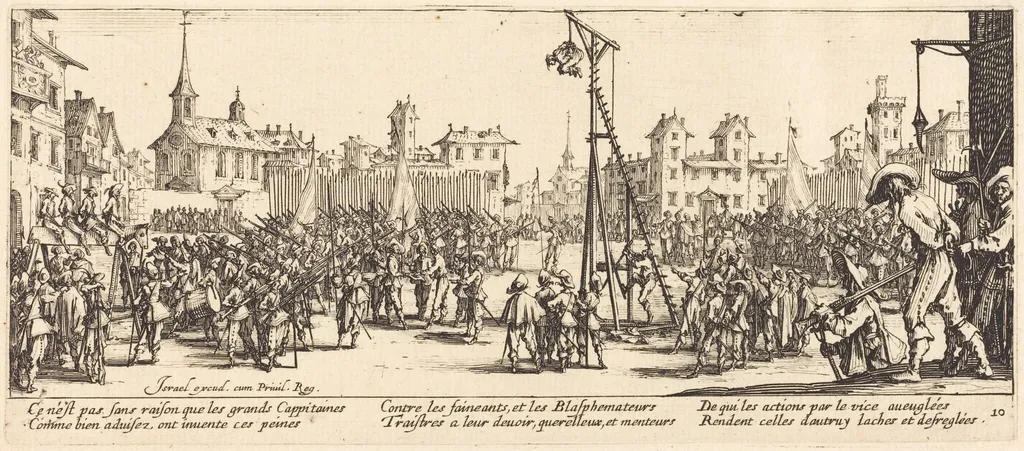
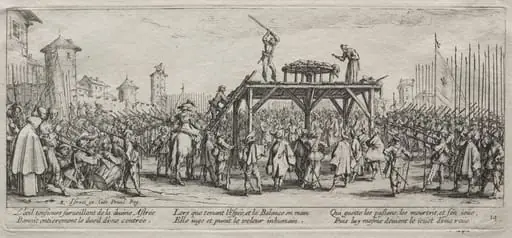
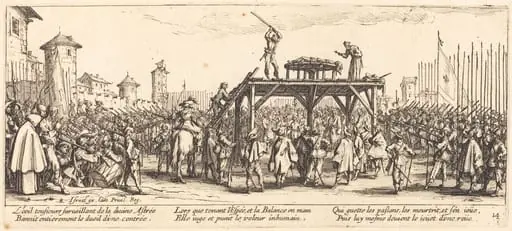
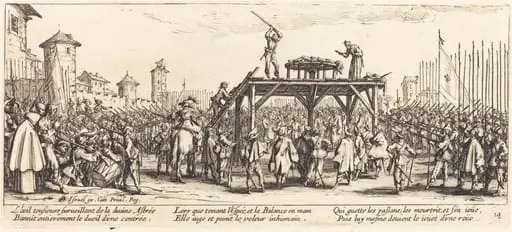
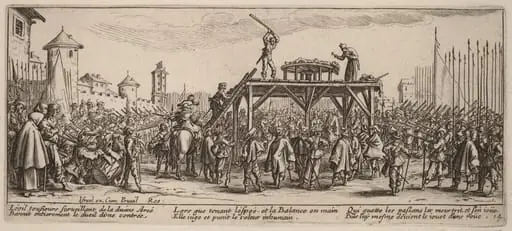
The Strappado is an ink print by the Baroque artist Jacques Callot. It dates from 1633 and is held in the collection of the National Gallery of Art.
About this work
Overview
As one of over 1,400 prints by the Lorrainer artist, it exemplifies his focus on the visceral realities of early 17th-century life.
Created around 1633 by Jacques Callot, *The Strappado* is an etching on laid paper that captures a moment of judicial torture. As one of over 1,400 prints by the Lorrainer artist, it exemplifies his focus on the visceral realities of early 17th-century life. Callot’s work often documented social and military customs with unflinching precision, and this piece stands as a stark record of punishment practices in his time.
Subject & Meaning
The image depicts a man suspended by ropes tied to his wrists, his body stretched vertically on a wooden frame — a method of interrogation known as the strappado. The scene is devoid of overt moral commentary, instead presenting the act with clinical detachment. Callot’s choice to render such a moment suggests an interest in the mechanisms of power and the physical toll of authority, rather than its justification.
Technique & Style
Callot employed fine, controlled etching lines to model the human form and the wooden apparatus with remarkable clarity. He used cross-hatching and varying line density to suggest shadow and texture, enhancing the three-dimensionality of the scene. The paper’s laid texture subtly interacts with the ink, adding a tactile quality that reinforces the rawness of the subject without softening its impact.
History & Provenance
The print emerged during Callot’s mature period in Florence, where he was employed by the Medici court. Though created in Italy, the image reflects broader European penal practices. No early ownership records are widely documented, but the work entered major collections in the 18th and 19th centuries, often grouped with other prints documenting violence and social order.
Context
In the 1630s, public torture was a routine feature of legal systems across Europe, used to extract confessions and deter crime. Callot’s etchings, including this one, were not intended as propaganda but as observational records. His depictions of war, punishment, and peasant life formed a visual archive that contemporaries would have recognized as truthful, if unsettling, reflections of their world.
Legacy
Callot’s *The Strappado* contributed to the tradition of printmaking as a medium for social documentation. Later artists and reformers referenced his unembellished portrayals of suffering to critique institutional brutality. Though not widely exhibited in his lifetime, the print’s technical rigor and unflinching subject matter ensured its endurance in academic and museum collections as a key example of Baroque graphic realism.
Artist & collection
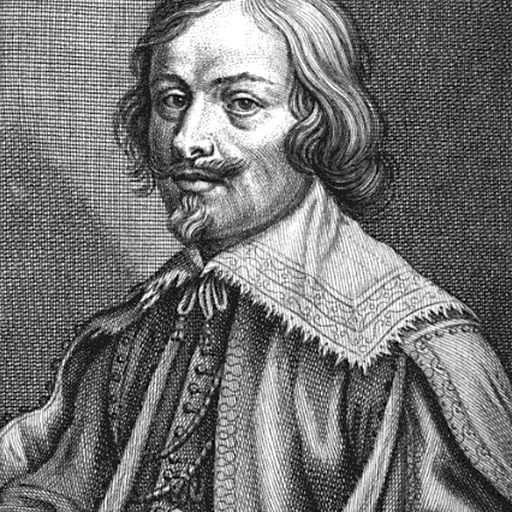
Artist
Jacques Callot was a baroque printmaker and draftsman from the Duchy of Lorraine.

 Holy Family at supper
 Restoration of the Aqueduct at Pisa
 Restoration of the Aqueduct at Pisa
 Square in Paris with Many Figures
 Square in Paris with Many Figures
 Horsemen Attacked by Robbers
 HOW WILL A COVERED PART BE CORRECTED?HOW WIKA A COVERED HEART DEED CORRECTED?
![Christ Walking on the Water [second plate], by Jacques Callot](https://artifactworldgallery.com/img/jacques-callot--christ-walking-on-the-water-second-plate--2069f3bfe4cb2126-w320.webp) Christ Walking on the Water [second plate]
Christ Walking on the Water [second plate]