Artwork
The Tomb
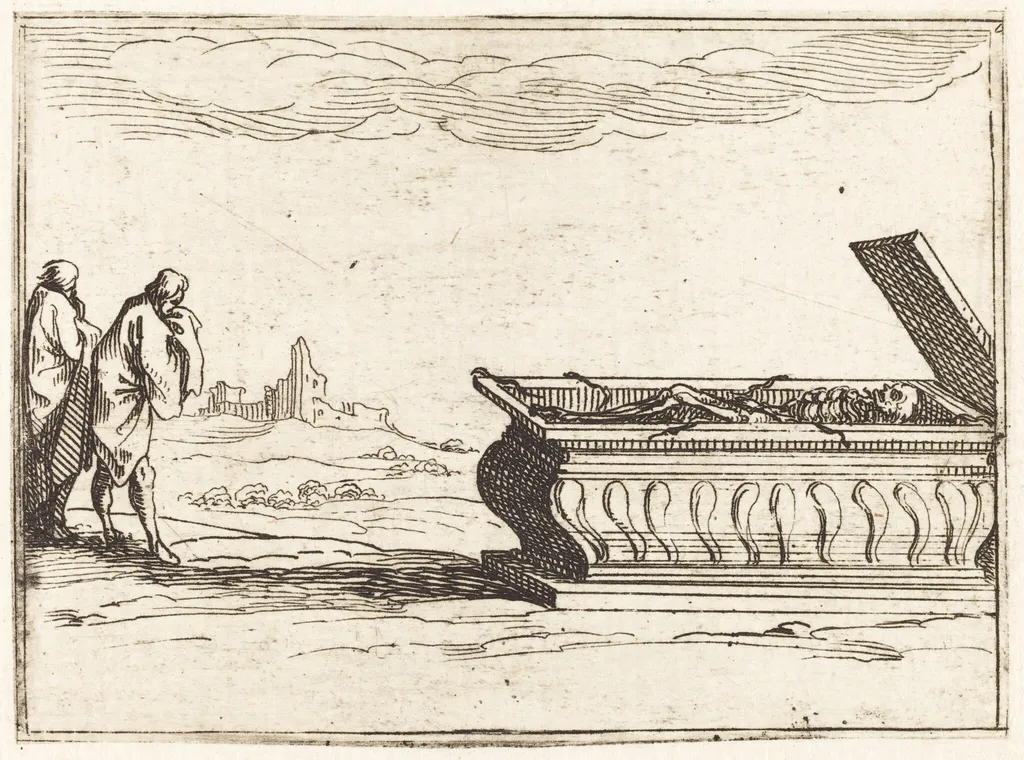
The Tomb is an ink print by the Baroque artist Jacques Callot. It dates from 1628 and is held in the collection of the National Gallery of Art.
About this work
Callot etched this after witnessing soldiers looting graves during the Thirty Years’ War.
Jacques Callot’s 1628 etching shows a cluttered graveyard. Skeletons lie half-buried in the dirt. Stones lean, bones poke through earth. Nearby, a horse stands, ribs visible, sniffing at a coffin lid.
This isn’t just macabre art. It’s a war scene. Callot etched this after witnessing soldiers looting graves during the Thirty Years’ War. The horse’s ribs mirror the bones below. The detail feels personal—like he counted every tooth.
His crowded scenes inspired later artists. Look up Jacques Callot.
Overview
The Tomb is a 1628 etching on laid paper by French Baroque printmaker Jacques Callot, characterized by a densely populated graveyard scene.
Subject & Meaning
The etching depicts a war-torn graveyard with skeletons, exposed bones, and a starving horse sniffing a coffin, reflecting Callot's eyewitness account of soldiers looting graves during the Thirty Years' War.
Technique & Style
Callot's mastery of etching is evident in the intricate details, such as the horse's visible ribs and meticulously rendered bones, showcasing his ability to capture complex compositions.
History & Provenance
Created in 1628, The Tomb is part of Callot's extensive oeuvre of over 1,400 etchings, which often documented contemporary military, religious, and social scenes.
Context
The work is informed by Callot's experiences during the Thirty Years' War, offering a somber commentary on the conflict's devastating impact.
Legacy
The Tomb's crowded yet detailed scenes influenced later artists, contributing to Callot's lasting impact on the development of printmaking.
Artist & collection

Artist
Jacques Callot was a baroque printmaker and draftsman from the Duchy of Lorraine.

 Holy Family at supper
 Restoration of the Aqueduct at Pisa
 Restoration of the Aqueduct at Pisa
 Square in Paris with Many Figures
 Square in Paris with Many Figures
 Horsemen Attacked by Robbers
 HOW WILL A COVERED PART BE CORRECTED?HOW WIKA A COVERED HEART DEED CORRECTED?
![Christ Walking on the Water [second plate], by Jacques Callot](https://artifactworldgallery.com/img/jacques-callot--christ-walking-on-the-water-second-plate--2069f3bfe4cb2126-w320.webp) Christ Walking on the Water [second plate]
Christ Walking on the Water [second plate]