Artwork
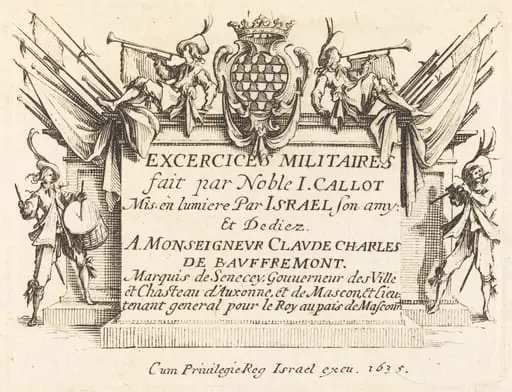
Title Page for "The Military Exercises"
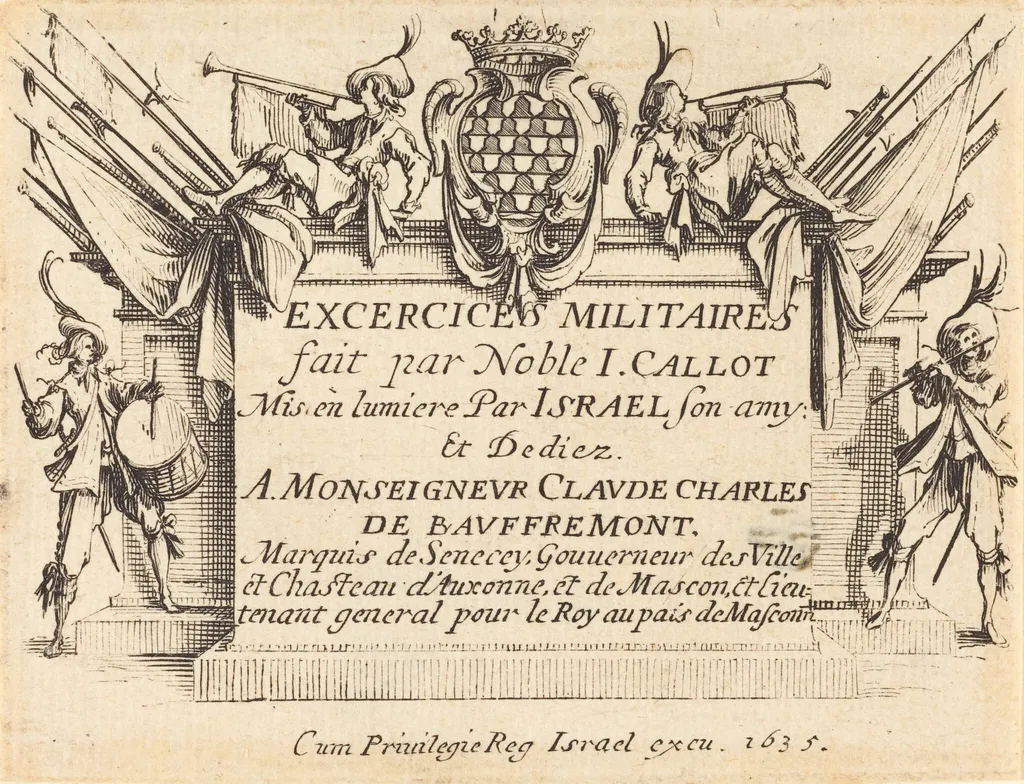
Title Page for "The Military Exercises" is an ink print by the Baroque artist Jacques Callot. It dates from 1634 and is held in the collection of the National Gallery of Art.
About this work
Overview
Executed on laid paper, it belongs to a body of over 1,400 prints by the Lorrainer artist, who specialized in documenting contemporary military and civic life.
Created in 1634 by Jacques Callot, this etching serves as the title page for a series depicting military drills. Executed on laid paper, it belongs to a body of over 1,400 prints by the Lorrainer artist, who specialized in documenting contemporary military and civic life. The image introduces a sequence centered on organized troop exercises, reflecting Callot’s sustained interest in the structure and spectacle of armed forces during the Thirty Years' War.
Subject & Meaning
The scene portrays soldiers arranged in disciplined rows, wielding muskets and swords, performing coordinated maneuvers on a raised platform. Two officers flank the group, presumably overseeing the drill. At the center, a heraldic coat of arms signals the patronage of a noble figure, while the inscription at the base names the dedicatee. The composition underscores order and hierarchy, presenting military training as a formal, state-sanctioned ritual.
Technique & Style
Callot employed fine, incised lines typical of etching to render dense detail with clarity. The black-and-white composition relies on sharp contrasts and rhythmic repetition of forms to convey motion within static ranks. Background elements are minimized, focusing attention on the soldiers’ postures and equipment. His precise hand captures texture in fabric, metal, and ground, enhancing the sense of realism without decorative excess.
History & Provenance
The print was produced during Callot’s mature period in Nancy, following years of travel and work in Italy and France. It was part of a commissioned series likely intended for circulation among military elites and courtly patrons. The inclusion of a noble’s coat of arms suggests direct sponsorship, aligning the work with the political and social interests of its time. No early provenance records survive, but its survival in multiple institutional collections indicates early recognition.
Context
Produced amid the Thirty Years' War, the image reflects the increasing standardization of European armies. Military drills were becoming central to state power, and prints like this helped disseminate ideals of discipline and hierarchy. Callot’s focus on training rather than battle offers a rare glimpse into the daily routines of soldiers, contrasting with more sensational war imagery common in the period.
Legacy
Callot’s technical innovations in etching influenced generations of printmakers across Europe. His detailed, narrative-driven military scenes established a visual language for documenting army life. Though not widely exhibited today, this title page remains a key example of how printmaking served both artistic and propagandistic functions in early modern Europe, bridging art and institutional record.
Artist & collection
Artist
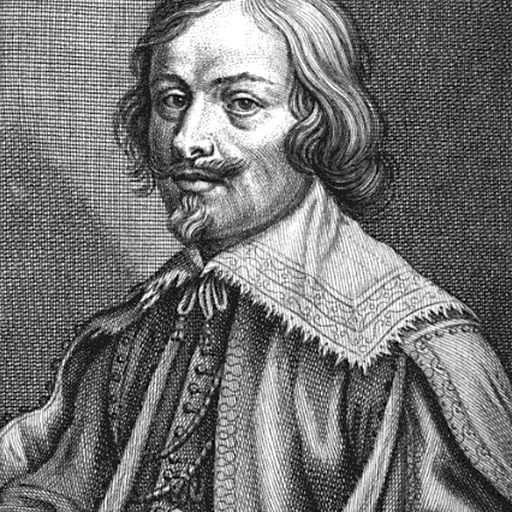
Jacques Callot was a baroque printmaker and draftsman from the Duchy of Lorraine.

 Holy Family at supper
 Restoration of the Aqueduct at Pisa
 Restoration of the Aqueduct at Pisa
 Square in Paris with Many Figures
 Square in Paris with Many Figures
 Horsemen Attacked by Robbers
 HOW WILL A COVERED PART BE CORRECTED?HOW WIKA A COVERED HEART DEED CORRECTED?
![Christ Walking on the Water [second plate], by Jacques Callot](https://artifactworldgallery.com/img/jacques-callot--christ-walking-on-the-water-second-plate--2069f3bfe4cb2126-w320.webp) Christ Walking on the Water [second plate]
Christ Walking on the Water [second plate]