Artwork
Turtle Dove Flying in the Desert
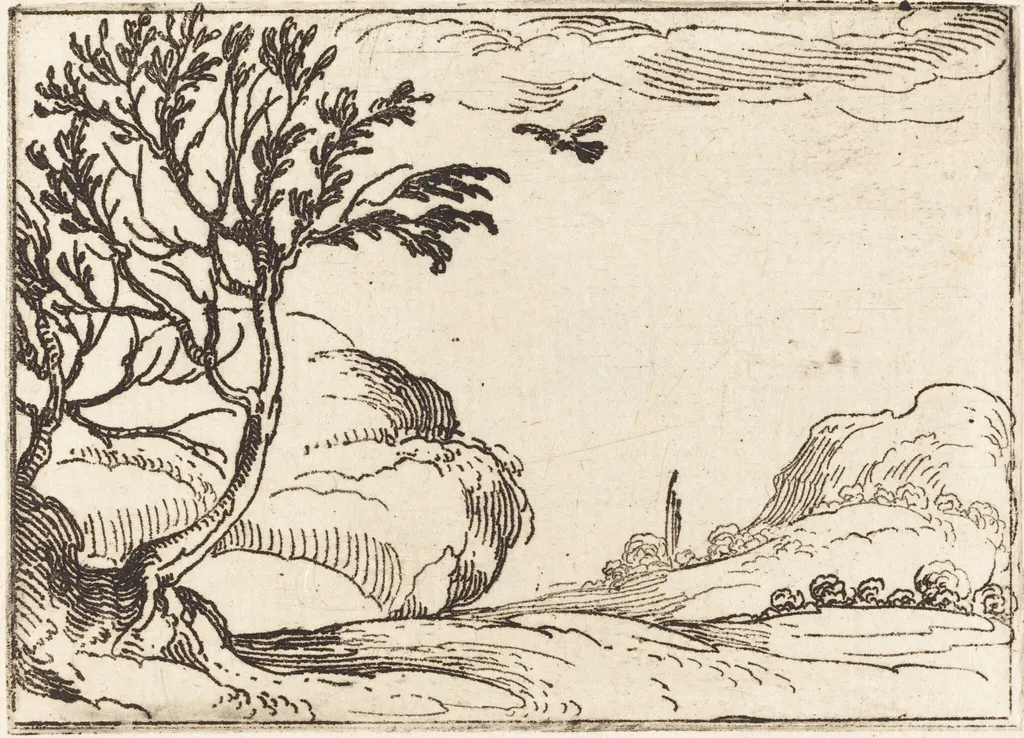
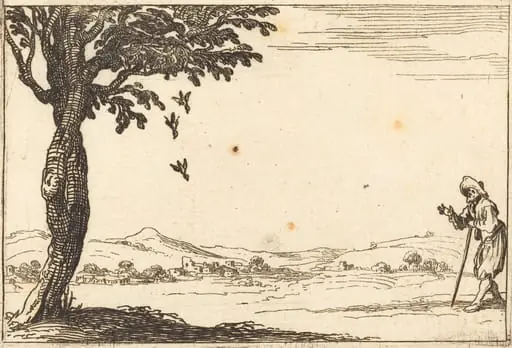
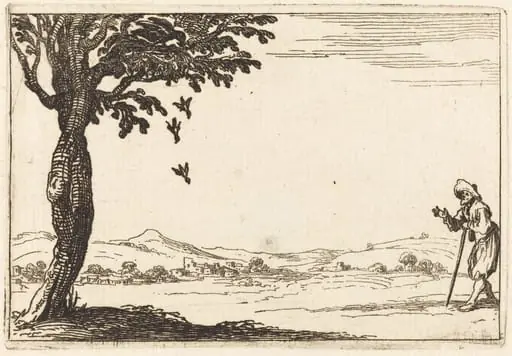
Turtle Dove Flying in the Desert is an ink print by the Renaissance artist Jacques Callot. It dates from 1628 and is held in the collection of the National Gallery of Art.
About this work
Overview
Jacques Callot produced this etching in 1628, during a period of intense printmaking activity. Made on laid paper, the work is one of over a thousand etchings he created, reflecting his dedication to the medium. Unlike many contemporaries who focused on grand narratives, Callot often turned to quiet, observational scenes, capturing subtle moments in the natural world with precision and restraint.
Subject & Meaning
The bird, a traditional symbol of peace and migration, moves through an empty expanse, evoking themes of transience and isolation without overt narrative.
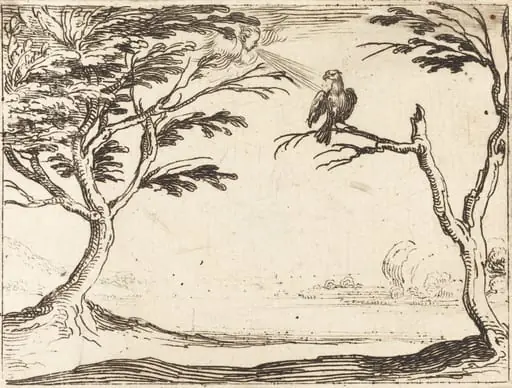
The image depicts a solitary turtle dove in flight over an arid landscape, accompanied by a lone tree, a low hill, and a distant ship on calm water. The absence of human figures and the stillness of the scene suggest contemplation rather than action. The bird, a traditional symbol of peace and migration, moves through an empty expanse, evoking themes of transience and isolation without overt narrative.
Technique & Style
Callot employed fine, controlled etching lines to render texture and atmosphere. The dry, cracked earth and wispy clouds are suggested through delicate hatching, while the ship and tree are defined with minimal yet precise strokes. His use of the etching needle allowed for deep, ink-rich lines that enhanced contrast and detail, showcasing his mastery of the medium’s capacity for subtle tonal variation.
History & Provenance
Created in 1628, the print emerged from Callot’s workshop in Nancy, then part of the Duchy of Lorraine. It was likely made for private collectors or fellow artists, as his smaller, observational prints circulated among connoisseurs rather than the public. No definitive early ownership records survive, but the work aligns with his known output from this period, when he refined his approach to landscape and natural subjects.
Context
In early 17th-century Europe, printmaking was increasingly valued for its ability to capture everyday scenes and natural phenomena. Callot’s focus on solitary figures and unpopulated landscapes stood apart from the dominant religious and historical themes. His work reflected a growing interest in empirical observation, influenced by scientific curiosity and the rise of landscape as an independent subject in art.
Legacy
Callot’s etchings, including this one, influenced later generations of printmakers through their technical precision and quiet realism. Though less celebrated than his battle scenes or courtly subjects, works like this demonstrate his range and sensitivity to atmosphere. His ability to convey depth and mood with minimal lines helped shape the evolution of landscape printmaking in the 17th and 18th centuries.
Artist & collection

Artist
Jacques Callot was a baroque printmaker and draftsman from the Duchy of Lorraine.

 Holy Family at supper
 Restoration of the Aqueduct at Pisa
 Restoration of the Aqueduct at Pisa
 Square in Paris with Many Figures
 Square in Paris with Many Figures
 Horsemen Attacked by Robbers
 HOW WILL A COVERED PART BE CORRECTED?HOW WIKA A COVERED HEART DEED CORRECTED?
![Christ Walking on the Water [second plate], by Jacques Callot](https://artifactworldgallery.com/img/jacques-callot--christ-walking-on-the-water-second-plate--2069f3bfe4cb2126-w320.webp) Christ Walking on the Water [second plate]
Christ Walking on the Water [second plate]