Artwork
The Tree with a Double Trunk
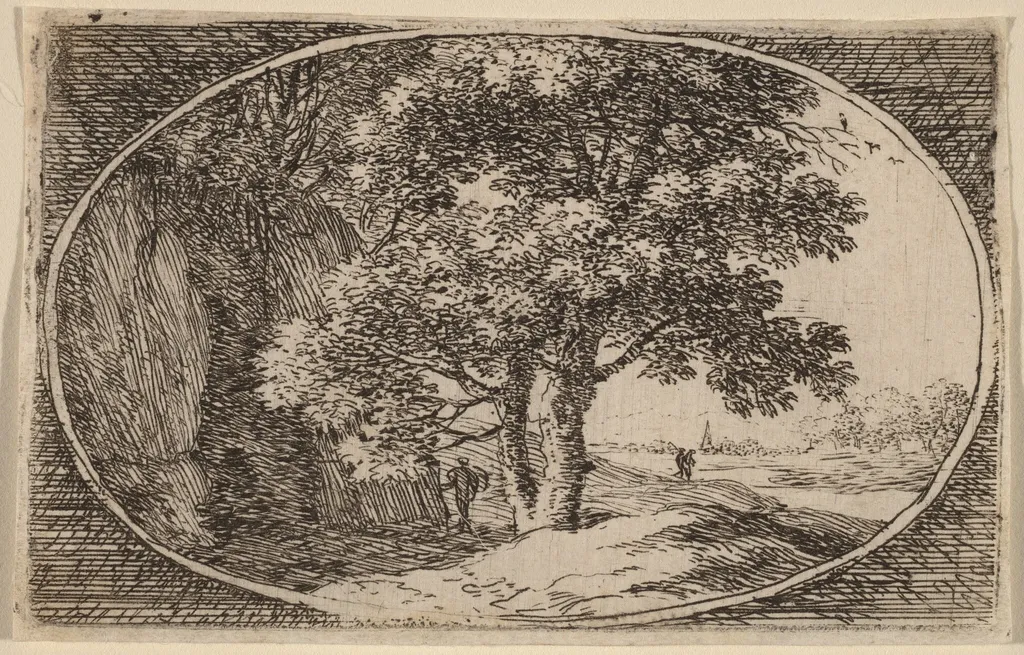
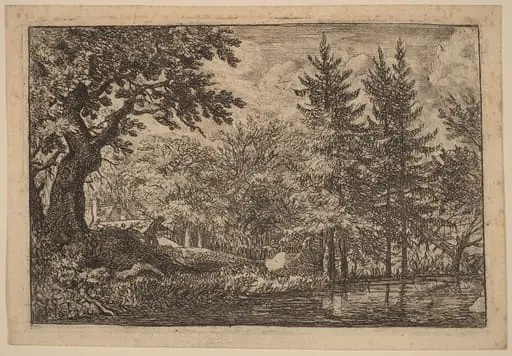
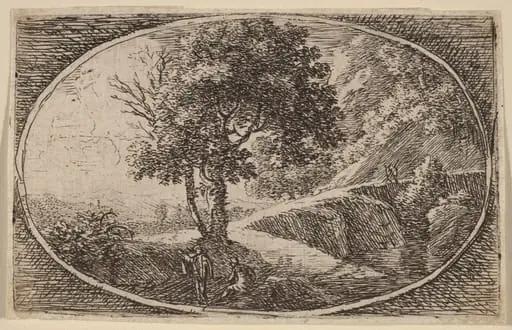
The Tree with a Double Trunk is an ink print by the Baroque artist Herman van Swanevelt. It dates from 1628 and is held in the collection of the National Gallery of Art.
About this work
Overview
Rendered in monochrome, the scene balances natural grandeur with quiet human presence, characteristic of early 17th-century Northern European printmaking.
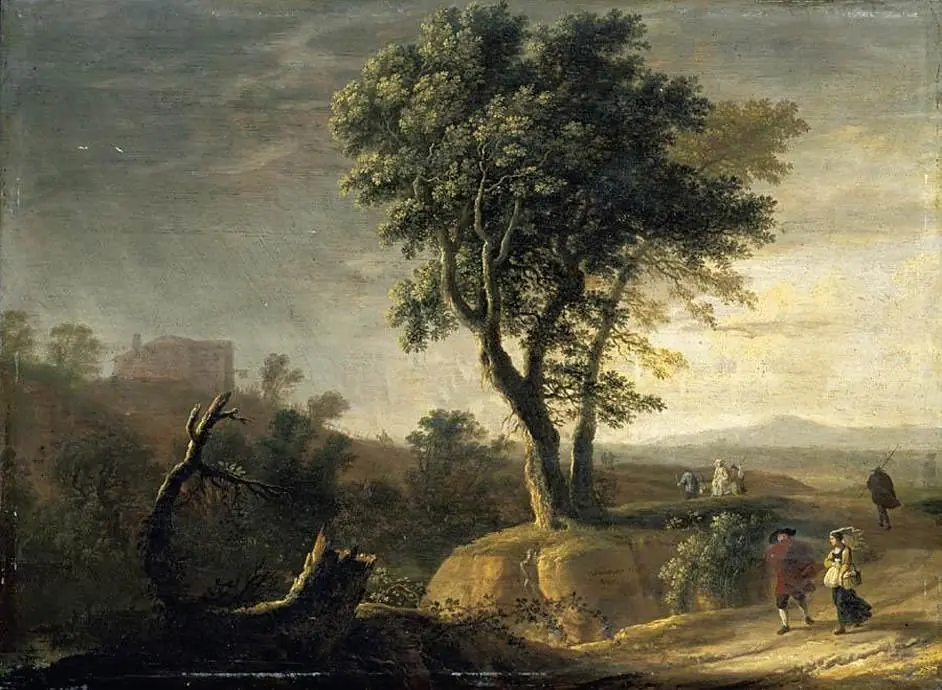
Created in 1628, The Tree with a Double Trunk is an etching by Herman van Swanevelt, a Dutch artist known for his landscape prints. The work presents a solitary, sprawling tree with two fused trunks, dominating the composition. Below, a winding path leads toward a distant hamlet and a river with a sailboat. Rendered in monochrome, the scene balances natural grandeur with quiet human presence, characteristic of early 17th-century Northern European printmaking.
Subject & Meaning
The double-trunked tree serves as the central motif, suggesting themes of duality, resilience, or interconnectedness. Its expansive branches overshadow the faint human elements—a lone walker and a distant village—implying nature’s dominance over human settlement. The path may symbolize a journey, while the sailboat hints at broader connections beyond the immediate landscape. The image invites contemplation rather than narrative, aligning with the meditative tone common in Dutch landscape prints of the period.
Technique & Style
Van Swanevelt employed fine, controlled etching lines to build texture and depth. The tree’s foliage is rendered with dense, cross-hatched strokes, contrasting with the looser, meandering lines of the grass and ground. The distant village and river are suggested with minimal strokes, creating atmospheric perspective. This method, using acid to bite lines into a metal plate, allowed for intricate detail unattainable in brushwork, making etching ideal for capturing subtle tonal variations and natural textures.
History & Provenance
The print was produced in 1628 during van Swanevelt’s early career, likely in Rome, where he spent much of his artistic life. Though little is documented about its early ownership, it aligns with the circulation of Dutch and Flemish prints among collectors in Northern Europe. Its survival in institutional collections suggests it was valued for its technical precision and compositional restraint, qualities appreciated by connoisseurs of print culture in the 17th century.
Context
Van Swanevelt worked within a tradition of landscape etching that flourished in the Netherlands and Italy during the 1620s. Artists increasingly turned to nature as a subject worthy of detailed study, moving away from purely religious or mythological themes. His work reflects the influence of Italian scenery and the Dutch emphasis on observation, blending romanticized elements with a grounded sense of place, contributing to the evolution of the topographical print.
Legacy
The Tree with a Double Trunk exemplifies the quiet sophistication of early Baroque printmaking. While van Swanevelt is less widely known than contemporaries like Rembrandt, his etchings contributed to the development of landscape as an independent genre. The work’s emphasis on natural form and atmospheric depth influenced later printmakers who sought to capture the emotional resonance of the natural world through precise, linear technique.
Artist & collection