Artwork
Aspasie
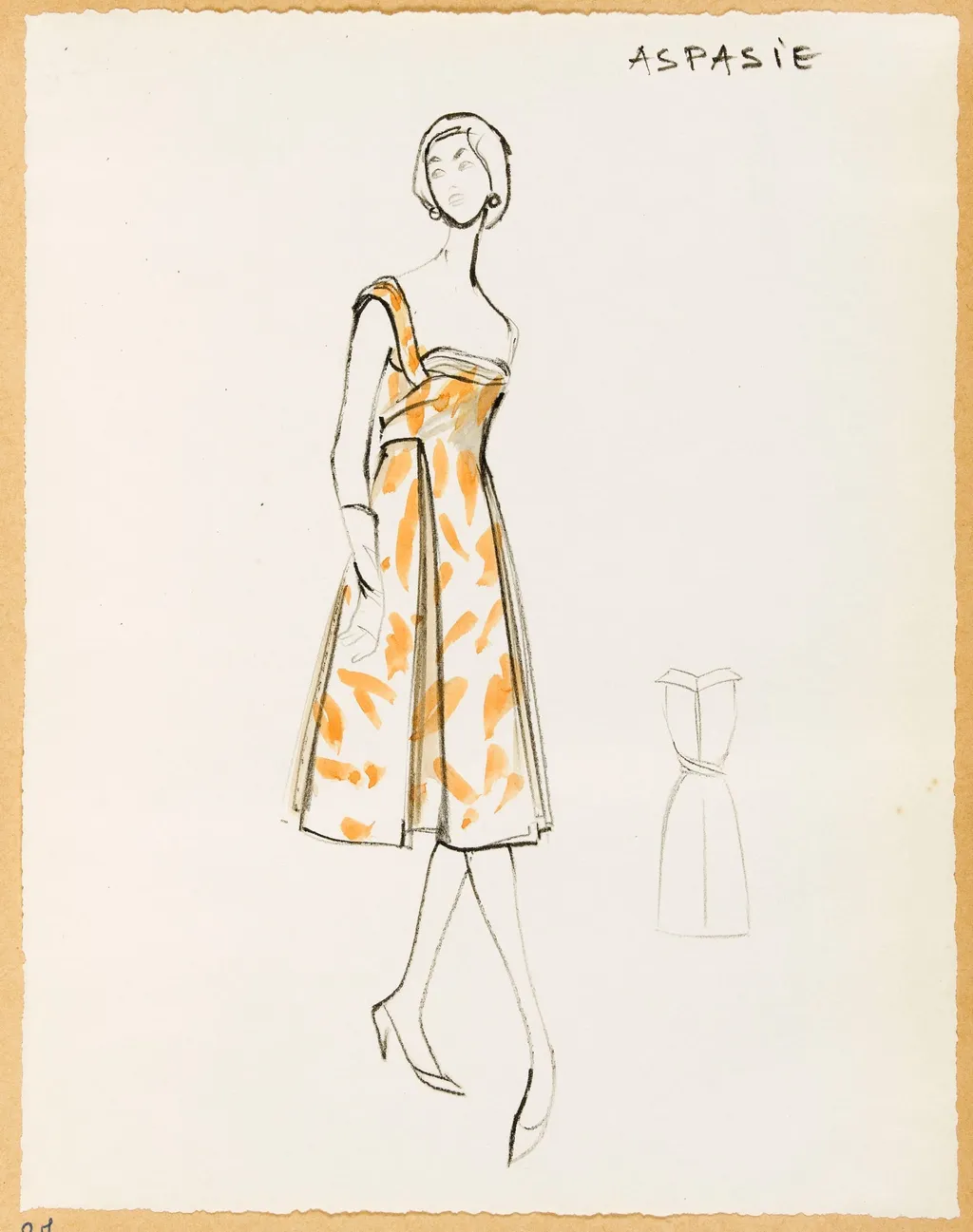
Aspasie is a drawing by Carven. It dates from 1957 and is held in the collection of the Palais Galliera - Musée de la Mode de la Ville de Paris.
About this work
Overview
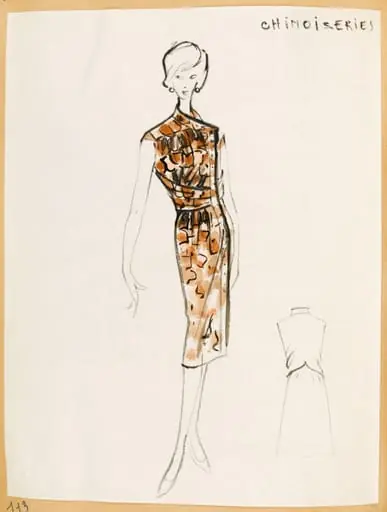
Created around 1957 by the French designer Carven, this ink sketch depicts a woman named Aspasie in a casual, fluid pose. Executed with swift, unrefined lines, the drawing appears to be an early design concept rather than a finished illustration. It is preserved in the collection of the Museum of Ethnography, where it serves as a record of mid-century fashion ideation.
Subject & Meaning
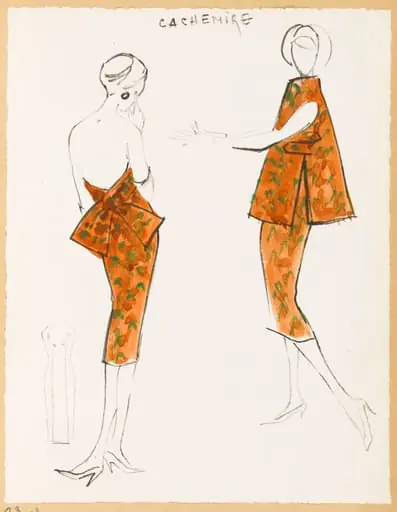
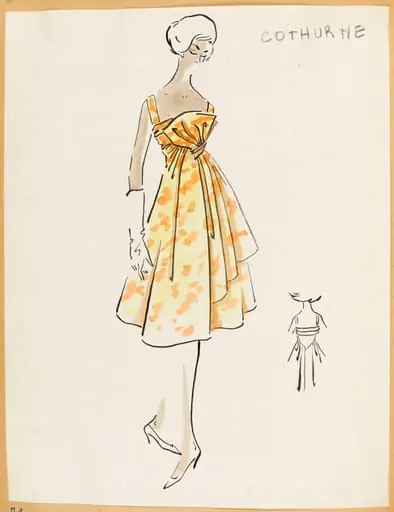
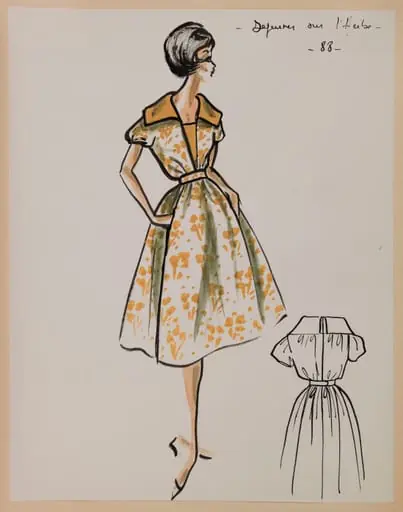
Her attire, marked by a bold orange geometric pattern on a pale ground, suggests a playful yet restrained aesthetic.
The figure, identified as Aspasie, is portrayed with quiet confidence—hand on hip, posture relaxed yet composed. Her attire, marked by a bold orange geometric pattern on a pale ground, suggests a playful yet restrained aesthetic. The inclusion of a secondary sketch of a jacket nearby implies the drawing was part of a broader design exploration, possibly for a seasonal collection or custom commission.
Technique & Style
The work is rendered in loose, economical ink lines that prioritize movement over precision. Details like the flared skirt and strapless bodice are suggested rather than fully defined, reflecting the spontaneity of a designer’s initial thoughts. The absence of shading and the minimal use of contour emphasize speed and conceptual clarity, typical of fashion sketches meant to capture form before refinement.
History & Provenance
The sketch entered the Museum of Ethnography’s collection as part of a broader acquisition of Carven’s archival materials. Its presence there reflects an institutional interest in documenting the creative process behind mid-century fashion, not merely the final garments. No record of its original commission or owner has been publicly documented, suggesting it was retained by the designer’s studio.
Context
In the late 1950s, Parisian fashion houses increasingly relied on rapid sketches to communicate ideas between designers and ateliers. Carven, known for her elegant yet accessible designs, used such drawings to explore silhouettes and patterns. This sketch aligns with the era’s shift toward more informal, wearable styles, moving away from the rigid structures of earlier decades.
Legacy
As a fragment of Carven’s design process, the sketch offers insight into how fashion ideas evolved from intuition to production. It stands as a quiet testament to the labor behind couture—unpolished, transient, and essential. Today, it contributes to scholarly understanding of how designers translated aesthetic vision into wearable form during a transformative period in fashion history.
Artist & collection
Artist
These delicate ink-on-paper drawings capture the quiet poetry of everyday things: pinecones, reeds, apples.

Museum
Palais Galliera - Musée de la Mode de la Ville de Paris
Continue through works from the same source collection.