Artwork
Croisière
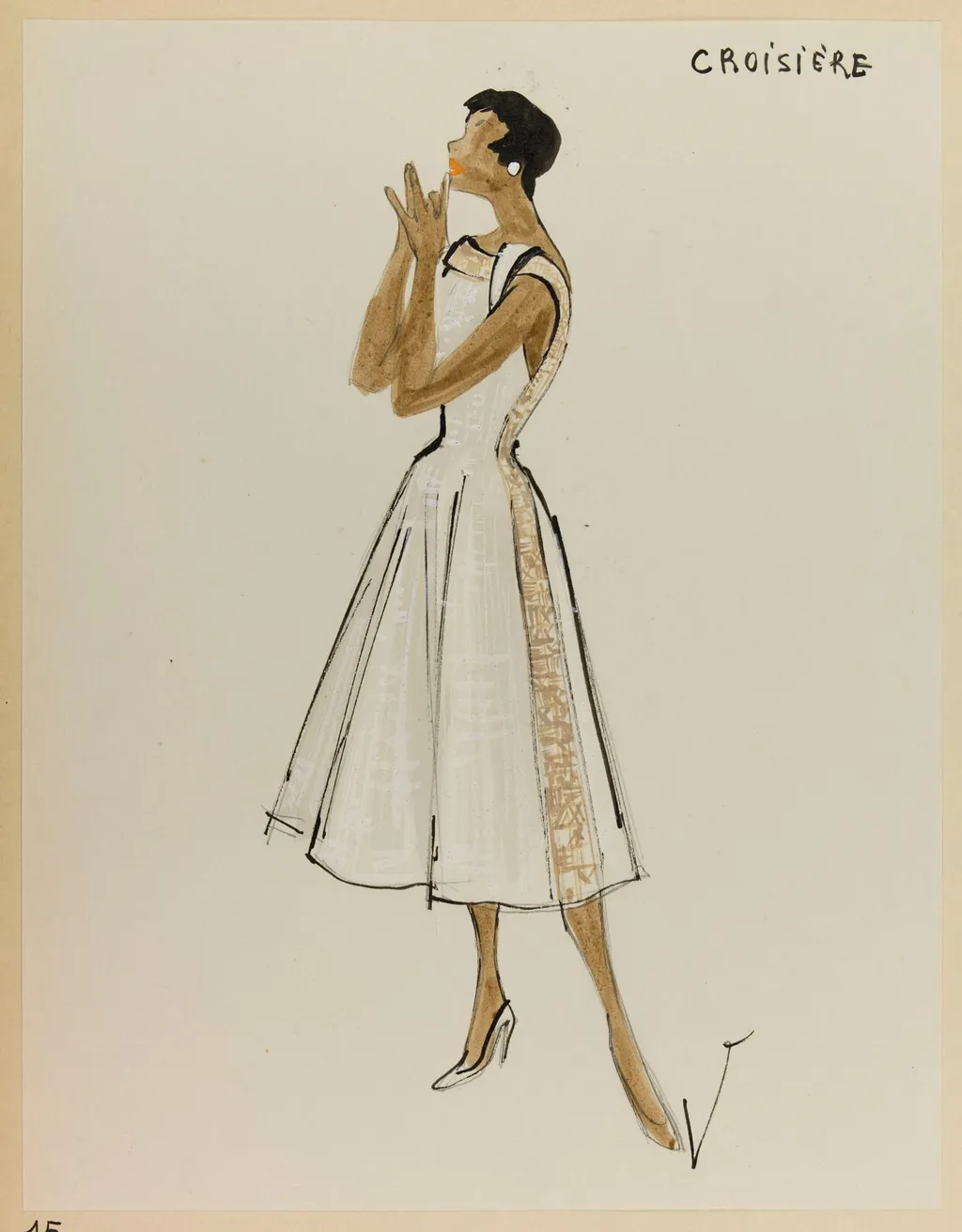
Croisière is a drawing by Carven. It dates from 1953 and is held in the collection of the Palais Galliera - Musée de la Mode de la Ville de Paris.
About this work
Overview
Created around 1953 by the designer Carven, this ink drawing captures a woman in motion, rendered with swift, unembellished lines.
Created around 1953 by the designer Carven, this ink drawing captures a woman in motion, rendered with swift, unembellished lines. Executed on paper, the work is part of the Museum of Ethnography’s collection. Its informal, spontaneous quality suggests a study rather than a finished illustration, emphasizing gesture over detail. The title, meaning 'cruise' or 'voyage,' evokes a sense of relaxed movement, possibly tied to mid-century leisure culture.
Subject & Meaning
The figure is depicted mid-stride, one hand near her mouth, the other lightly pressed to her chest, suggesting a moment of quiet contemplation or casual self-awareness. Her posture and attire imply an everyday setting—perhaps a seaside promenade or ship deck. The absence of context focuses attention on bodily rhythm and personal demeanor, aligning the image with themes of modern, independent femininity in postwar Europe.
Technique & Style
The drawing employs loose, fluid ink lines that prioritize movement over precision. Shading is minimal, achieved through sparse, directional strokes rather than cross-hatching. The dress’s striped pattern is suggested with a single vertical line, while the collar and footwear are simplified to essential forms. The sketch’s economy of means reflects a designer’s eye for silhouette and gesture, prioritizing dynamism over realism.
History & Provenance
The work originated in Carven’s personal sketchbook during the early 1950s, a period when the designer was actively developing ready-to-wear collections. It entered the Museum of Ethnography’s holdings in the late 20th century as part of a broader effort to document fashion as cultural expression. Its preservation underscores its value as a record of design thinking, not merely aesthetic output.
Context
In postwar France, fashion design increasingly emphasized accessibility and movement, mirroring societal shifts toward casual living. Carven’s sketches like this one reflect a move away from rigid haute couture toward garments suited to active, modern lifestyles. The figure’s attire and posture align with emerging ideals of feminine autonomy, where leisure and ease replaced formality as markers of style.
Legacy
Though not widely exhibited, this drawing contributes to understanding how fashion designers translated daily life into wearable form. Its preservation in an ethnographic museum signals a recognition of fashion as cultural artifact. The work remains a quiet example of how sketching functioned as both creative tool and personal record in mid-century design practice.
Artist & collection
Artist
These delicate ink-on-paper drawings capture the quiet poetry of everyday things: pinecones, reeds, apples.
Museum
Palais Galliera - Musée de la Mode de la Ville de Paris
Continue through works from the same source collection.