Artwork
Fleur d'or
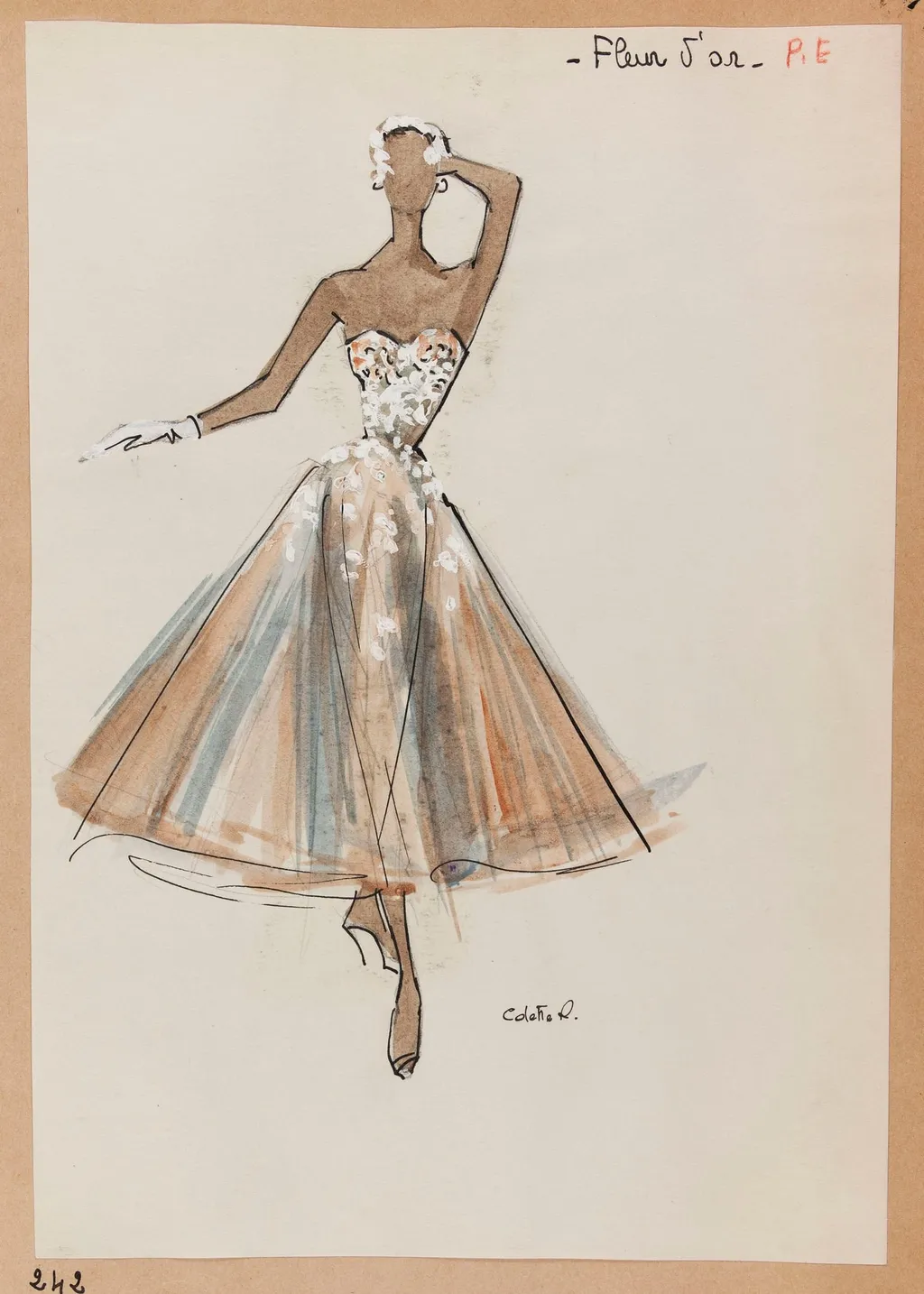
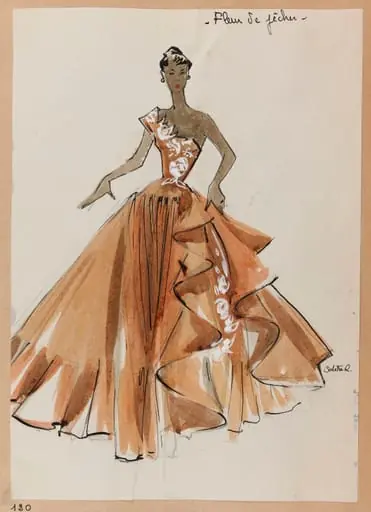
Fleur d'or is a drawing by Carven. It dates from 1951 and is held in the collection of the Palais Galliera - Musée de la Mode de la Ville de Paris.
About this work
Overview
Its modest scale and informal medium suggest it may have served as a design study rather than a finished piece.
Fleur d’or is a watercolor sketch attributed to the French fashion designer Carven, dated around 1951. It resides in the collection of the Museum of Ethnography. The work captures a female figure in motion, rendered with fluid brushwork and minimal detail. Its modest scale and informal medium suggest it may have served as a design study rather than a finished piece. The title and visual motifs point to an emphasis on floral elegance and luminous color.
Subject & Meaning
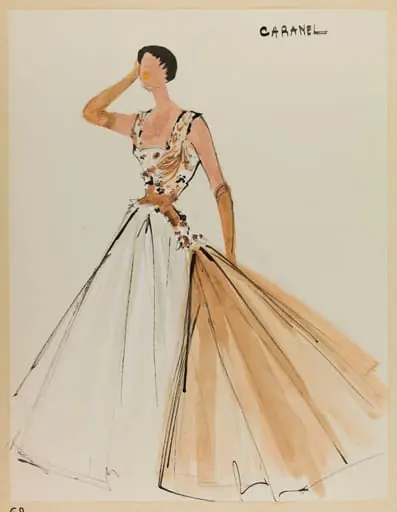
The figure is depicted with arms raised, one hand lightly touching the head, suggesting a moment of pause or self-adornment. The flowing, strapless dress features a delicate floral motif near the chest and soft, gradient stripes along the skirt, evoking movement and texture. The title, meaning 'flower of gold,' may reference the dress’s pattern or the luminous quality of the watercolor washes. No narrative context is provided, leaving interpretation open to the interplay of garment and gesture.
Technique & Style
Executed in watercolor with loose, confident brushstrokes, the sketch employs wet-on-wet washes to create subtle transitions in the skirt’s stripes. The bodice’s floral pattern is defined with finer lines, contrasting the broader, atmospheric areas of the dress and background. The artist avoids heavy outlines, relying instead on color and tone to suggest form. The technique reflects a spontaneous, almost improvisational approach typical of fashion sketches used for design development.
History & Provenance
The work is signed 'Carven' in handwriting, the sole identifier linking it to the designer. It entered the Museum of Ethnography’s collection without documented provenance prior to its acquisition. No exhibition history or related correspondence is publicly recorded. Its presence in an ethnographic institution, rather than a fashion archive, suggests it was acquired for its cultural representation of mid-century French aesthetic sensibilities.
Context
Created in the early 1950s, Fleur d’or aligns with postwar French fashion’s emphasis on lightweight silhouettes and feminine detail. Carven, known for tailored yet fluid designs, often drew inspiration from everyday movement and natural forms. This sketch reflects a broader trend among designers to use rapid watercolor studies to explore textile patterns and drapery before committing to fabric. Its ethnographic placement hints at a growing interest in fashion as cultural artifact during that era.
Legacy
Fleur d’or remains a rare surviving example of Carven’s preparatory work, offering insight into her design process. While not widely exhibited, it contributes to scholarly understanding of how fashion designers translated aesthetic ideas into tangible forms. Its preservation in an ethnographic context underscores evolving perspectives on fashion as a material expression of cultural identity, rather than merely commercial output.
Artist & collection
Artist
These delicate ink-on-paper drawings capture the quiet poetry of everyday things: pinecones, reeds, apples.
Museum
Palais Galliera - Musée de la Mode de la Ville de Paris
Continue through works from the same source collection.