Artwork
Mandragore
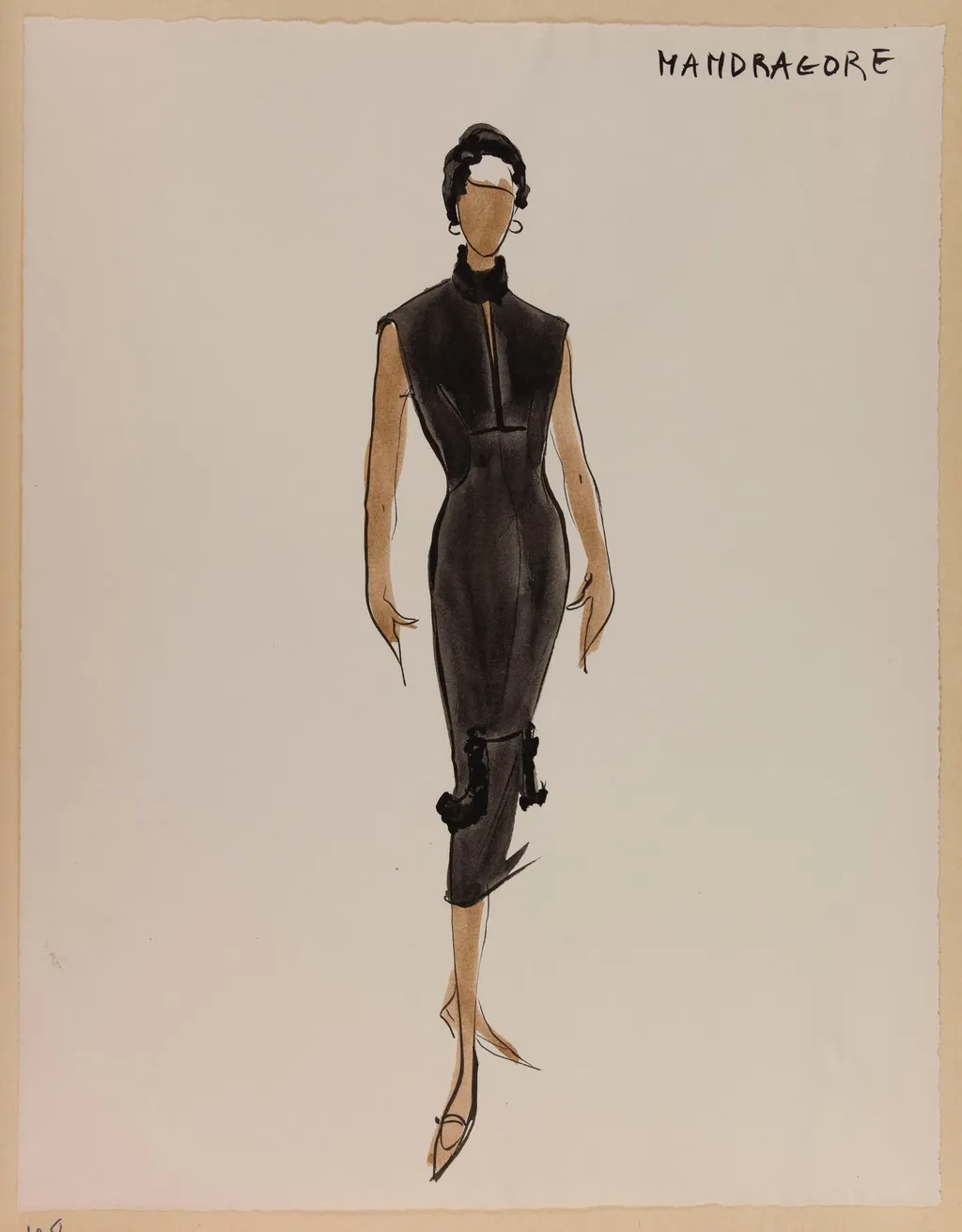
Mandragore is a drawing by Carven. It dates from 1956 and is held in the collection of the Palais Galliera - Musée de la Mode de la Ville de Paris.
About this work
Overview
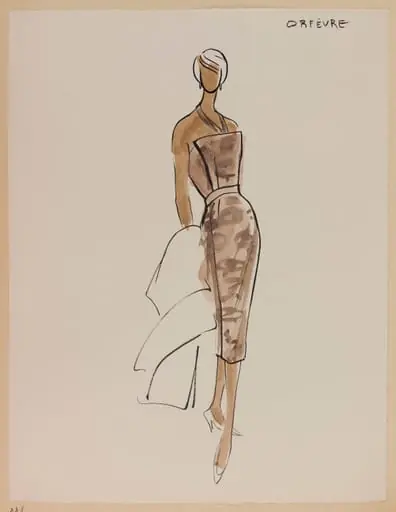
Mandragore is a graphite drawing created around 1956 by the French designer Carven. It is part of the collection at the Museum of Ethnography. The work presents a full-length portrait of a woman in a minimalist style, rendered with precise, unadorned lines. The absence of heavy shading and the clarity of form suggest a focus on silhouette and posture rather than texture or depth.
Subject & Meaning
The subject is a woman dressed in a sleeveless, knee-length black dress with a high neckline and high heels. Her frontal stance and composed expression convey stillness and self-possession. The title, Mandragore, references a plant with mythic associations, possibly alluding to themes of allure, mystery, or ancient femininity, though the connection remains implied rather than explicit.
Technique & Style
The drawing employs clean, continuous lines with no cross-hatching or tonal gradients. The figure is outlined with economy, and details like the dress hem and heel are suggested rather than elaborated. This restrained approach emphasizes form and gesture, aligning with mid-century fashion illustration traditions that valued clarity and elegance over ornamental detail.
History & Provenance
The work was produced during Carven’s active years as a fashion designer, likely as a study or promotional sketch. It entered the Museum of Ethnography’s collection in the latter half of the 20th century, possibly as part of a broader acquisition of design artifacts reflecting cultural aesthetics of the era. Its provenance remains tied to the designer’s personal archive.
Context
Created in postwar France, Mandragore reflects the era’s shift toward streamlined, modernist aesthetics in fashion. While Carven was known for couture, this drawing suggests an interest in the symbolic power of dress and posture. The work exists at the intersection of fashion design and graphic art, capturing a moment when clothing was increasingly viewed as an expression of identity.
Legacy
Mandragore endures as a quiet example of mid-century fashion drawing, valued for its restraint and formal precision. It contributes to scholarly understanding of how designers translated clothing into visual language beyond the runway. Though not widely reproduced, it remains a reference point in studies of French design culture from the 1950s.
Artist & collection
Artist
These delicate ink-on-paper drawings capture the quiet poetry of everyday things: pinecones, reeds, apples.
Museum
Palais Galliera - Musée de la Mode de la Ville de Paris
Continue through works from the same source collection.