Artwork
Minerve
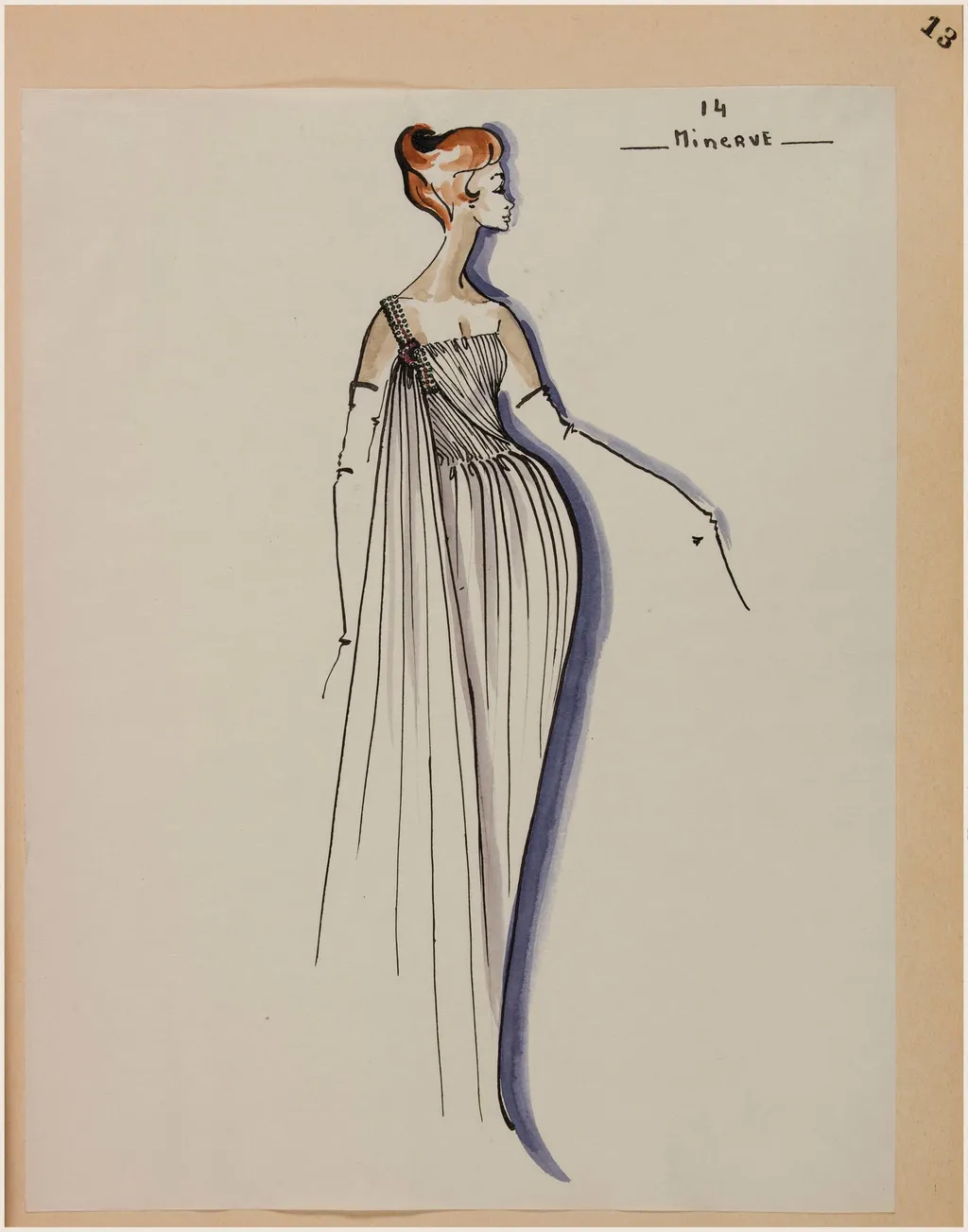
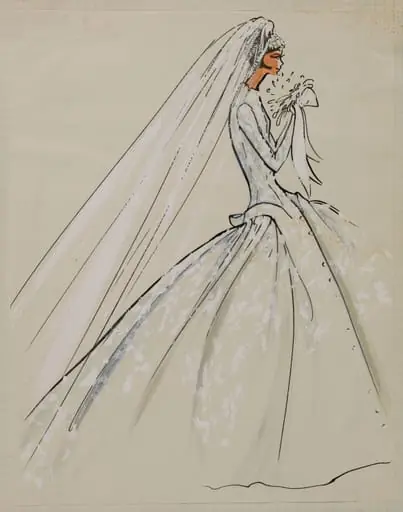
Minerve is a drawing by Carven. It dates from 1958 and is held in the collection of the Palais Galliera - Musée de la Mode de la Ville de Paris.
About this work
If you're interested in learning more about the artist's technique, you might want to look up the subject of pleating.
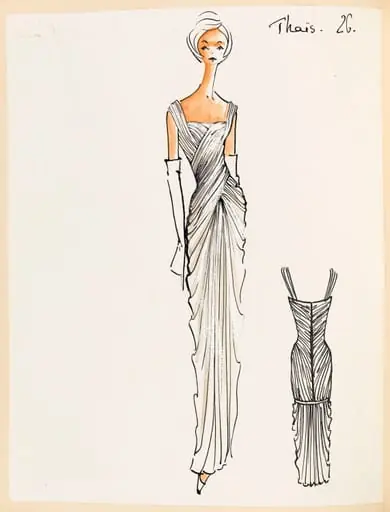
This drawing depicts a woman in a long, pleated dress with a bustier top. The dress is white, and the woman's hair is styled in an updo. She is facing to the right, with her left arm extended behind her.
The woman's dress is detailed with thin, vertical pleats that run down the entire length of the garment. The bustier top is adorned with a decorative brooch or clasp. The overall style of the drawing suggests a fashion illustration from the early 20th century.
If you're interested in learning more about the artist's technique, you might want to look up the subject of pleating.
Overview
Minerve is a pencil or ink drawing attributed to the designer Carven, dated around 1958. It resides in the collection of the Museum of Ethnography. The work presents a stylized female figure in formal attire, rendered with precise linework and attention to textile detail. Though labeled as an image, its function aligns with fashion documentation rather than fine art, reflecting mid-century design practices.
Subject & Meaning
The figure, named Minerve, evokes classical allusion through its title, referencing the Roman goddess of wisdom and crafts. The attire—structured bustier and long, pleated skirt—suggests haute couture, possibly designed for a specific collection. The pose, with one arm extended backward, implies grace and poise, reinforcing ideals of elegance tied to postwar French fashion identity.
Technique & Style
The drawing employs fine, parallel lines to render the vertical pleats of the dress, emphasizing texture and movement. The bustier is defined with minimal shading, highlighting the central brooch as a focal point. Hair is rendered in tight, controlled strokes, suggesting an updo typical of the era. The style is restrained and linear, characteristic of fashion illustrations meant for editorial or client presentation.
History & Provenance
Created in the late 1950s, the work likely originated as part of Carven’s design archive, possibly used to present garments to clients or publishers. It entered the Museum of Ethnography’s collection through donation or acquisition, likely chosen for its representation of mid-century French fashion culture. No public records detail its exhibition history prior to institutional custody.
Context
In the postwar period, French fashion houses like Carven emphasized craftsmanship and tailored silhouettes. Fashion drawings like Minerve served as intermediaries between designer and atelier, capturing details before production. The classical naming convention reflects a broader trend of invoking antiquity to lend prestige to contemporary design, aligning with cultural narratives of renewal after conflict.
Legacy
Minerve remains a quiet example of how fashion illustration preserved design intent before digital tools. Its preservation in an ethnographic museum underscores its value as cultural artifact rather than fine art. The work contributes to understanding how textile techniques and gendered aesthetics were visually codified in mid-century Europe, influencing later archival practices in fashion history.
Artist & collection
Artist
These delicate ink-on-paper drawings capture the quiet poetry of everyday things: pinecones, reeds, apples.
Museum
Palais Galliera - Musée de la Mode de la Ville de Paris
Continue through works from the same source collection.