Artwork
Dyer Sharp Wynkoop
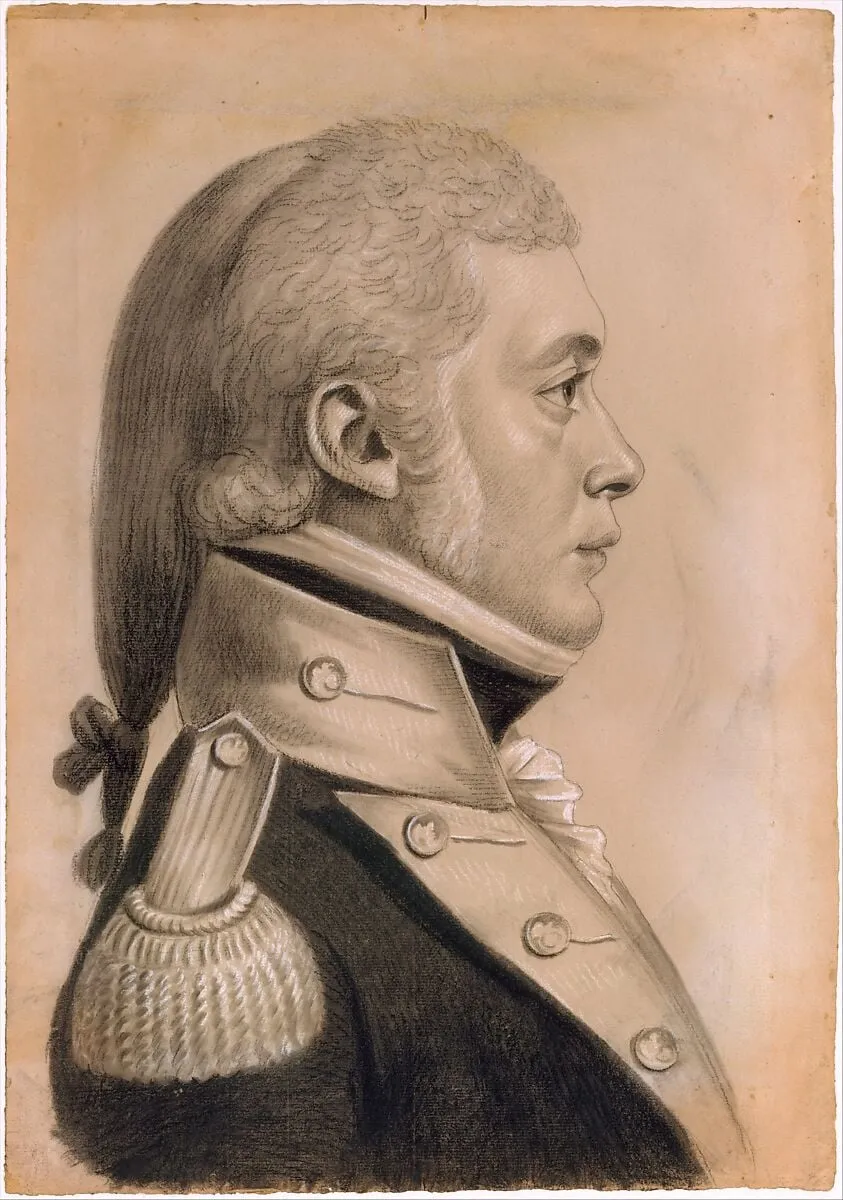
Dyer Sharp Wynkoop is a gouache drawing by the Romanticist artist Charles Balthazar Julien Févret de Saint-Mémin. It dates from 1800 and is held in the collection of the Metropolitan Museum of Art.
About this work
Overview
Created in 1800, this portrait depicts Lieutenant Dyer Sharp Wynkoop, a marine officer, rendered in conté crayon, charcoal and white chalk on gouache‑coated paper. The figure is shown in a crisp profile, his dark coat and white collar standing out against a pale background, his hair pulled back and his expression composed.
Technique & Style
The image was produced using a physiognotrace, a device that traced the sitter’s silhouette before the artist added details by hand. This method allowed for rapid, inexpensive portraiture in the early United States. The combination of conté, charcoal and chalk gives the drawing a precise, almost sculptural quality, while the gouache ground provides a smooth, uniform surface.
Subject & Meaning
Lieutenant Wynkoop is presented in formal military attire, emphasizing his rank and the professional identity of the young American navy. The restrained composition and subdued palette focus attention on the sitter’s demeanor, suggesting steadiness and reliability—qualities prized in a nascent republic’s armed forces.
History & Provenance
The work was executed by Charles Balthazar Julien Févret de Saint‑Mémin, a French émigré who settled in the United States after fleeing the Revolution. While in America he turned to portrait engraving, applying his French academic training to the demands of a new market. The drawing now belongs to the American Wing collection.
Context
Saint‑Mémin’s American portraits, including this one, illustrate the transfer of European artistic techniques to the United States during the early Republic. The use of the physiognotrace reflects a broader trend toward affordable, reproducible portraiture, catering to a growing middle class eager to document personal status and civic identity.
Artist & collection

Artist
Charles Balthazar Julien Févret de Saint-Mémin
Charles Balthazar Julien Févret de Saint-Mémin (French pronunciation: ; 1770–1852) was a French portrait painter and museum director.