Artwork
Church Bells Ringing, Rainy Winter Night
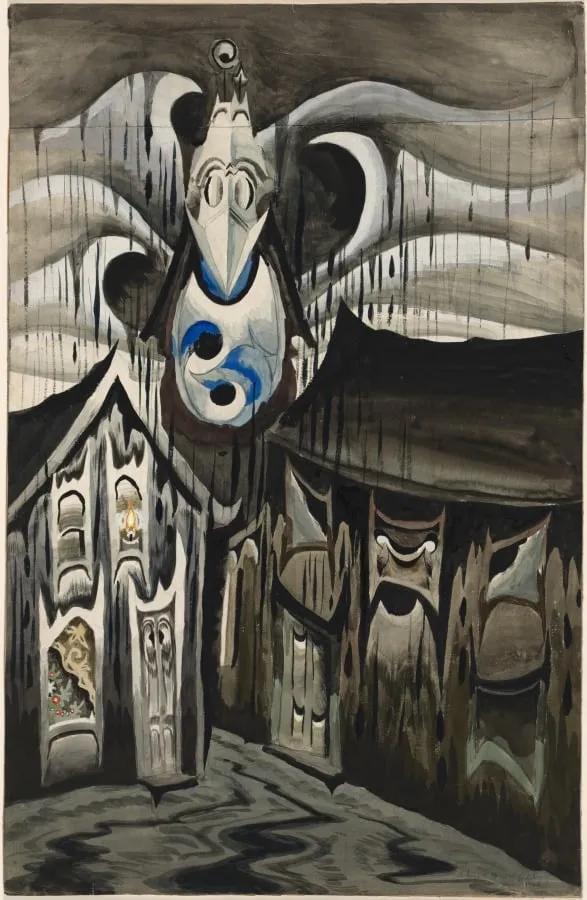
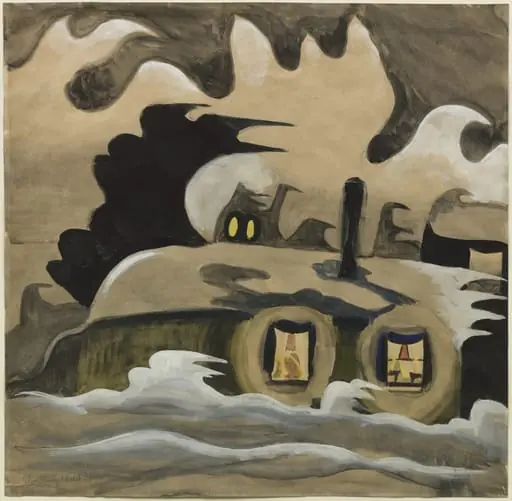
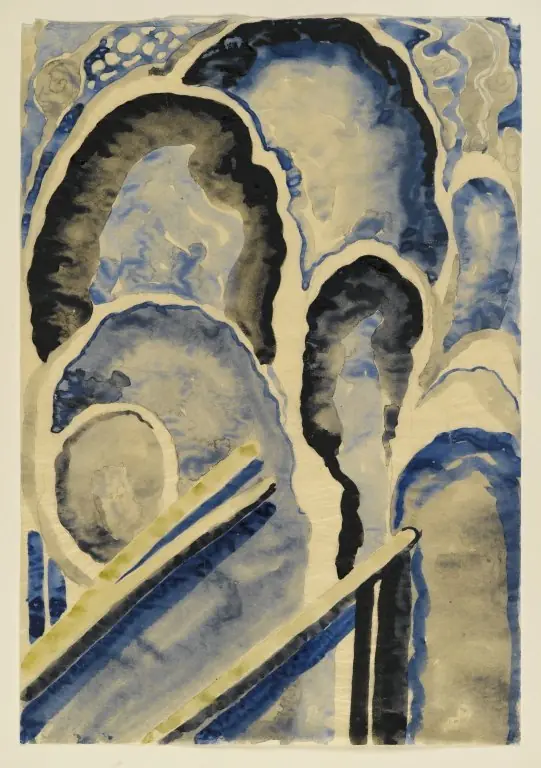
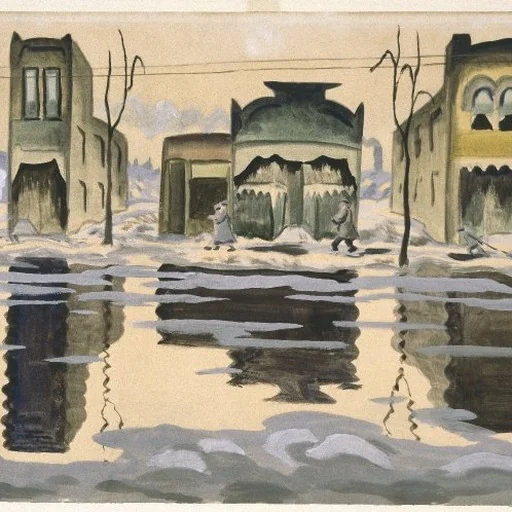
Church Bells Ringing, Rainy Winter Night is a drawing by Charles Burchfield. It dates from 1917 and is held in the collection of the Cleveland Museum of Art.
About this work
Overview
Created during a pivotal year in Charles Burchfield’s early career, this watercolor captures a quiet yet charged moment in his hometown of Salem, Ohio.
Created during a pivotal year in Charles Burchfield’s early career, this watercolor captures a quiet yet charged moment in his hometown of Salem, Ohio. Though he had briefly left art school and returned to a clerical job, he devoted nights and lunch breaks to observing and recording the emotional atmosphere of his surroundings. The drawing reflects a personal turning point, where inner turmoil found visual expression through everyday scenes.
Subject & Meaning
The scene centers on the Baptist church spire, flanked by two darkened homes, under a rain-slicked winter sky. For Burchfield, the church bells evoked childhood dread—a deep, rumbling sound that echoed through stormy nights. The warm glow from a window, hinting at a Christmas tree, suggests a child’s coping mechanism: seeking comfort in memory amid fear. The architecture becomes a vessel for psychological states, not just physical space.
Technique & Style
Burchfield used layered watercolor washes to build a muted, atmospheric gray palette, with delicate ink lines defining the structures. Rain is rendered as fine, diagonal streaks, intensifying the sense of chill and isolation. The forms are simplified yet weighty, with exaggerated silhouettes that distort perspective to convey emotional tension rather than realism. His brushwork is precise yet expressive, balancing control with intuitive mark-making.
History & Provenance
Executed in 1916, the work emerged from a period of professional uncertainty after Burchfield’s abrupt departure from the National Academy of Design. He produced hundreds of drawings during this time, often revising compositions through multiple sketches. This piece was among those he later regarded as central to his artistic development. It remained in his personal collection until his death, later entering a major museum’s holdings.
Context
Burchfield’s work in this period diverged from mainstream American realism, drawing instead from personal memory and emotional symbolism. He developed a private visual lexicon—'Conventions for Abstract Thoughts'—to translate feelings like fear and melancholy into recurring motifs. The hooked forms near the steeple and the jagged window shapes were not decorative but coded expressions of inner life, aligning his art with early psychological modernism.
Legacy
This drawing helped define Burchfield’s mature style, in which the mundane became a conduit for psychological depth. His symbolic system influenced later American artists interested in emotional landscape and subjective realism. Though largely overlooked during his early career, works like this one were later recognized as foundational to a uniquely American mode of expression that merged the everyday with the uncanny.
Artist & collection
Artist
Charles Ephraim Burchfield (April 9, 1893 – January 10, 1967) was an American painter and visionary artist, known for his passionate watercolors of nature scenes and townscapes.