Artwork
Tiered Court Scene
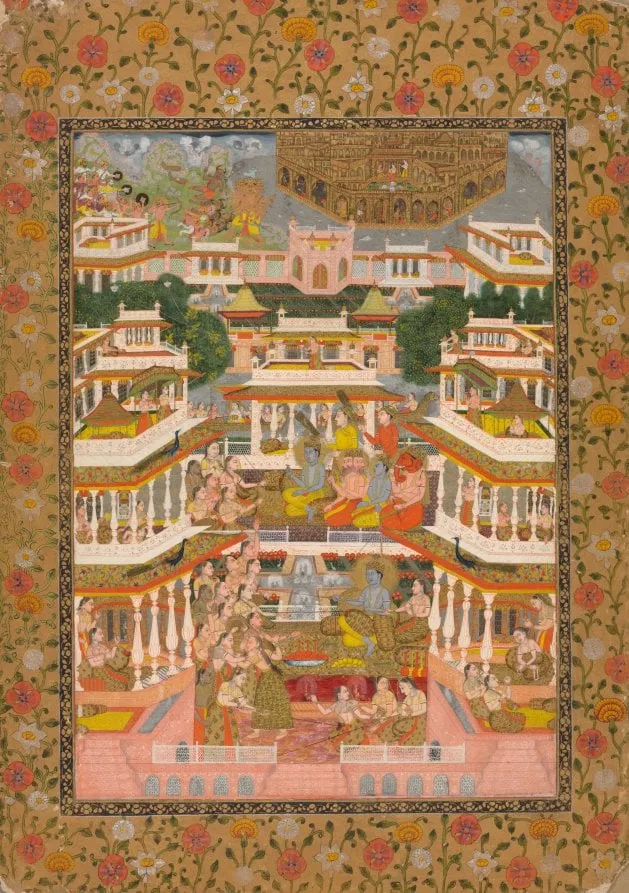
Tiered Court Scene is an unspecified painting by the Baroque artist Chitarman II. It dates from 1735 and is held in the collection of the Cleveland Museum of Art.
About this work
It mixes royal court life with epic tales, showing how different traditions could share the same space.
You see a tall, busy painting split into three stacked scenes. At the top, a blue-skinned hero fights a demon in a golden city. The middle shows gods flying kites, listening to music, and rowing boats. At the bottom, people splash red water at each other in a palace garden.
This painting was made for a Muslim emperor who wanted to celebrate Hindu stories. It mixes royal court life with epic tales, showing how different traditions could share the same space.
To see more paintings like this, look up the Mughal court of Muhammad Shah (reigned 1719–48).
Overview
This vertical painting was created during the reign of Mughal Emperor Muhammad Shah, who revived imperial patronage of Hindu narratives after a century of diminished focus. Divided into three horizontal bands, it depicts episodes from the Ramayana and Krishna legends alongside scenes of courtly celebration. The composition unites religious myth, seasonal ritual, and aristocratic leisure within a single frame, reflecting a syncretic cultural climate at the Mughal court.
Subject & Meaning
The upper register illustrates Rama’s battle against the demon king Ravana in Lanka, a pivotal moment from the Ramayana. The central band portrays deities engaged in springtime pastimes—music, boating, and kite flying—blending divine imagery with courtly recreation. At the base, Krishna and Radha participate in Holi, the festival of colors, surrounded by palace attendants. Together, these scenes affirm Hindu cosmology while embedding it within the emperor’s own cultural sphere.
Technique & Style
Executed in opaque watercolor on paper, the painting employs fine brushwork and rich, layered pigments to distinguish each register. Figures are rendered with delicate detail, and spatial depth is suggested through tiered composition rather than linear perspective. The use of gold leaf highlights architectural elements and divine forms, while the crowded, rhythmic arrangement of figures echoes Persian and indigenous Indian traditions of manuscript illustration.
History & Provenance
Commissioned around the 1730s for Emperor Muhammad Shah, the work emerged from the imperial atelier in Delhi, where artists from diverse regional backgrounds collaborated. It likely originated as part of a larger illustrated manuscript or album, intended for private royal viewing. Its survival reflects the continued value placed on Hindu iconography within a Muslim-ruled court, despite broader political and religious shifts of the era.
Context
Muhammad Shah’s reign marked a period of cultural pluralism in the declining Mughal Empire, where Hindu themes were actively revived alongside Persianate traditions. This painting reflects a broader trend among late Mughal elites to embrace regional religious narratives as symbols of legitimacy and refinement. The blending of epic myth with courtly festivity signals a deliberate effort to unify diverse communities under shared aesthetic and spiritual values.
Legacy
The painting stands as a testament to the fluid boundaries between religious and royal identity in 18th-century India. It influenced later Pahari and Rajasthani schools, which similarly merged devotional subjects with courtly life. Though the Mughal Empire waned, such works preserved a tradition of visual syncretism that continued to shape Indian painting well into the colonial period.
Artist & collection

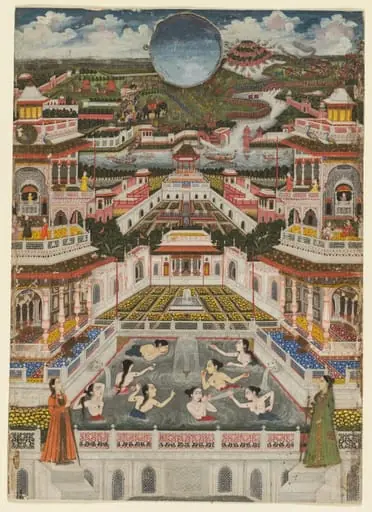 Women bathing before an architectural panorama
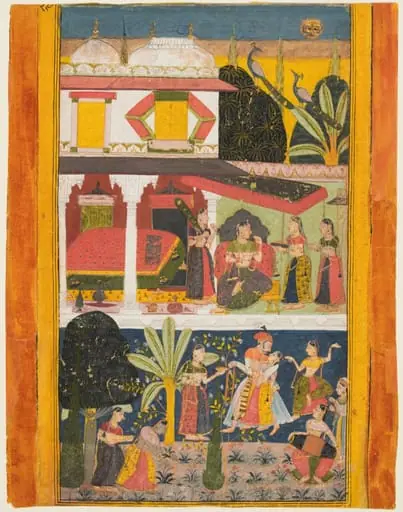 A Heroine and Her Paramour: Malavi Ragini, from a Ragamala
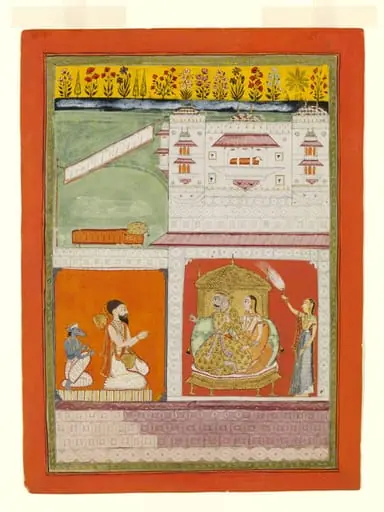 Sri Raga
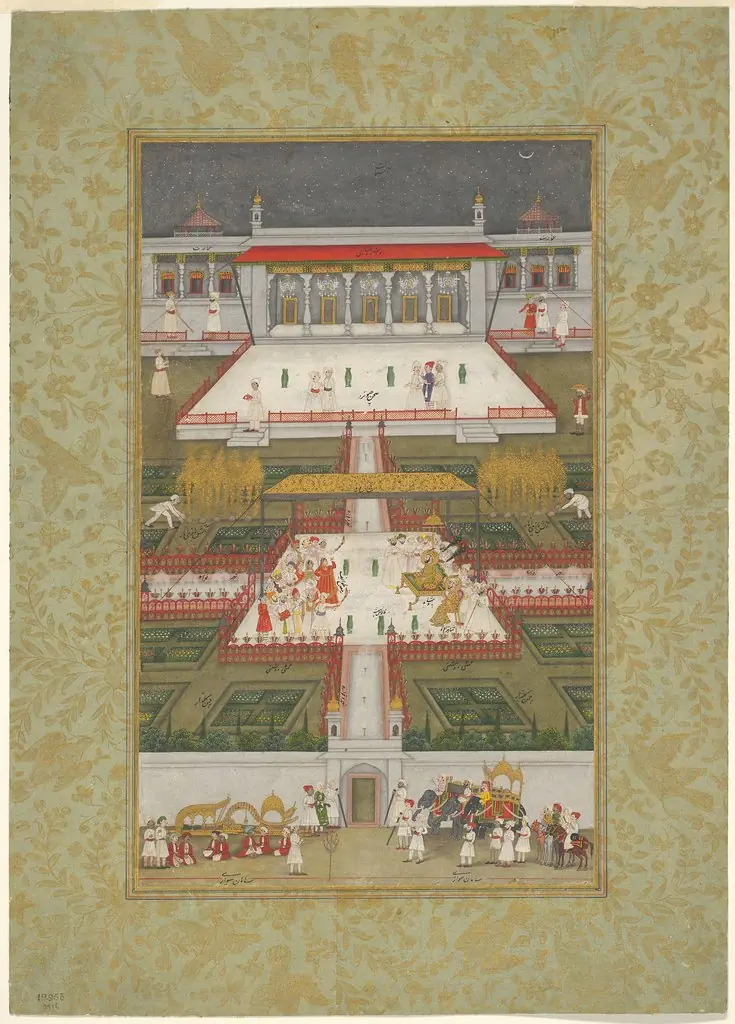 Ruler Entertained by Dancers in a Paradise Garden
 Pichvai of Shri Nathji
 A Royal Woman in a Pavilion: Desavarari Ragini of Dipak, from a Ragamala
 A Heroine and Her Paramour: Malavi Ragini, from a Ragamala
 Lovers in a Zenana Garden at Night
 Shaiva Shrines in a Landscape
 Woman Longing for Her Lover: Verati Ragini of Dipak, from a Ragamala