Artwork
W. tower of the church, Lisseweghe
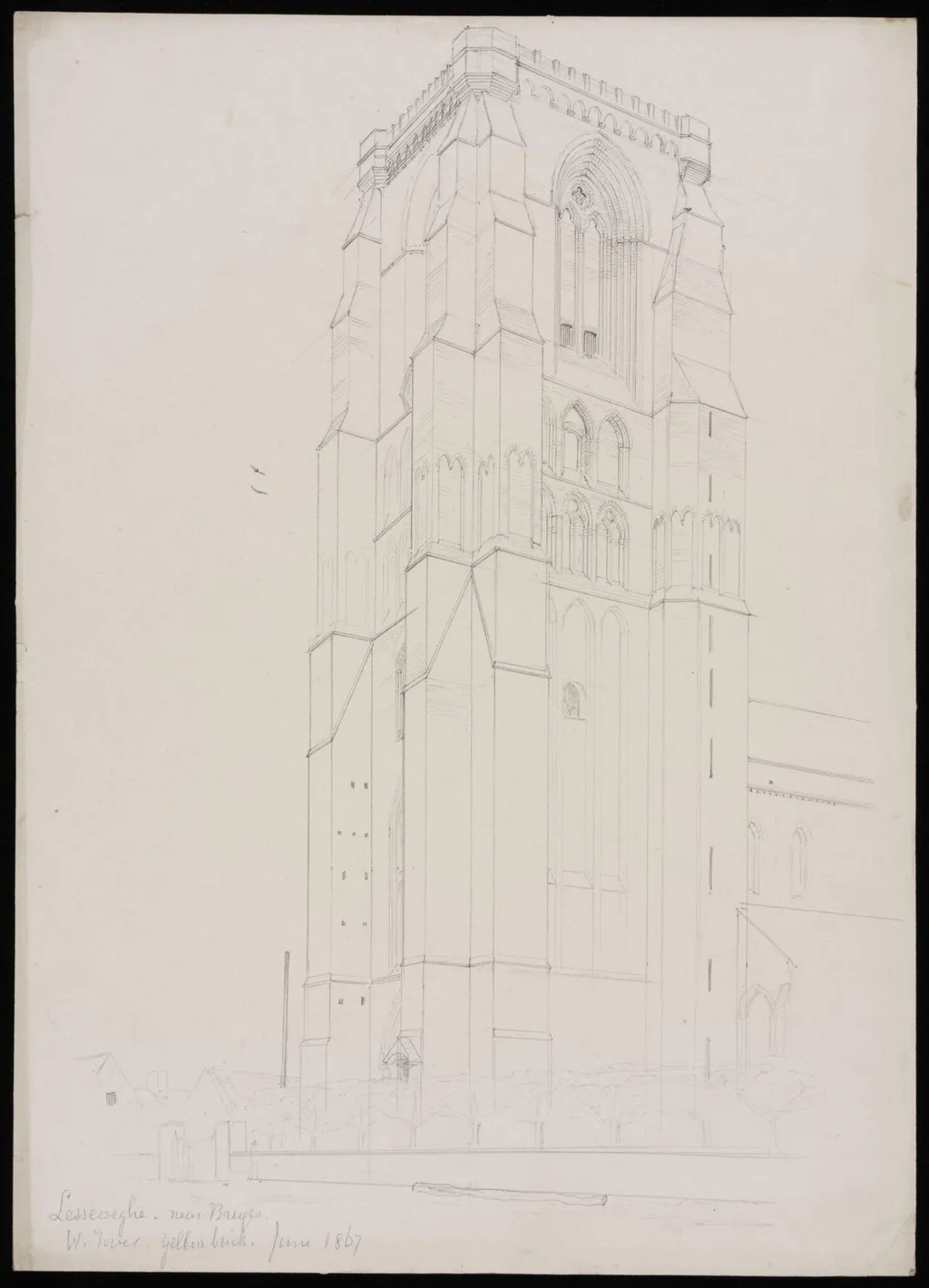
W. tower of the church, Lisseweghe is a drawing by the Impressionist artist Somers Clarke. It dates from 1867 and is held in the collection of the Victoria and Albert Museum. This pencil drawing captures the western tower of a church in Lisseweghe, a village near Bruges.
About this work
The artist focused on details like the tower’s height and the way light might hit its edges.
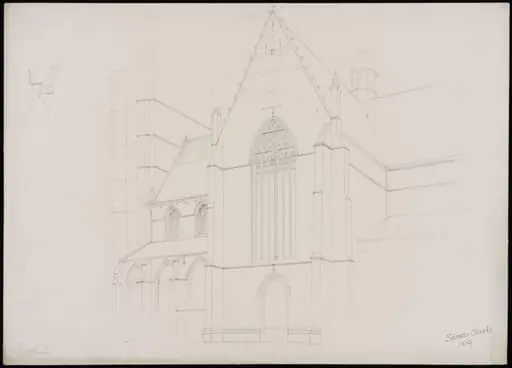
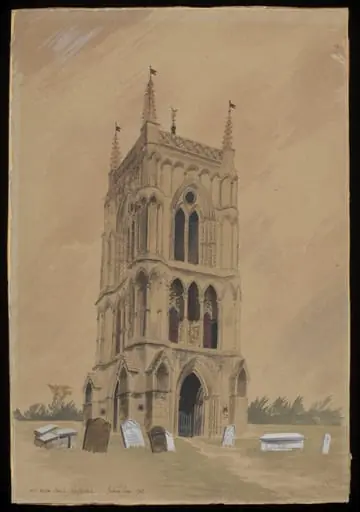
This sketch shows a tall church tower drawn in pencil. The lines are light but precise, marking every stone and window. The tower has pointed arches and steep angles, with a smaller roof on top.
The artist focused on details like the tower’s height and the way light might hit its edges. The date and place are written in the corner: June 1867, Lisseweghe.
Want to see more? Check out the Victoria and Albert Museum.
Overview
This pencil drawing captures the western tower of a church in Lisseweghe, a village near Bruges. Executed in June 1867, the work emphasizes architectural precision, rendering individual stones and window openings with careful, unobtrusive lines. The composition isolates the tower’s verticality, its pointed arches and steep angles dominating the sheet.
Subject & Meaning
The subject is an ecclesiastical structure, specifically the west tower of a parish church. By concentrating on the tower’s form and detailing its masonry, the artist records both its physical presence and its symbolic role as a landmark. The absence of human figures directs attention to the building’s structural and aesthetic qualities.
Technique & Style
The drawing employs fine, controlled pencil strokes to delineate each architectural element. Light shading suggests the play of light across surfaces, while the absence of heavy outlines preserves a sense of transparency. The style reflects a documentary approach, prioritizing accuracy over expressive distortion.
History & Provenance
Created in 1867, the drawing bears an inscription noting its date and location. Its subsequent history remains tied to private or institutional collections, though it has been associated with holdings such as those of the Victoria and Albert Museum. The work’s early provenance is not extensively documented.
Context
The mid-nineteenth century saw renewed interest in medieval architecture, often documented through sketches. This drawing aligns with that trend, capturing a Gothic-inspired tower in a period when such structures were subjects of both preservation and artistic study. The focus on Lisseweghe reflects broader efforts to record regional landmarks.
Artist & collection

Artist
George Somers Clarke was an architect and English Egyptologist who worked on the restoration and design of churches and at a number of sites throughout Egypt, notably in El Kab, where he built a mud brick house.

![The New Church of St. Mary - Old Hagerston [sic], July 1827, by T. H. Shepherd](https://artifactworldgallery.com/img/t-h-shepherd--the-new-church-of-st-mary-old-hagerston-sic-july-1827--b5b98602e349ff69-w320.webp)