Artwork
Virgin and Child with St. John
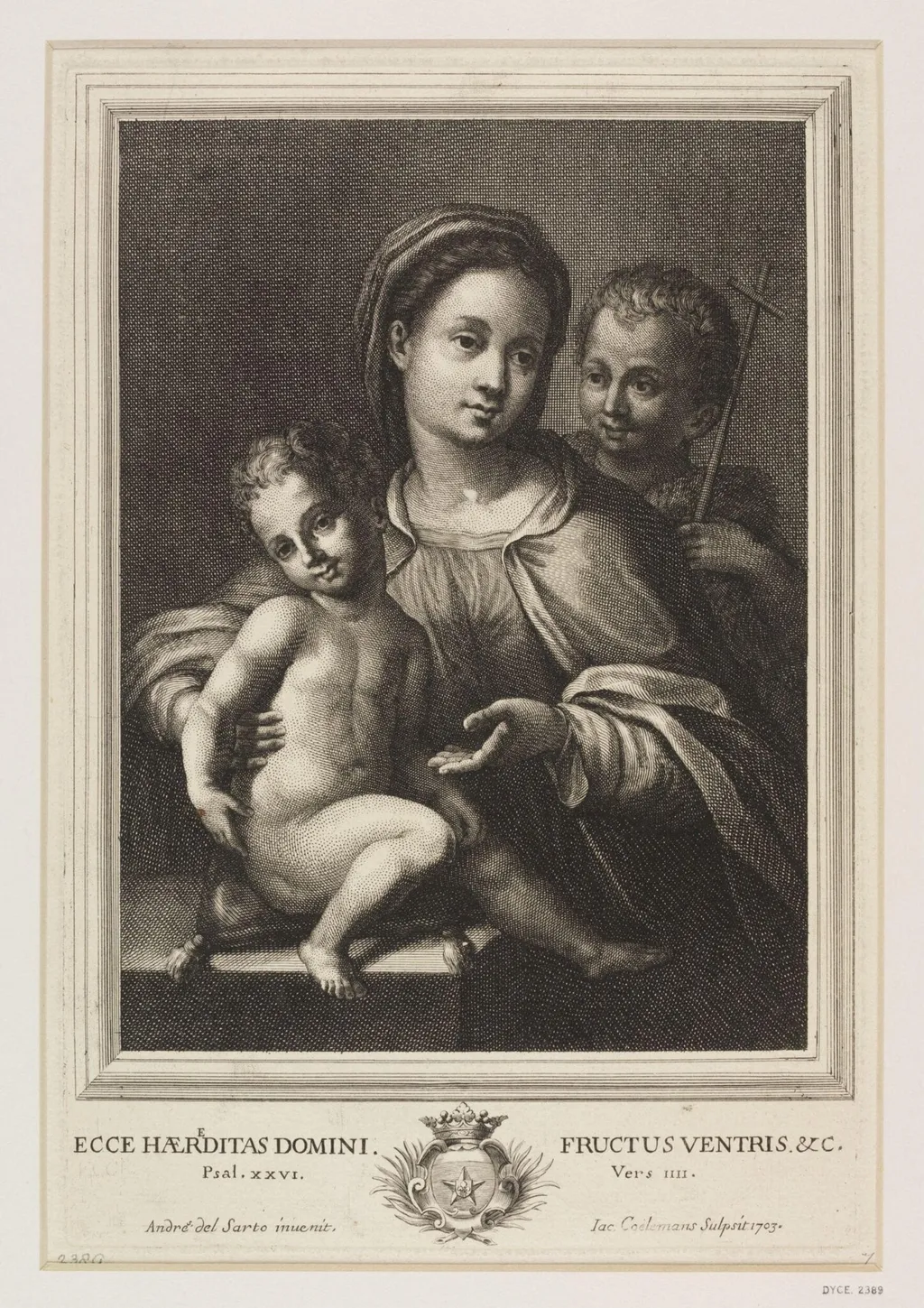
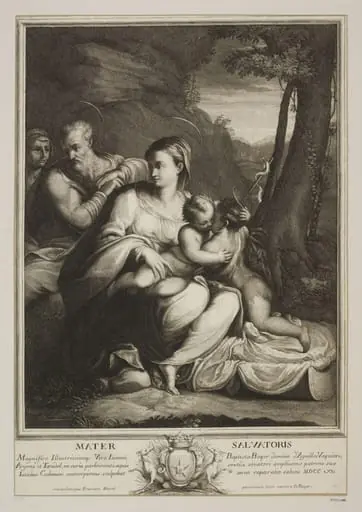
Virgin and Child with St. John is a print by Jacobus Coelemans. It dates from 1750 and is held in the collection of the Victoria and Albert Museum.
About this work
Overview
This 1750 print on paper reproduces a composition originally painted by Andrea del Sarto, adapted by Jacobus Coelemans.
This 1750 print on paper reproduces a composition originally painted by Andrea del Sarto, adapted by Jacobus Coelemans. It presents the Virgin Mary with the infant Jesus and the young St. John the Baptist in a devotional grouping. The image was produced through engraving techniques common in 18th-century reproductive printmaking, intended to disseminate renowned religious imagery beyond original paintings.
Subject & Meaning
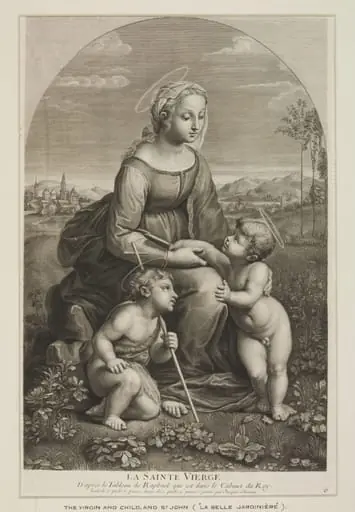
The Virgin holds the Christ Child, who reaches toward St. John, who clasps a small wooden cross. This gesture suggests a prefiguration of Christ’s future sacrifice, while St. John’s presence underscores his role as the forerunner. The intimate arrangement reflects Renaissance ideals of familial tenderness within sacred narrative, emphasizing spiritual connection over theatrical drama.
Technique & Style
Coelemans employed fine linear engraving to render fabric folds, facial features, and subtle shading. The dark background enhances the figures’ three-dimensionality through controlled contrasts, echoing the chiaroscuro of the original painting. Details in the clothing and skin tones are rendered with precision, reflecting the printmaker’s aim to faithfully translate a painterly style into engraved form.
History & Provenance
The print stems from a 16th-century oil painting by Andrea del Sarto, a leading Florentine Mannerist. Coelemans, a Flemish engraver active in the mid-18th century, reproduced it as part of a broader European tradition of translating celebrated paintings into accessible prints. Its survival suggests continued interest in devotional imagery and the circulation of artistic models across centuries.
Context
In the 18th century, reproductive prints like this served educational and devotional purposes, especially where access to original artworks was limited. The choice of Sarto’s composition reflects enduring reverence for High Renaissance ideals, even as Baroque and Rococo styles dominated contemporary painting. Such prints bridged elite art and broader religious audiences.
Legacy
This print exemplifies how Renaissance compositions were preserved and transmitted through printmaking long after their creation. It contributed to the canonization of Sarto’s imagery in Northern Europe and illustrates the collaborative nature of artistic legacy—where painters, engravers, and patrons each played a role in sustaining visual traditions across generations.
Artist & collection
Artist
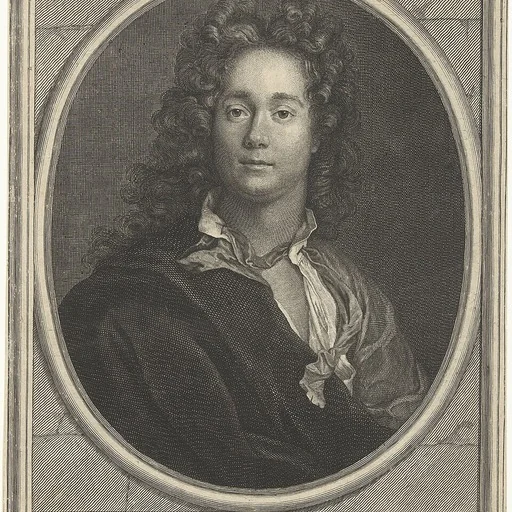
Jacobus Coelemans or Jacob Coelemans, known in France as Jacques Coelemans (Antwerp, 23 August 1654 – Aix-en-Provence, 11 February 1732) was a Flemish engraver and printmaker, known for his reproductive prints after famous painters and…