Artwork
Drapery Study for "Mary and Elizabeth Royall"
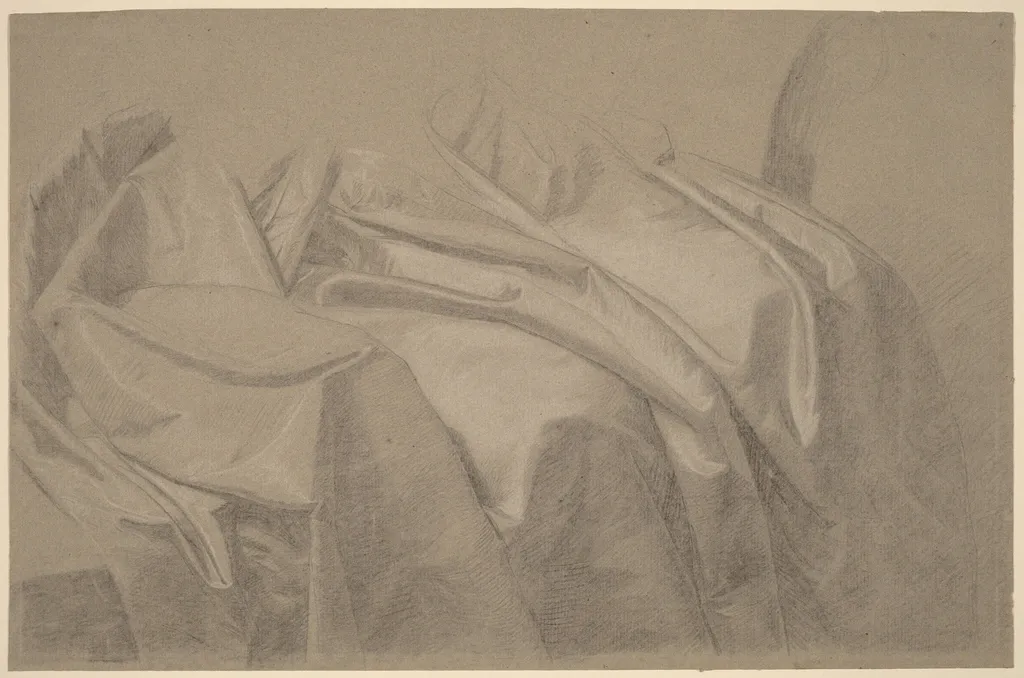
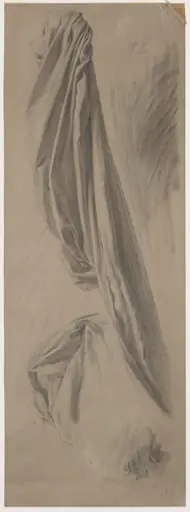
Drapery Study for "Mary and Elizabeth Royall" is a graphite drawing by the Romanticist artist John Singleton Copley. It dates from 1758 and is held in the collection of the National Gallery of Art.
About this work
Overview
John Singleton Copley produced this graphite and white chalk drawing on gray‑brown laid paper around 1758. It functions as a preparatory study for the portrait of Mary and Elizabeth Royall, focusing exclusively on the treatment of fabric.
Subject & Meaning
The image records a single swath of cloth, rendered as if draped over an unseen form. The folds and creases convey volume, suggesting a smooth, lustrous material such as silk or satin that would have been appropriate for a formal garment in the mid‑eighteenth century.
Technique & Style
Copley employed graphite for the deeper shadows and white chalk for highlights, creating a broad tonal range that models the surface of the fabric. The contrast between dark and light gives the paper a sense of three‑dimensionality, while the loose, gestural strokes reveal the artist’s exploratory approach to texture.
History & Provenance
The drawing was executed as part of Copley’s preparatory work for the commissioned portrait of the Royall sisters. It remains a documented example of his early American practice, predating his later, larger oil paintings.
Artist & collection

Artist
John Singleton Copley (July 3, 1738 – September 9, 1815) was an American-born British painter active in both the Thirteen Colonies and England.



![Drapery Studies [recto], by Baldassare Franceschini](https://artifactworldgallery.com/img/baldassare-franceschini--drapery-studies-recto--8283f7732b58979e-w320.webp)
![Study of Drapery [verso], by John Singer Sargent](https://artifactworldgallery.com/img/john-singer-sargent--study-of-drapery-verso--af011b294c02210f-w320.webp)